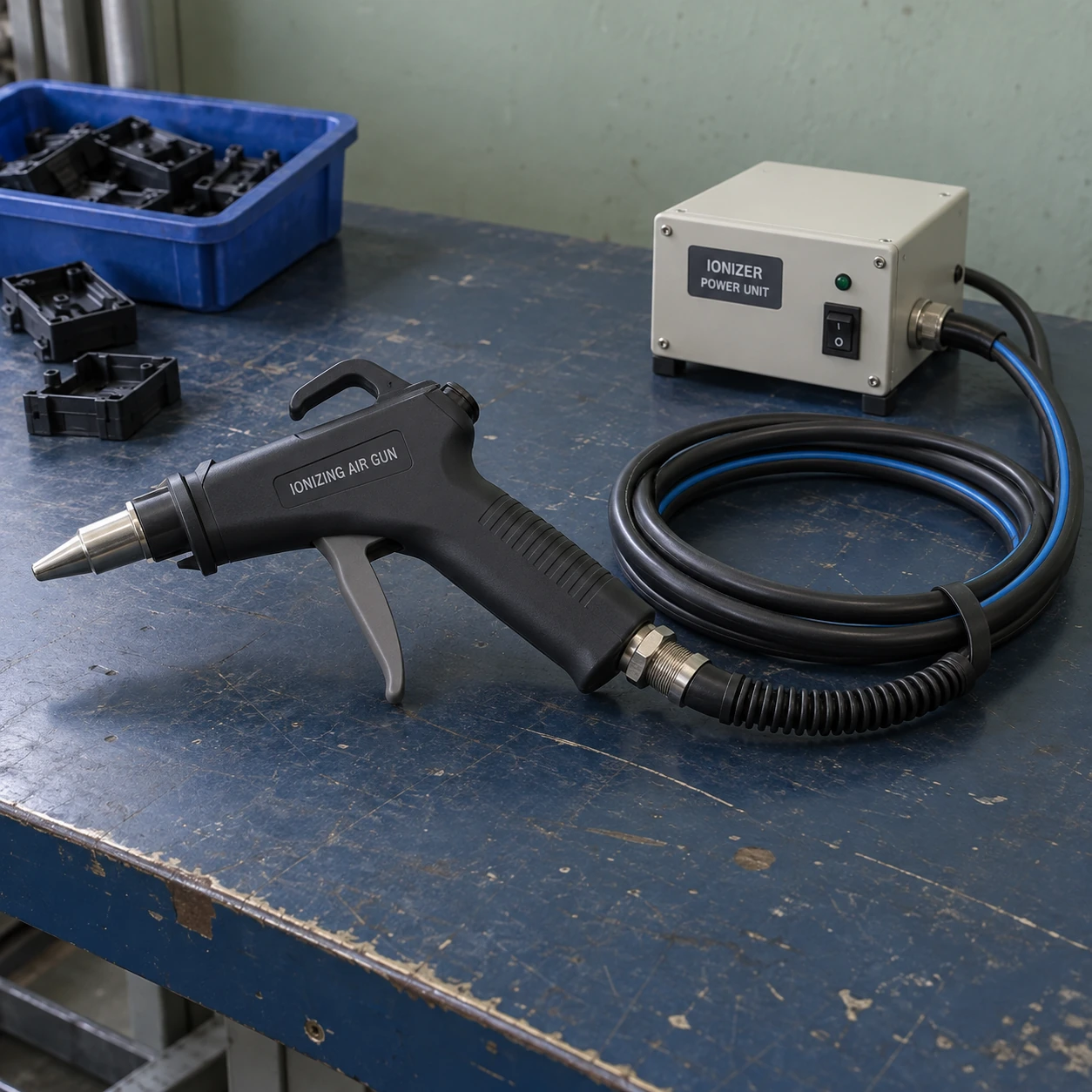
Ionizing Air Guns
Ionizing Air Guns
| Gun envelope (L × W × H, mm) | 178 × 28 × 157 / 203 × 34 × 168 / 251 × 52 × 153 |
|---|---|
| Dimension scope | Gun body only; external supply, flexible line and operating clearance are additional |
| Air service | Clean, dry compressed air with preparation matched to the selected nozzle and process |
| Electrical arrangement | Matched ionizing power unit and compatible gun cable |
| Operator control | Hand trigger; compatible mounted support or foot control where required |
| Supply scope | Gun, power unit, hose/cable assembly and mounting accessories selected together |
The three envelopes describe different gun constructions. Pressure, flow and working distance depend on the selected assembly.
The nozzle, line routing and mounting arrangement can be customized to suit the parts and workstation.
Ionizing air guns combine a directed air jet with ion generation at the point of use. They help release electrostatically attracted particles from an exposed part before the air stream carries those particles away. The process needs both effective neutralization and somewhere for the displaced dirt to go.
Neutralize, dislodge and collect
A conventional air jet may remove loose dust while charge continues attracting particles back to a plastic surface. An ionizing gun adds charge neutralization to the blow-off operation. This distinction matters before optical inspection, assembly or packing, particularly on insulating trays and molded parts.
The gun does not collect the released particles. Arrange a suitable capture or extraction path so dirt is not driven onto the next part, into a sensitive mechanism or toward the operator. Position the part and receiving area before deciding the direction of the jet.
Match the tool to the access
- Small recesses
- A compact nozzle can improve access, but the tip still needs a clear route to the charged surface. A deep cavity can shield areas from both air and ions; moving the part may be more useful than increasing pressure.
- Broad surfaces
- Use a repeatable sweep that reaches the full surface without dwelling on delicate features. Large repeated tasks may justify a fixed ionizing arrangement instead of continuous hand-held work.
- Repeated cycles
- A support or compatible foot-operated arrangement can reduce hose drag and variation in aim. Confirm that the selected controls coordinate ionization with airflow rather than merely opening an unrelated air valve.
Prepare the services
Oil, moisture or particles in compressed air can defeat the cleaning objective. Specify air preparation at the point of use and review the condition of hoses and fittings. Filtration requirements depend on the product; an ordinary compressed-air connection does not establish cleanroom suitability.
Route the flexible assembly so it does not pull the gun from the work position or rub against sharp edges. Keep the matched power unit accessible for safe isolation and maintain its specified grounding.
Define a repeatable operation
Record the nozzle, operating setting, stand-off and sweep used for a satisfactory part. Recheck both cleanliness and residual charge when the part shape or material changes. A high-pressure blast alone does not prove better neutralization and can move small components or increase airborne contamination.
Inspect and clean the emitter according to the selected equipment instructions after isolating its services. Do not aim the gun at people or use an ordinary unit in a potentially explosive environment. For continuous local ion delivery without compressed air, compare Ionizing Air Blowers.
The nozzle, line routing and mounting arrangement can be customized to suit the parts and workstation.