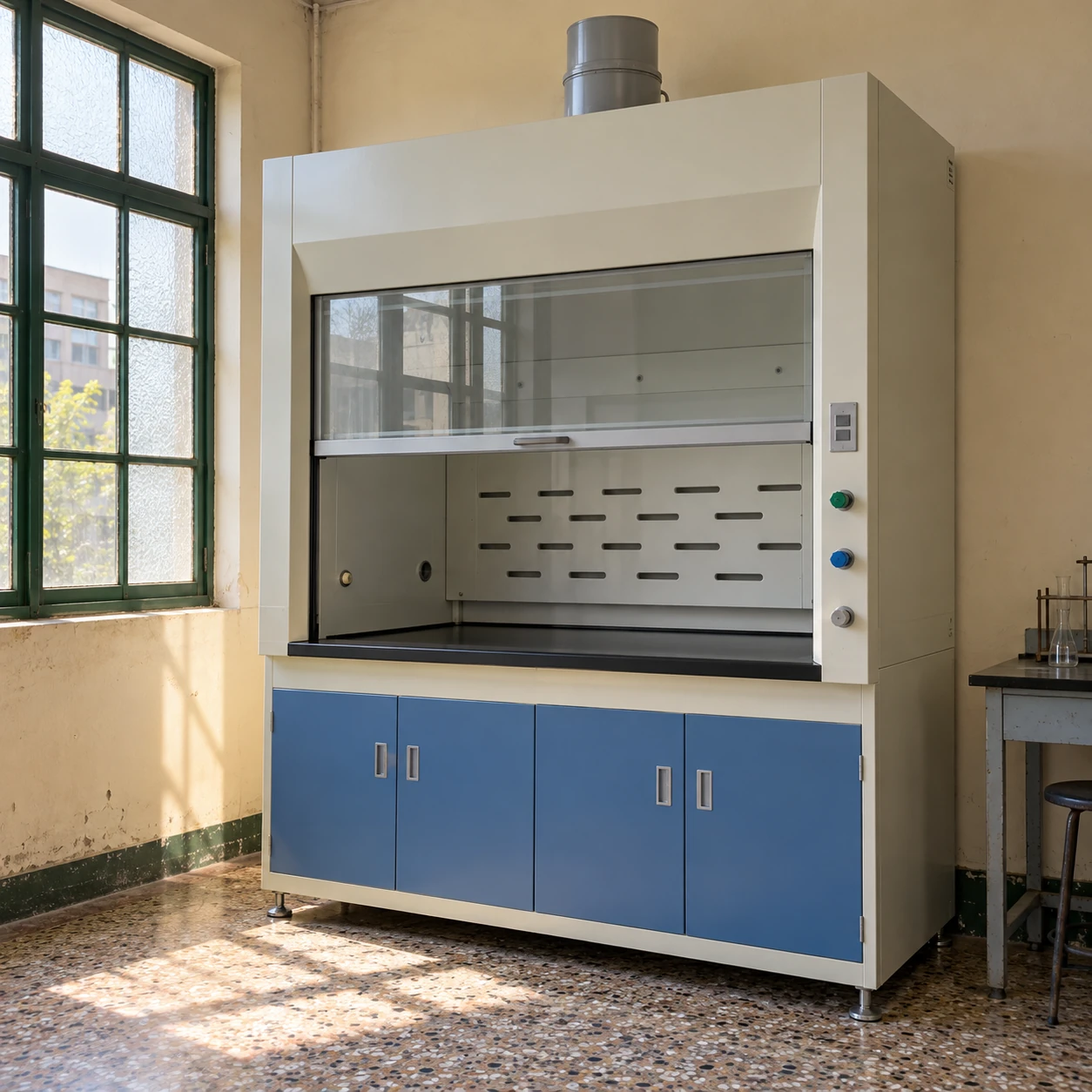
Laboratory Fume Hoods
lab fume hood
| Brand | shengtongJH |
|---|---|
| Equipment format | Ducted benchtop hood for industrial testing and analysis |
| External W × D × H options | 1040 × 800 × 2200 / 1240 × 800 × 2200 / 1540 × 800 × 2200 mm |
| Matched chamber W × D × H | 820 × 670 × 730 / 1020 × 670 × 730 / 1320 × 670 × 730 mm |
| Working surface height | 850 mm option |
| Housing | Powder-coated steel with selected chemical-resistant liner |
| Work surface | Phenolic resin or another chemically compatible surface |
| Front access | Vertical sash; operating position set during commissioning |
| Base configuration | Storage base or supported frame to suit access requirements |
| Service fittings | Water tap and sink, gas tap or electrical outlets by task |
| Exhaust interface | Top duct outlet; installed fan duty selected for the full route |
| Operating indication | Visible airflow monitor and specified alarm response |
| Power supply options | 220 V, 50/60 Hz; other supplies by component selection |
Chamber size is the enclosed internal space, not the available safe operating opening or unobstructed apparatus footprint. Confirm delivery sections and service clearances with the accepted layout.
Width, base arrangement, service fittings and exhaust connections can be customized to the existing laboratory and its daily workflow.
A lab fume hood for an existing testing room needs to fit the work as well as the floor plan. Usable chamber depth, the delivery route and the available exhaust connection can be more decisive than the nominal cabinet width.
Measure the task before measuring the wall
List the apparatus that must remain inside during the operation, including stands, tubing and containers. Leave room to work behind the sash without reaching around crowded equipment. A narrow cabinet that physically holds the apparatus may still be unsuitable if it forces the operator to work at the opening or blocks the airflow passages.
Consider loading and cleaning separately from normal use. Large equipment may require a wider access opening for placement, but that does not mean the same opening is approved for operation. Keep those two positions clear in the installation and user instructions.
Fit the delivery route
Check doorways, corridors, lifts and the approach to the final position. Confirm which cabinet sections can be delivered separately and how they are joined. Removing a structural part or altering the sash assembly on site is not an acceptable shortcut for an undersized access route.
Allow access to the fan connection, lighting and service points after the hood is installed. A cabinet fitted tightly under existing services may be difficult to inspect or repair.
Do not reuse an exhaust connection blindly
An existing duct may have the wrong material, condition or capacity for the new task. Establish its route and what else connects to it. The replacement hood must be considered with the fan and room replacement air, not attached solely because the outlet diameters look similar.
Nearby supply diffusers, doors and passing staff can disturb the inlet flow. Review the room in use rather than only with the laboratory empty.
Put services where they help the operator
Choose only the fittings required for the process. The wet-chemistry configuration provides a closer look at sink, worktop and service choices. Accessible isolation and sensible tubing routes reduce reaching and clutter. A sink also requires a compatible drain arrangement and an appropriate waste-handling procedure; it does not authorize disposal of every chemical.
Do not assume a standard lower cupboard is approved flammable-liquid storage. Storage construction and segregation must suit the contents independently of the hood above it.
Define the handover
Before bringing the new hood into use, document its working sash position, airflow and alarm behaviour under the actual room conditions. Keep the chemical scope and maintenance access clear. A small laboratory benefits from a simple, well-defined installation more than from unnecessary features that nobody can maintain.
Width, base arrangement, service fittings and exhaust connections can be customized to the existing laboratory and its daily workflow.