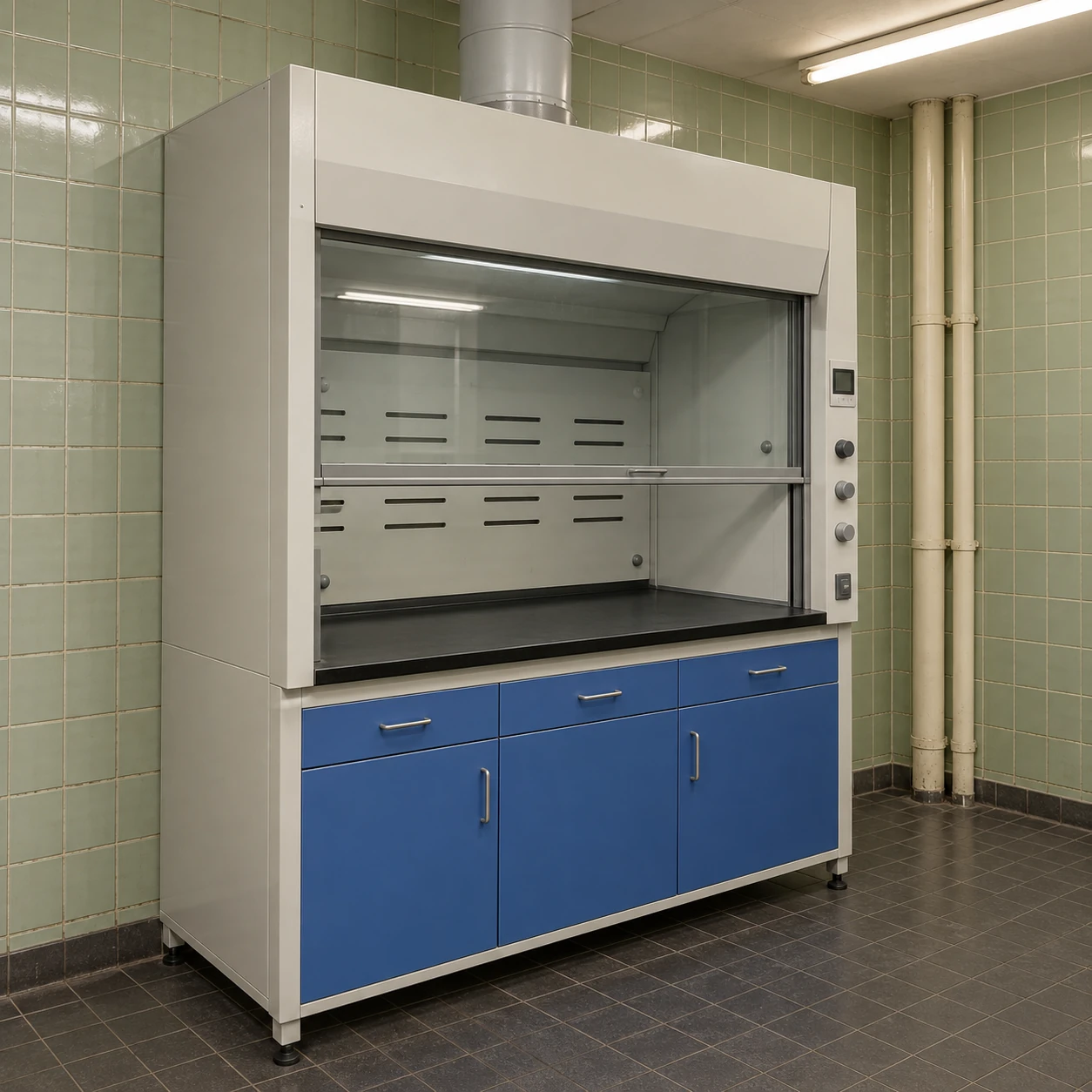
Laboratory Fume Hoods
fume hood lab
| Brand | shengtongJH |
|---|---|
| Application | Replacement or upgraded ducted laboratory chemical hood |
| External W × D × H options | 1040 × 800 × 2200 / 1240 × 800 × 2200 / 1540 × 800 × 2200 mm |
| Corresponding chamber W × D × H | 820 × 670 × 730 / 1020 × 670 × 730 / 1320 × 670 × 730 mm |
| Outer cabinet | Powder-coated steel |
| Liner/worktop | Selected for the actual chemical and temperature duty |
| Sash access | Vertical sliding arrangement with designated working position |
| Exhaust arrangement | Connection to a surveyed and suitably selected fan/duct system |
| Operating monitor | Airflow indication and low-flow alarm with defined response |
| Maintenance access | Accessible baffles, service isolation and exhaust connections |
| Services | Water, gas and electrical fittings matched to current tasks |
| Electrical options | 220 V, 50/60 Hz; fan and accessory supply specified separately |
| Handover information | Operating settings, accepted chemical scope and maintenance requirements |
Replacement size does not confirm compatibility with an existing duct or fan. The complete installed duty and operating condition must be reassessed for the replacement.
Replacement dimensions, materials, services and exhaust connections can be customized to the assessed laboratory task and existing installation.
Upgrading a laboratory fume hood begins with identifying why the existing installation is no longer suitable. Replacing the cabinet alone may leave an exhaust, room-air or operating problem unchanged.
Treat poor capture as a system problem
An airflow alarm or suspected loss of containment requires the laboratory's established response; continuing hazardous work while trying different fan settings is not an appropriate diagnosis. Arrange assessment by competent ventilation and laboratory safety personnel before returning the affected operation to use.
Record what changed: new apparatus, a different sash position, altered supply air, another extraction system, duct maintenance or a new chemical process. This history helps distinguish a cabinet defect from a change elsewhere in the system.
At the working opening
Check whether equipment and stored items obstruct the intended air path. Review the sash and baffles against the selected design. Unapproved changes to baffles can redistribute flow rather than improve it.
In the laboratory
Consider doors, supply diffusers and traffic in front of the hood. A satisfactory result in an empty room may not represent normal operation. Other exhaust equipment can also change the room balance.
Along the exhaust route
Have the fan duty, duct condition and any treatment stage assessed together. A restriction, failed component or changed system setting may require correction outside the cabinet.
Know when replacement is justified
Severely damaged surfaces, incompatible materials, an unreliable sash or inadequate usable space can make a different hood necessary. Choose the replacement around the current process. Repeating the old external dimensions without reviewing the chamber and services can preserve the same limitations.
If the task has changed to a more corrosive, hotter or otherwise more hazardous operation, reassess the equipment type itself. A new general-purpose cabinet does not resolve a requirement for a specialist design. The existing exhaust materials may also be unsuitable for the new chemistry.
Plan the changeover
Agree how the old equipment will be made safe and removed, taking account of previous chemical use. Confirm the new cabinet's access route and connection points before dismantling the installation. The compact laboratory selection explains the difference between chamber capacity and delivery access.
Establish a new baseline
Complete the required installed checks, confirm alarm function and record the accepted operating condition. Do not carry over an old speed setting or monitor label without establishing that it applies to the replacement.
Make future fault finding easier
Keep the equipment identity, service information and ventilation records accessible to maintenance staff. Clear records help separate a routine service need from a change in containment performance. shengtongJH can source the replacement and selected accessories around the assessed interfaces and process requirements.
Replacement dimensions, materials, services and exhaust connections can be customized to the assessed laboratory task and existing installation.