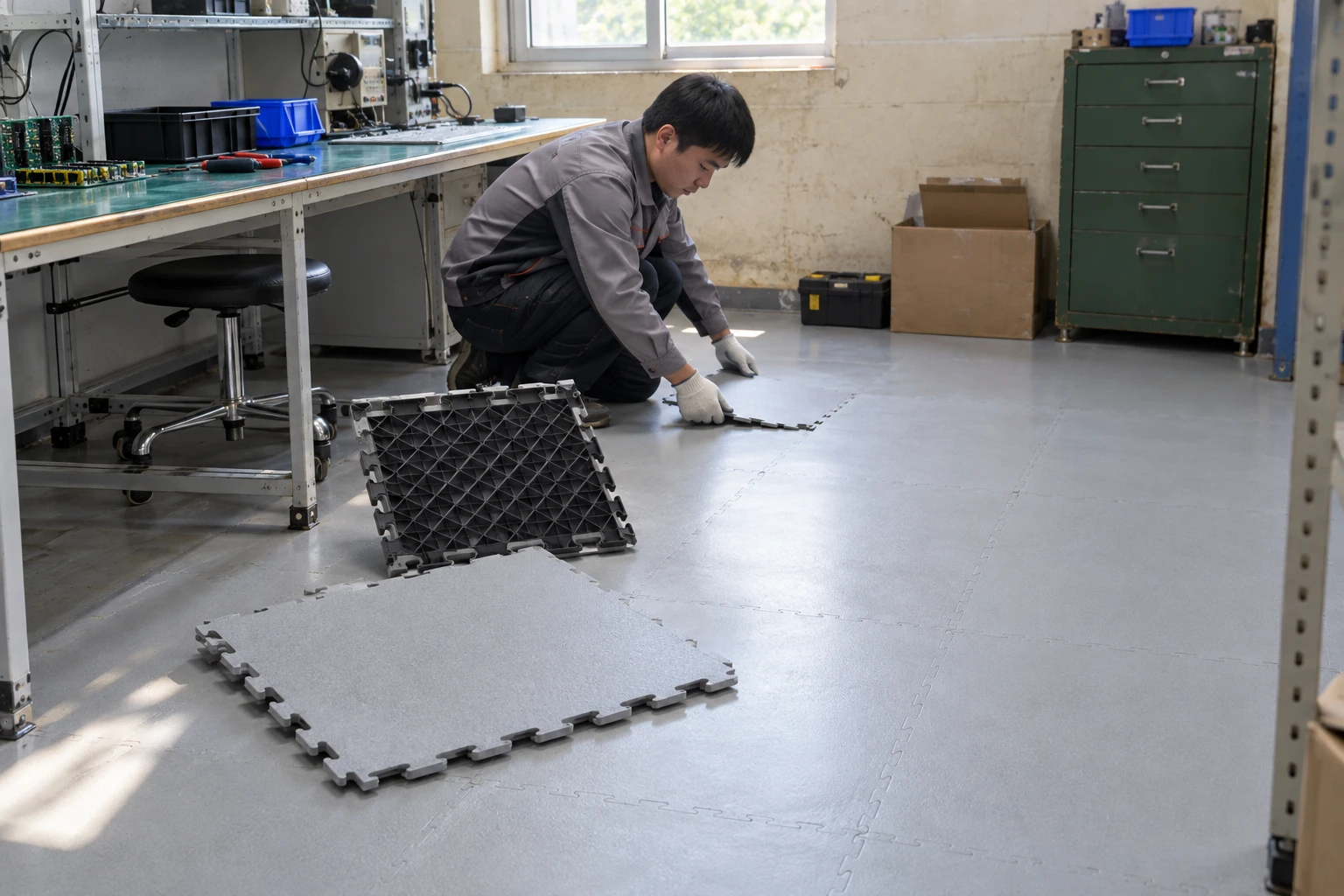
ESD Vinyl Flooring
current market trends for esd vinyl flooring in manufacturing facilities
| Review date | 23 October 2026 |
|---|---|
| Bonded sheet option, W × L | 2 × 20 m at 2.0 mm overall thickness |
| Bonded tile options, W × L | 608 × 608 or 615 × 615 mm at 2.0 mm overall thickness |
| Modular option, W × L | 607 × 607 mm at 10.3 mm overall thickness |
| Purchasing evidence | Installed-system electrical acceptance, material identity and current product-specific documentation |
| Project considerations | Shutdown window, floor build-up, local replacement, cleaning and life-cycle scope |
Formats describe different flooring systems. Choose a complete assembly for the process; a thicker modular floor and a thin bonded floor have different transition and installation requirements.
Manufacturing buyers face several distinct ESD vinyl floor options, from bonded sheet to replaceable modular tiles. Current manufacturer ranges and technical guidance point to practical procurement priorities: managing refurbishment, evaluating the working electrical system and comparing documented material impacts alongside service requirements.
Review date: 23 October 2026. The following is a qualitative reading of current product portfolios and primary technical guidance. Those sources show available approaches and purchasing considerations; they do not establish market size, sales growth or a ranking of suppliers.
Refurbishment choices are broadening
Manufacturers offer ESD flooring in both thin bonded constructions and thicker interlocking formats. For an operating factory, this creates a useful distinction between replacing a permanent finish and installing a modular surface that can be approached in sections. Forbo's Colorex Plus EC range is one published example of an adhesive-free modular construction.
The purchasing implication is to compare disruption as well as material price. Door clearance, transitions, floor flatness, grounded continuity and equipment movement can decide whether a modular option actually shortens a project. Removing an adhesive application does not remove all preparation or acceptance work. A bonded sheet may still suit a room where cleaning continuity and low floor build-up dominate the decision.
Electrical evidence needs to follow the people and equipment
The ESD Association's footwear and flooring guidance explains why independently acceptable components must also work together. Procurement based only on a floor's resistance figure misses the behavior of the actual footwear–floor combination.
For a manufacturing facility, a stronger specification connects the material purchase with installation acceptance and ongoing checks. Identify the footwear, mobile equipment, cleaning products and operating conditions early. This makes competing quotations more comparable and reduces the risk of discovering a system mismatch after the floor is installed.
Environmental information is becoming part of the comparison package
Current product documentation includes environmental declarations alongside technical data. Forbo's ESD and cleanroom document library lists product-specific declarations for several floor constructions, including documents with validity dates extending into 2028 and 2029.
The useful direction for buyers is documented comparison, rather than choosing by an isolated recycled-content claim. Check the declared product, thickness, assessment scope and validity period. Installation materials, replacement frequency and the actual local route for used flooring also affect a project decision; an environmental declaration alone does not prove that one option is best for every facility.
Sheet and tile remain different answers
Current ranges continue to distinguish sheet products from bonded and modular tiles. For example, Forbo's Sphera SD/EC technical data, revised in November 2025, documents a sheet-floor route within an ESD portfolio. The presence of several formats supports a process-led selection; it is not evidence that one format is replacing all others.
Tile replacement can be attractive around frequently moved workstations. Sheet layout can reduce field joints in an open wet-cleaned area. The better option depends on the site's maintenance access, substrate, cleaning detail and electrical requirements.
Turn a market observation into a comparable quotation
Ask for the same scope from each supplier: floor construction, accessories, preparation assumptions, installation responsibilities, electrical acceptance and maintenance documentation. Keep freight, installation and any required shutdown work visible in the comparison. This gives the facility a decision it can act on without relying on an unsupported growth forecast or a promise that every ESD vinyl product performs alike.
Floor formats, renovation phasing and the supporting supply package can be customized to the facility and its maintenance strategy.