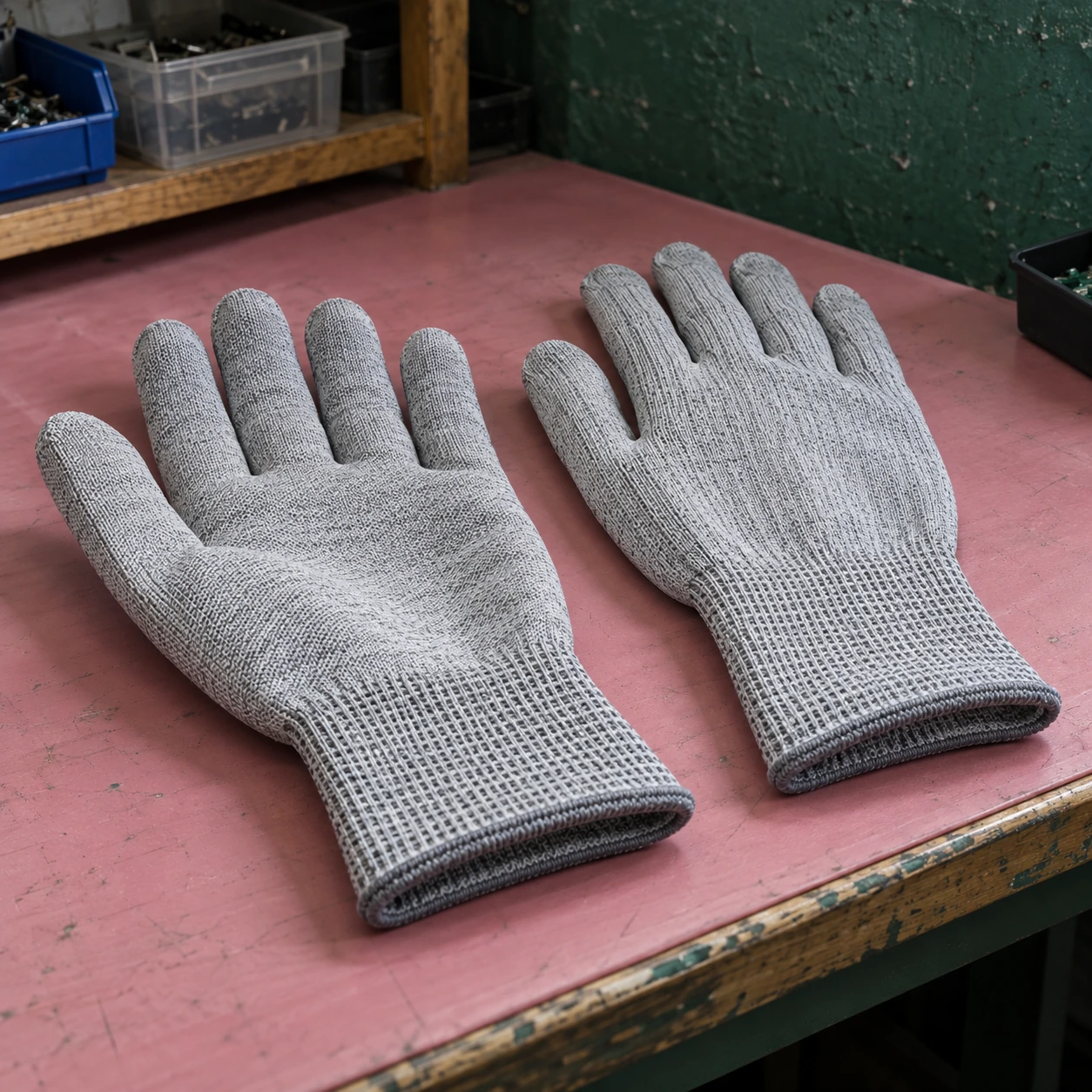
ESD Gloves
anti esd gloves
| Construction | Conductive-fibre knit; uncoated or selectively coated |
|---|---|
| Uncoated sizes | S / M / L / XL |
| Uncoated overall length (mm) | S 170 / M 180 / L 190 / XL 210 |
| Contact alternatives | Bare conductive knit, PU fingertips or PU palm |
| Cuff | Elastic knitted wrist |
| Electrical assessment | Identify material testing and worn-glove system testing separately |
| Use cycle | Reusable styles with a defined care and replacement procedure |
The listed lengths apply to uncoated knit choices. Coated constructions have their own size and length selection.
Liner, coating coverage, sizes and packing can be customized around the handling process and its electrical acceptance requirements.
Anti ESD gloves are selected to manage the hand-to-part interface during static-sensitive work. The name describes an intended purpose; the liner, contact surface and verification method determine whether a particular glove fits that purpose.
Look beyond the anti-static label
Friction and separation occur each time a gloved hand grips a tray, releases a component or moves over a working surface. The glove adds another material to those contacts. Conductive fibres or a suitably formulated film can help manage charge, but the finished contact area must be evaluated for the intended work.
Visible dark threads do not establish a complete electrical result. Neither does a palm coating with a particular colour. Construction details explain how the glove is intended to function; test evidence establishes the behaviour of the particular item under stated conditions.
Three descriptions that answer different questions
- Material resistance
A measurement made on the glove material characterises that sample and electrode arrangement. Surface and through-material measurements are different. A number without a method, conditioning information or identified glove is difficult to interpret.
- In-use resistance
This evaluates the contact while the glove is worn within a defined test arrangement. Fit, the part of the glove being contacted and the operator interface matter. The EOS/ESD Association distinguishes this from intrinsic material testing in its discussion of glove and finger-cot measurements.
- Application approval
The site's ESD programme determines whether the glove is appropriate for the devices and handling process. A favourable isolated material result does not replace that decision, establish cleanroom suitability or give the operator electrical-shock protection.
Keep the contact surface consistent
An uncoated liner gives a textile contact across the hand. Fingertip coating changes the grip at the pinch points while leaving most of the palm uncovered. Palm coating suits tasks where the whole hand supports a housing. Choose the area that the task uses and evaluate that finished surface.
For dry precision work, excessive loose fabric can catch on a latch or fold between two mating parts. A thick or stiff coating may also reduce feedback. Trial the actual movement, rather than selecting solely by how a glove feels when the hand is open.
When a previously accepted glove becomes unreliable
Check whether the supplied variant changed, the working face became worn, or the cleaning procedure introduced a new residue. Keep worn and freshly issued samples distinct during investigation. Do not assume that a darker mark is the only sign of contamination, or that a newly washed pair has automatically recovered its previous performance.
Choose controls that remain practical
Define how operators identify an acceptable pair, when it is replaced and how a reusable style is cared for. If the process needs a continuous film barrier, compare ESD nitrile glove options. Keep the work area's personnel grounding in place; changing gloves does not replace that system.
Liner, coating coverage, sizes and packing can be customized around the handling process and its electrical acceptance requirements.