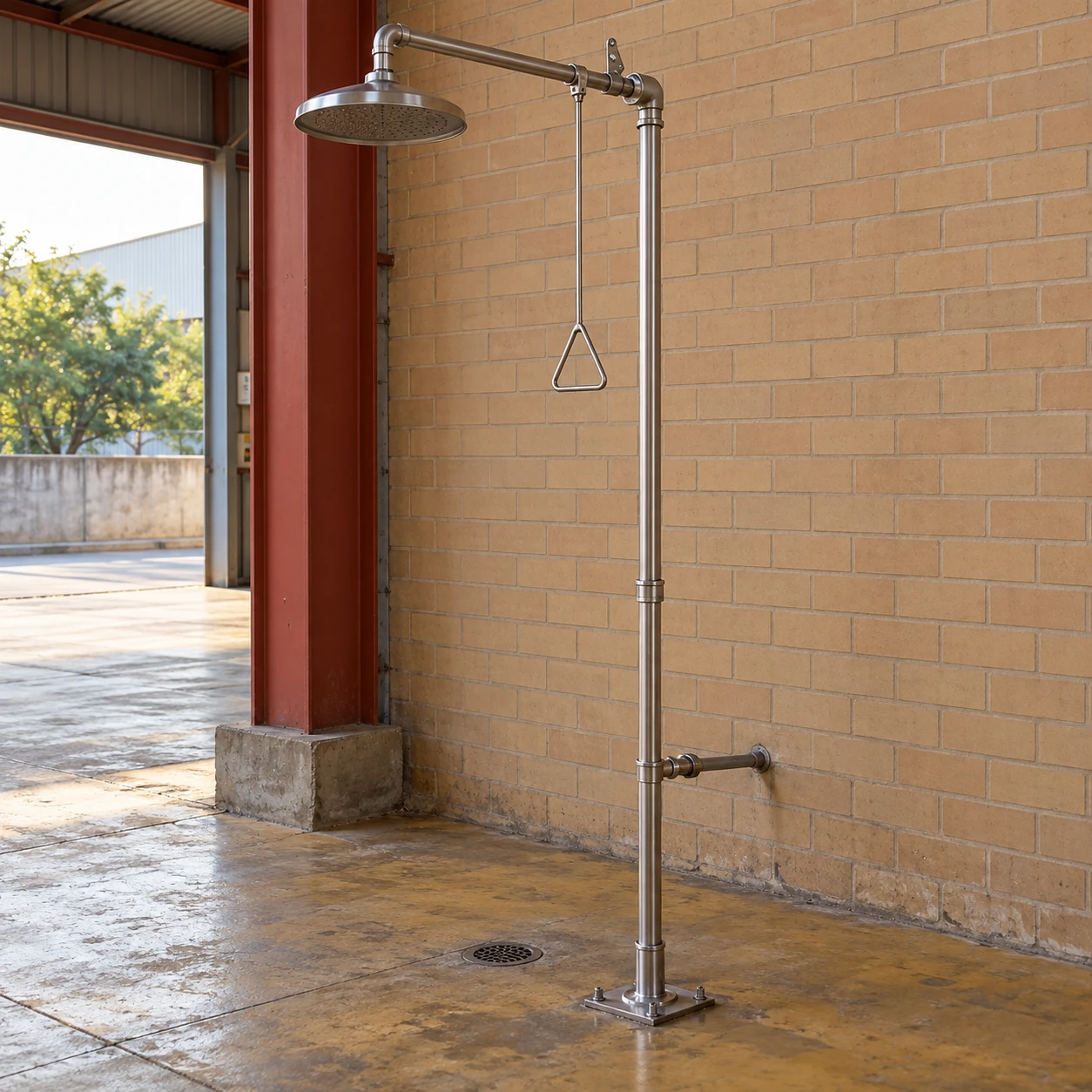
Emergency Safety Showers
emergency safety shower
| Brand | shengtongJH |
|---|---|
| Mounting | Floor-mounted riser, wall-mounted arm or overhead-fed assembly |
| Construction | Stainless steel or coated galvanized pipework; stainless steel or ABS drench head, matched to exposure |
| Head diameters | Approx. 203 mm or 254 mm; head size is not the water coverage diameter |
| Installed head height | 2083–2438 mm above the standing surface for an ANSI/ISEA Z358.1 installation; overall assembly height varies |
| Water connection | Nominal 25 mm (1 in) or 32 mm (1¼ in), depending on assembly; specify BSP or NPT |
| Hydraulic requirement | At least 75.7 L/min for 15 minutes at the shower; supply pressure must satisfy the selected assembly while flowing |
| Flushing temperature | Tepid water, 16–38°C under ANSI/ISEA guidance; assess the chemical-specific requirements |
| Operation and services | Pull-rod stay-open valve; basic manual unit requires no electricity. Tempering, alarms and freeze protection selected separately |
These are configuration choices and installation requirements. Final dimensions, hydraulic performance and any required compliance documentation must match the supplied assembly and the site installation.
Mounting, materials, connections and supporting accessories can be customized for the intended use scenario, subject to the applicable safety requirements.
An emergency safety shower provides rapid whole-body drenching where an industrial splash can reach clothing or skin. A usable installation combines the right shower assembly with an accessible location and a dependable flushing-water supply.
Whole-body drenching at the point of risk
A chemical transfer point, cleaning-chemical preparation area or industrial testing room can expose more than the hands. When a hose coupling releases or an open vessel splashes, liquid may reach the torso, legs and clothing. The overhead drench head distributes water over the body; the pull rod opens a valve that stays open, leaving the user's hands free.
This is a dedicated emergency fixture, with a water distribution pattern and supply demand unlike a domestic shower. It does not replace process containment, appropriate protective equipment or the site's emergency response arrangements. An overhead body shower is also unsuitable for direct eye irrigation. Where both eye and body exposure are credible, consider an emergency safety shower and eyewash combination.
Choose the mounting around the structure
A freestanding riser puts the activation rod and overhead head on a floor-supported assembly. It suits a clear bay with a sound anchoring surface and a practical pipe route. The base connection must support normal activation and service loads; the water pipe alone should not be treated as an improvised structural support.
A wall-mounted arm can preserve floor space where a wall or structural column can carry the fixture. An overhead-fed version may suit an existing service arrangement, but neither configuration removes the need for a reachable control, adequate head position and unobstructed standing space.
Make the approach usable
The route matters as much as the floor area occupied by the pipe stand. Stored drums, trolley parking, steps or a locked door can turn a nearby fixture into an inaccessible one. Keep the approach on the same level as the hazard, identify the location clearly and maintain access as the workshop layout changes.
The ISEA selection and use guide explains the access and hazard-assessment principles. A site safety professional should determine the position against the actual chemicals and work process; a straight-line measurement on a drawing does not establish that an injured person can reach it.
Why a good-looking fixture can still deliver poor drenching
A restricted feed
A high static pressure reading can hide a weak supply. Small branch pipes, partially closed valves, fouled strainers and other water users may cause pressure to fall when the shower opens. Size and test the complete supply route at operating flow, including any tempering valve.
Unsuitable water temperature
Cold winter pipework or sun-heated water can make continued flushing difficult. A suitable emergency tempering arrangement addresses supply temperature; freeze protection addresses loss of flow. These are different functions, so insulation or trace heating alone should not be assumed to provide the complete solution.
An obstructed spray area
A low ceiling beam, nearby machine or added enclosure can interrupt the water pattern even when the head itself is correctly positioned. Select the mounting and any privacy screen together, leaving the shower coverage and escape route clear.
Resolve wastewater handling before the installation is occupied
A shower discharge can spread across a workshop floor and carry the contaminant with it. Determine whether the site needs a drain, a collection arrangement or another approved method of handling runoff. The decision depends on the substances involved and local requirements. Avoid a raised bund or loose hose across the approach that creates a trip hazard.
Routine activation also produces water. An appropriate test collection device makes maintenance practical without turning the emergency standing area into permanent storage.
Keep the assembly ready between uses
Plumbed equipment needs regular activation to demonstrate operation and clear stagnant water from the branch. Follow the equipment instructions and site procedure; established guidance includes weekly activation and a more complete annual assessment. A visible stream alone does not establish correct flow, temperature or distribution.
Inspect the pull mechanism, valve return-to-ready condition, head openings, anchor fixings and pipe joints. Replace damaged or incompatible components with parts approved for that assembly. Coated steel and stainless steel offer different maintenance considerations, but neither material is universally resistant to every chemical environment.
For a quotation, send the chemical exposure context, indoor or outdoor location, mounting position, available flowing water pressure and connection standard. shengtongJH coordinates the fixture and supporting supply requirements so that the quoted scope identifies the shower, tempering equipment, alarms and installation interfaces separately.
Mounting, materials, connections and supporting accessories can be customized for the intended use scenario, subject to the applicable safety requirements.