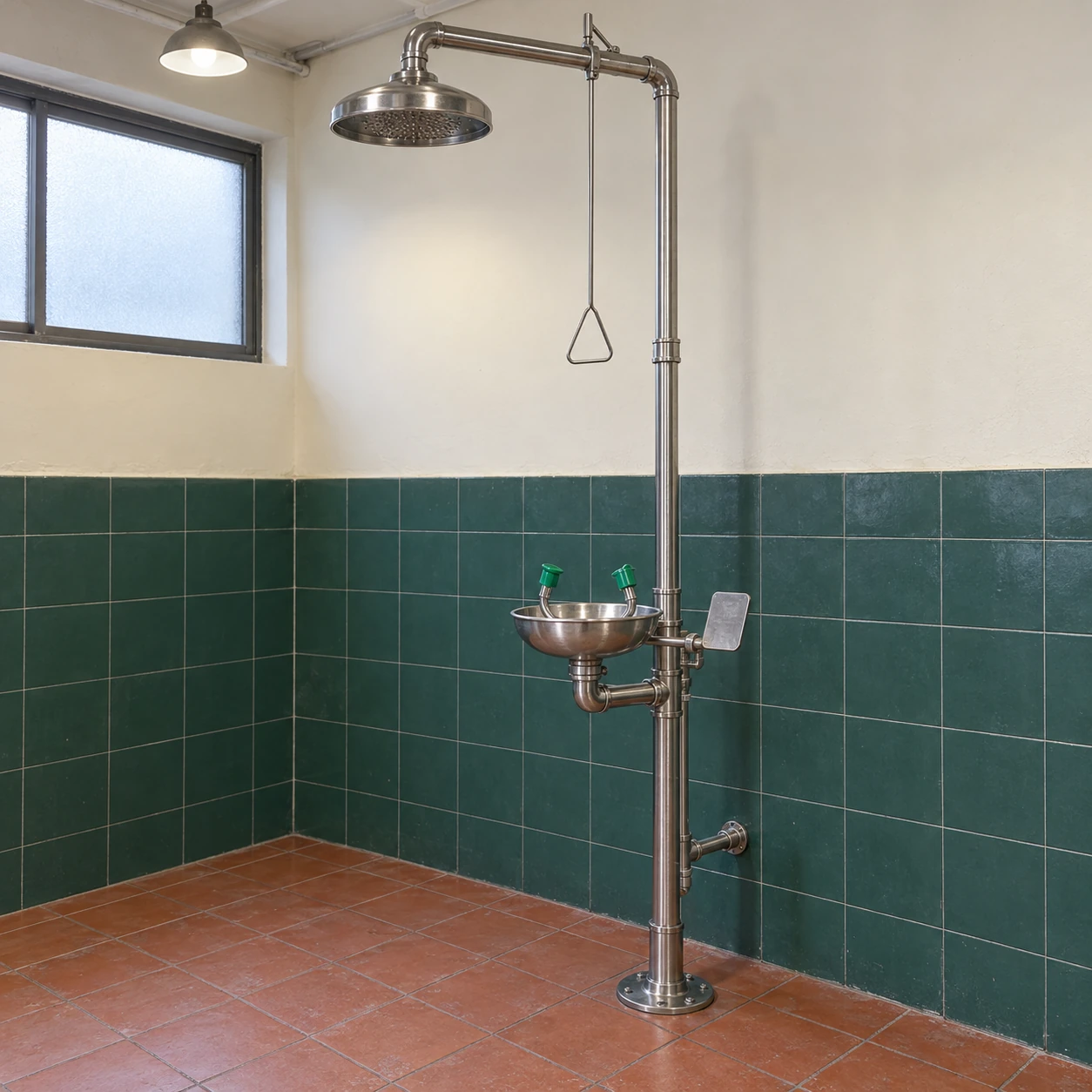
Emergency Safety Showers
emergency safety shower and eyewash
| Brand | shengtongJH |
|---|---|
| Assembly | Floor-mounted shower with eyewash bowl; eye/face-wash outlet option where required |
| Materials | 304 stainless steel pipework and bowl; alternative materials selected for the water and chemical environment |
| Component dimensions | Shower heads approx. 203 or 254 mm diameter; eyewash bowls commonly around 280 mm. These are component sizes, not an installation footprint |
| Mounting levels | ANSI/ISEA shower head: 2083–2438 mm; eyewash nozzles: 838–1143 mm above the standing surface |
| Supply and waste | Common assemblies use 25 mm (1 in) or 32 mm (1¼ in) nominal water connections; separate bowl waste commonly 32 mm (1¼ in). Specify BSP or NPT |
| Simultaneous flow basis | Shower ≥75.7 L/min plus eyewash ≥1.5 L/min; eye/face wash requires ≥11.4 L/min instead. Maintain each outlet's required performance for 15 minutes |
| Water temperature | Tepid supply, 16–38°C under ANSI/ISEA guidance; tempering capacity must match the selected outlets |
| Controls | Independent stay-open pull rod and eyewash push flag; foot-operated eyewash available by assembly |
| Services and options | Manual operation without electrical power; protective nozzle covers, inlet strainer, alarm and freeze protection selected as needed |
Select a matched assembly and verify flow and temperature with both outlets operating together; actual demand may exceed the minimum figures. Required compliance documentation must identify the supplied equipment.
The shower and eyewash assembly, materials, connections and accessories can be customized for the intended use scenario while retaining the required safety performance.
A combination station brings body drenching and controlled eye flushing to one accessible location. The two outlets serve different exposure needs, but their shared water connection must support both when they operate together.
Two exposure paths, two controlled outlets
At a mixing bench or transfer point, the same splash may reach both the face and the body. A combination station keeps the two flushing functions together without asking an injured worker to move between separate locations. The overhead shower provides body coverage; dedicated low-velocity outlets allow both eyes to be flushed.
The shower control
A pull rod operates the overhead valve. The valve remains open after activation, allowing continued drenching without holding the handle. The head position and clear standing area determine where the water falls; the presence of a bowl below does not define that coverage.
The eyewash control
A push flag opens the eyewash branch independently. Protective covers help keep airborne dust off the nozzles and must move away as intended during use. A matched foot control can provide another activation method, but it should not introduce an obstruction or substitute an unsuitable self-closing valve.
Specify the shared feed for simultaneous operation
Testing each outlet separately can miss the main weakness of a combination unit. When the shower opens, its demand can reduce the pressure available at the eyewash. The result may be a satisfactory body spray but weak or uneven eye-flushing streams. The upstream branch, water source, regulating components and emergency mixing valve must therefore be selected as one hydraulic system.
Use the actual rated demand of the selected outlets when sizing the supply. An eye/face-wash attachment may require substantially more water than a basic eyewash. Two fixtures with the same threaded connection are not necessarily interchangeable, and a mixer chosen only for its connection size may create excessive pressure loss.
Commission the complete installation with both controls open. A combination label or a large supply pipe cannot replace this check.
Choose the lower outlet for the hazard
An eyewash and an eye/face wash are different device categories. A basic eyewash directs suitable streams to both eyes. An eye/face wash also provides the required wider face coverage. Adding a larger collection bowl to an ordinary eyewash does not turn it into an eye/face-wash assembly.
The choice follows the substances, splash direction and tasks at the workstation. The site assessment should also consider whether more than one person could need a fixture at once. One combination station supplies two functions at a single position; it is not automatically a multi-person emergency facility.
Where only a body-shower assembly is being procured, the emergency safety shower page covers separate mounting and supply considerations. Keep any independently required eye protection or eyewash provision in the site scope.
Separate clean water from wastewater
The eyewash bowl collects used flushing water and sends it to a waste connection. It is not a storage tank or a return path into the clean-water supply. Plan the water inlet and bowl drain separately, including the thread type, drainage route and any backflow protection required by the installation rules.
The bowl does not collect the shower's body-drenching discharge. Floor runoff still needs an appropriate solution for the chemicals present. Position drain connections and any privacy enclosure so they leave clear access to the eyewash and the space beneath the shower.
Match materials and protection to the room
Stainless pipework and a stainless bowl suit many industrial utility areas, while coated assemblies may be practical in other locations. Select materials against the actual chemical atmosphere and water chemistry. A grade designation alone is not a guarantee of resistance to every corrosive substance.
Dusty surroundings may call for additional nozzle or bowl protection. A cold external position needs a suitable freeze-protected design; a hot location may need measures against overheated stagnant water. Alarm equipment can help summon assistance, with its electrical and environmental requirements specified separately from the manual fixture.
Maintain both functions as one station
A service check should exercise both activation mechanisms, verify nozzle-cover operation and inspect the strainers, outlets, valves and waste route. A blocked eyewash filter can affect one branch while the shower still appears normal. Routine activation and the required periodic inspection should therefore record the condition of each function, including simultaneous performance.
The CCOHS emergency shower and eyewash guidance explains how selection, access, tepid water and maintenance work together. The applicable jurisdiction and site hazard assessment determine the final installation requirements; compliance evidence must identify the supplied equipment.
shengtongJH can coordinate a quotation around the required lower outlet, material selection, mounting space and available water services. Include whether tempering, alarm contacts, foot activation or winter protection belongs in the supply. This helps distinguish a complete configured station from a bare shower-and-bowl assembly with essential supporting items omitted.
The shower and eyewash assembly, materials, connections and accessories can be customized for the intended use scenario while retaining the required safety performance.