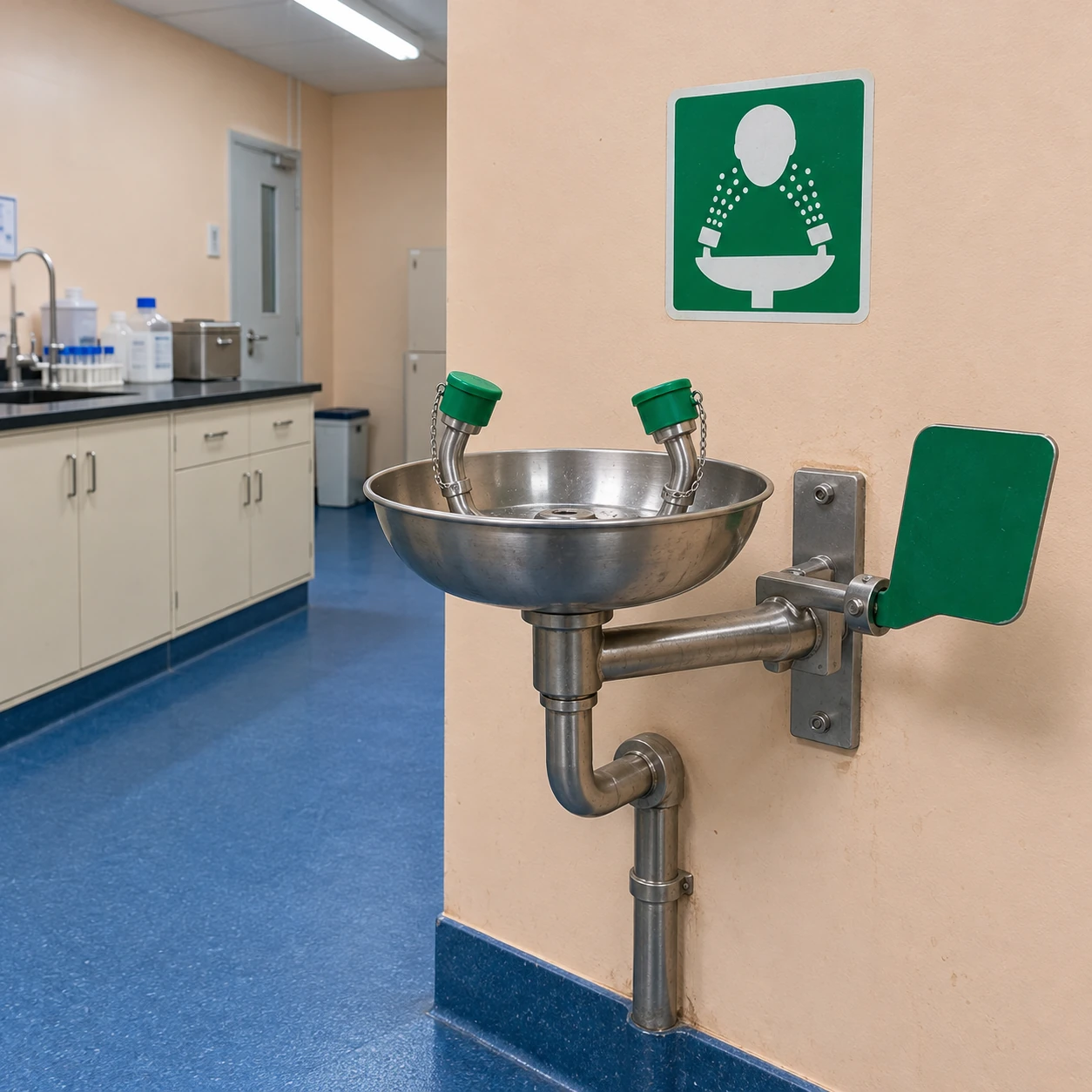
Emergency Eyewash Stations
emergency eyewash station hospital
| Workplace arrangements | Wall-mounted or pedestal fixed eyewash; supported self-contained reservoir where the assessment permits |
|---|---|
| Bowl sizes | Approximately 283 mm diameter stainless steel or 280 mm diameter ABS |
| Compact wall exterior W × D × H | 380 × 359 × 365 mm for an ABS-bowl configuration; other assemblies use their approved dimensions |
| Reservoir capacities | 34.1 L or 60.6 L gravity-fed assemblies with a defined fluid-service procedure |
| Fixed interfaces | 1/2-inch NPT or Rp 1/2 water supply; matching 1-1/4-inch waste arrangement |
| Actuation | Stay-open hand control or compatible pull-down activation on a self-contained unit |
| Surface and outlet choices | Cleanable stainless steel or polymer surfaces, protected heads and replaceable service components |
| Supporting accessories | Emergency-service temperature control, identification sign, suitable bracket and compatible maintenance parts |
These are workplace emergency fixtures. Select the complete assembly, fluid supply and cleaning method through the facility's occupational safety and water-management requirements.
Mounting, materials, connection details and supporting accessories can be coordinated with the hospital work area and its facilities requirements.
Hospital eyewash provision concerns the work being performed: laboratory reagent handling, chemical preparation, cleaning-product dilution and similar staff activities can create different exposure risks. The equipment decision should follow those activities and the facility's response arrangements, rather than treating every hospital room as the same application.
Chemical exposure areas
Review the substances used and the way staff transfer, mix or handle them. Where an injurious corrosive splash is possible, immediate suitable flushing provision is a central part of the workplace assessment. Eye-only equipment may be insufficient where the task can also contaminate the face or body.
In U.S. workplaces, the relevant corrosive-material requirement is OSHA 1910.151(c). The facility must determine the requirements that apply in its jurisdiction and match the equipment to the substances and exposure routes.
Blood or other potentially infectious material
Exposure-control arrangements are a separate consideration. OSHA's bloodborne-pathogens interpretation addresses prompt water flushing of exposed mucous membranes, together with appropriate protective equipment and post-exposure procedures. It does not turn every clinical space into the same chemical-eyewash application.
Staff should follow the facility's established response and prompt medical evaluation process. Purchasing a fixture does not replace that process or the preventive controls for splash exposure.
A tidy bowl does not prove the water path is ready
Emergency fixtures may remain unused for long periods. Cleaning the visible surface alone does not address stagnant water, scale or contamination inside the supply branch. Include the station in the facility's water-management and maintenance responsibilities so that operational checks and fluid quality are considered together.
OSHA's eyewash-water guidance describes health risks associated with improperly maintained stations. For plumbed equipment, follow the activation and flushing instructions for the installed unit. For a reservoir system, manage the permitted fluid, replacement interval and cleaning procedure. Neither an unverified additive nor a claim that water looks clear establishes suitability.
Choose cleaning agents compatible with the bowl, head covers and seals. Aggressive cleaning that damages a valve seal or leaves residue around the outlets can undermine equipment readiness. Keep instructions available to both the cleaning team and engineering staff.
Fit the station into the staff workflow
Locate the fixture on the assessed route from the exposure, with access that remains clear when carts, waste bins or mobile equipment are present. An emergency station behind a locked service cupboard is a different proposition from one available in the work area. Review the operating position as well as the route.
Coordinate water discharge with the room layout so that the fixture does not wet nearby electrical equipment or interfere with essential circulation. A wall-mounted station can keep the floor open, while a pedestal may allow a more suitable position away from a crowded counter.
An ordinary handwashing tap is not automatically a compliant eyewash. The required flushing pattern, temperature and operation must be established for the actual arrangement. Personal rinse bottles can have a supporting role but should not be used to justify removing necessary primary equipment.
Coordinate the order with the people who will maintain it
Occupational safety, facilities staff and the relevant infection-prevention or water-management team should agree the location, equipment duty and servicing responsibility. Include access needs, approved cleaning products, supply information and the required documentation in the purchase brief. Send the room and installation requirements so that the equipment and accessories can be specified together. These stations provide workplace emergency flushing; they are not a substitute for patient treatment equipment or clinical care.
Mounting, materials, connection details and supporting accessories can be coordinated with the hospital work area and its facilities requirements.