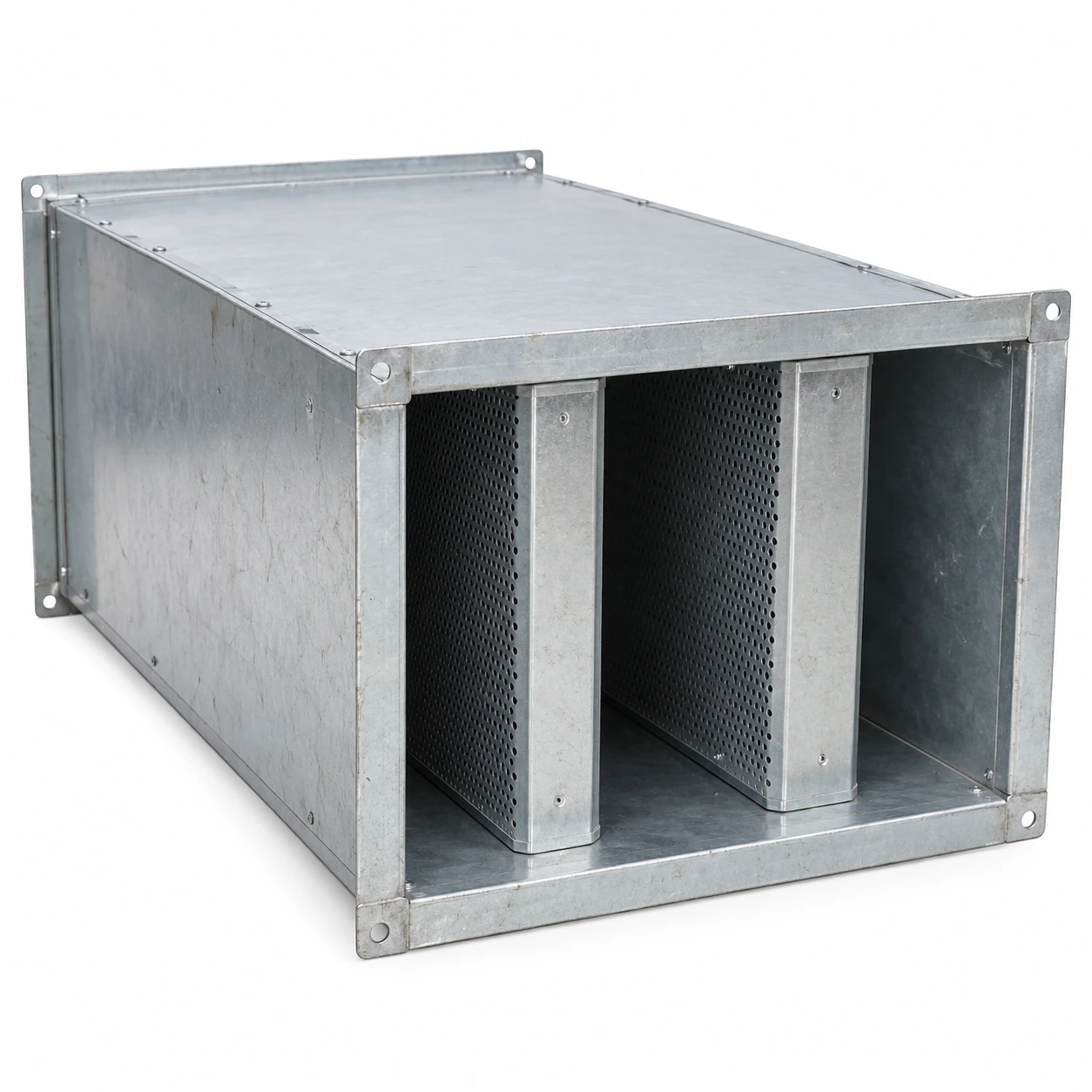
Duct Silencers
duct silencer
| Brand | shengtongJH |
|---|---|
| Construction | Rectangular casing with absorptive splitter baffles |
| Connection W × H | 300 × 300 / 500 × 400 / 600 × 600 mm |
| Body length L | 500 / 1000 / 1500 mm along airflow |
| Casing | Galvanized steel; stainless steel by application |
| Splitter options | 100 or 200 mm nominal thickness, with matched passages |
| Acoustic filling | Mineral-fibre absorber with compatible protective facing |
| Air-facing surface | Perforated metal over a fibre-retaining layer |
| Connections | Duct-profile or angle flanges matched to adjacent ductwork |
| Selection inputs | Air volume, frequency-band attenuation and permitted pressure loss |
| Access | Inspection arrangement selected for the duct route |
Dimensions describe selectable construction envelopes, not tested acoustic ratings. Match the complete geometry to the required airflow and frequency-band performance.
Casing dimensions, splitter layout, materials and connections can be customized to the ventilation duty and installation space.
A duct silencer reduces sound travelling along an air path while allowing ventilation air to pass. The useful choice depends on the noise source, its frequency content and the airflow available through the silencer, rather than the size of the metal casing alone.
Find the path the noise actually takes
Fan sound can travel inside a duct, radiate through thin casing or reach the building through rigid supports. An in-duct silencer primarily addresses the airborne path inside the duct. If the dominant problem is a vibrating fan base or a rattling access panel, adding acoustic baffles will not remove that source.
Check where the noise is strongest and how it changes with fan operation. A distinct tone may need attention at a particular frequency, while broad rushing noise can indicate excessive velocity or turbulent fittings. This distinction prevents buying a large silencer that treats the wrong problem.
Absorption needs both surface and space
Protected absorbent material takes energy from sound as air passes through the lined passages. Increasing length or changing splitter construction can improve attenuation in particular bands. However, making the passages narrower also changes airflow resistance. External dimensions alone cannot show whether two designs perform alike.
A quieter component can still create noise
Air moving rapidly through restricted passages generates additional sound. Sharp inlet conditions and an uneven velocity profile can worsen this effect. Select insertion loss together with regenerated noise and pressure drop, using the intended airflow rather than a catalogue headline.
Define the outcome before selecting the casing
Provide the fan duty, duct connection, available length and the space that needs protection. Where an acoustic assessment is available, include its frequency-band requirements. shengtongJH can use these inputs to source a suitable construction and the corresponding technical data. A universal decibel reduction is not a reliable substitute for that selection.
For a rectangular main duct, compare a splitter arrangement; for a round branch, consider an inline configuration with a clearly defined bore. Keep inspection access in the purchase scope so the selected acoustic section remains serviceable after installation.
Casing dimensions, splitter layout, materials and connections can be customized to the ventilation duty and installation space.