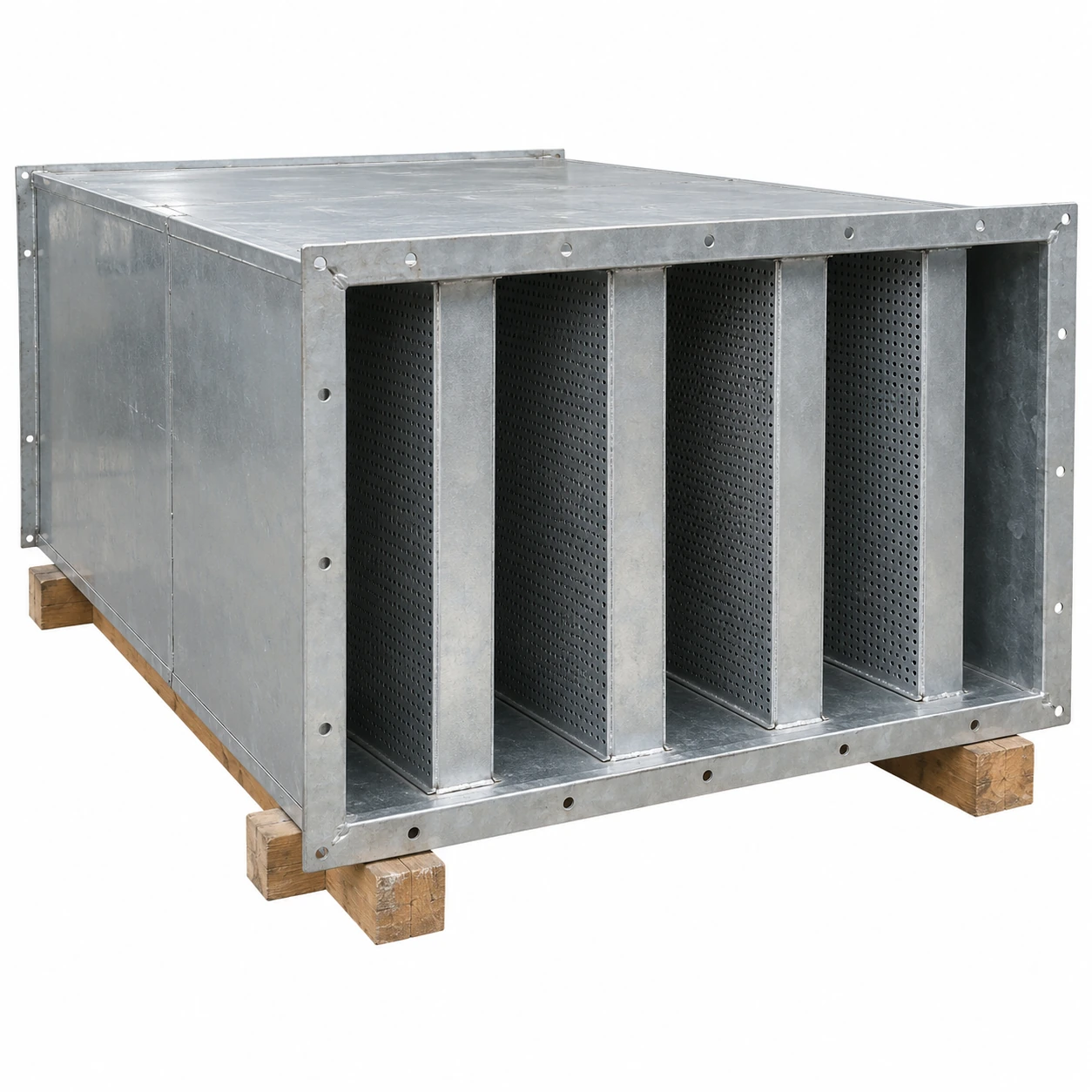
Duct Silencers
rectangular duct silencer
| Brand | shengtongJH |
|---|---|
| Connection width × height | 500 × 400 / 800 × 600 / 1000 × 800 mm |
| Acoustic body length | 500 / 1000 / 1500 mm in the airflow direction |
| Splitter thickness options | 100 or 200 mm nominal |
| Splitter number and spacing | Selected for the clear opening and duty |
| Casing material | Galvanized sheet steel; stainless steel option |
| Acoustic surface | Perforated protective sheet with retaining layer |
| Absorbent core | Mineral-fibre construction selected for the air service |
| End frame | Duct-profile or angle flange to the agreed interface |
| Supporting structure | Independent casing supports at designated positions |
| Optional provisions | Inspection access and matching inlet/outlet transitions |
W × H refers to the connection opening; length follows airflow. Flanges, stiffeners and insulation increase the overall installation envelope.
Rectangular dimensions, splitter spacing, casing material and flange patterns can be customized to the duct and acoustic duty.
A rectangular duct silencer divides the air path into passages between acoustic splitters. Its connection size, splitter thickness and free passage area must be selected together, especially on wide industrial ventilation ducts.
Look inside the opening
Two silencers with the same outer connection can have very different clear passages. Thick splitters occupy more of the opening; additional splitters create more absorbing surface but also alter the route available to the air. The useful comparison is the complete arrangement at the required air volume.
Passage velocity rises as free area decreases. That affects resistance and flow-generated sound, so simply adding baffles is not a reliable way to improve a selection. Ask for the relationship between construction, insertion loss, pressure drop and regenerated noise.
Length and frequency belong together
A longer absorbing path can improve performance, but the benefit varies with frequency and construction. A requirement dominated by low-frequency fan sound should be evaluated with the corresponding band data. An overall attenuation claim cannot show whether the troublesome part of the spectrum is treated.
Where a route has limited length, discuss an alternative cross-section or acoustic construction rather than assuming a shorter box gives the same result. Any proposed change still needs to fit the available pressure and installation space.
Coordinate the transition
An abrupt change in duct section can produce uneven entry flow. Include a suitable transition and adjacent fittings in the selection; the silencer cannot be assessed as though those components do not exist.
Support the casing
Large flanges provide a connection, not permission to suspend the entire assembly from adjoining thin ductwork. Use designated support positions and avoid distorting the casing or splitter alignment during installation.
Keep passages reachable
Inspection and cleaning access should suit the actual baffle arrangement. If access is possible only from one end, consider how maintenance will reach deeper passages before fixing the unit permanently into a crowded route.
Information for a usable quotation
Supply the clear opening, flow direction, air volume, available body length and acoustic requirement. Identify whether transitions, support details and external insulation are part of the order. This lets shengtongJH compare equivalent scopes instead of comparing bare casing prices with complete assemblies.
Rectangular dimensions, splitter spacing, casing material and flange patterns can be customized to the duct and acoustic duty.