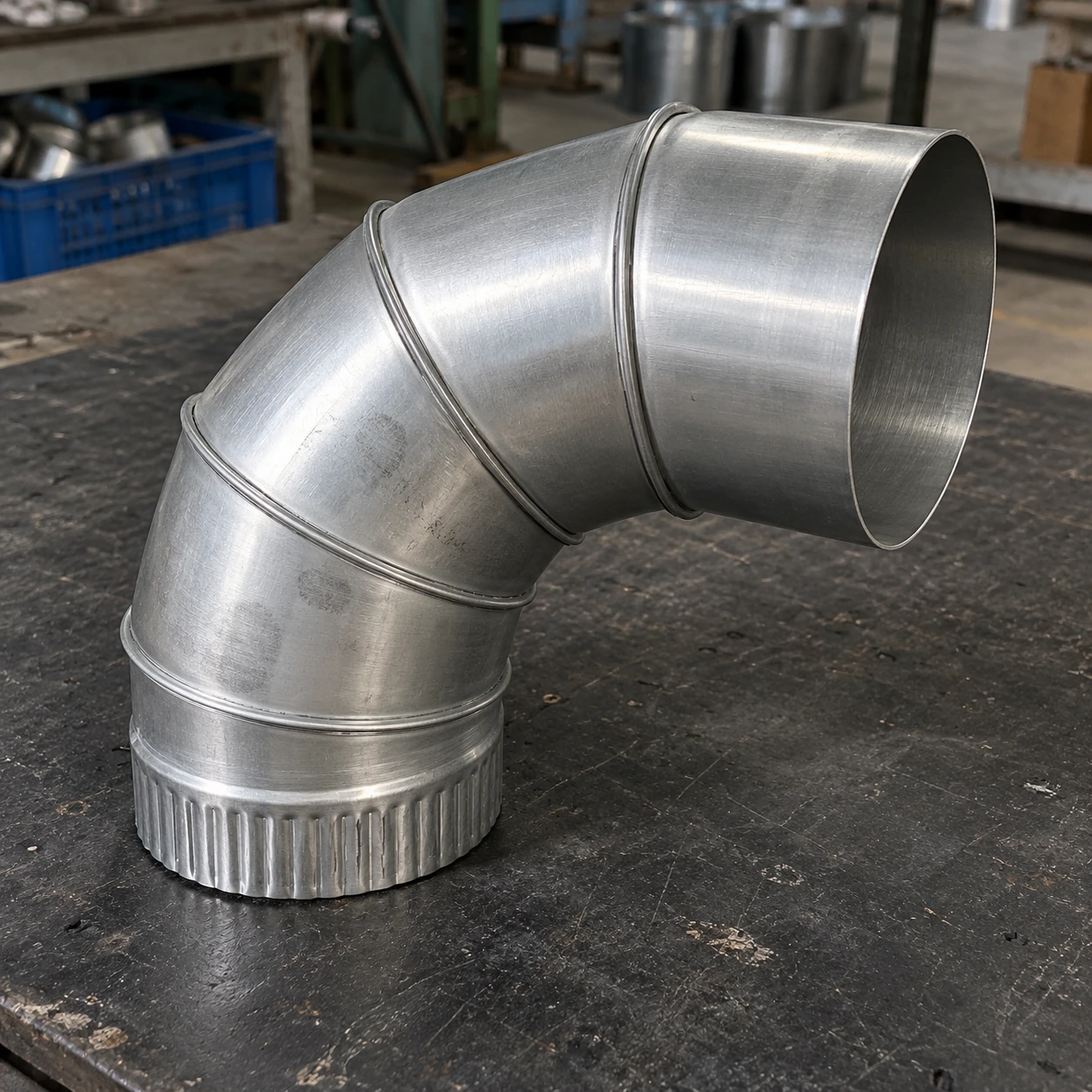
Light sheet-metal ventilation fittings
aluminum duct elbows
| Nominal connection sizes | 4 / 6 / 8 / 10 inch series |
|---|---|
| Nominal metric equivalents (mm) | 101.6 / 152.4 / 203.2 / 254; not interchangeable with metric series without checking |
| Construction | Segmented adjustable or fixed fabricated elbow |
| Turn | Up to 90° for the selected adjustable construction |
| End connection | Plain / crimped or specified flange |
| Material detail | Aluminum alloy and thickness specified for the duty |
Inch-series dimensions above are nominal diameter conversions, not measured outside diameters. Match the actual pipe and connector series.
Aluminum duct elbows can be configured to suit the ventilation duty, mating duct and exposure conditions.
Aluminum elbows offer a light metal connection for compatible ventilation pipework. Their low weight can help handling, but thin walls and adjustable segment joints still need careful support and sealing. The correct choice starts with the air stream and the adjoining duct material.
Adjustable segments simplify alignment
Rotating the segments changes the relationship between the two end axes. This can help an installer follow a modest offset without forcing the pipe. Establish the final shape before securing the surrounding run, then seal and restrain the joints according to the selected system.
An adjustable elbow is not an expansion joint or a vibration isolator. Repeated movement can work its seams and connections. Where movement is expected, provide a component designed for that movement.
A fixed bend suits a defined route
A fabricated fixed elbow avoids relying on site rotation to establish the angle. Its ends can be coordinated with the duct connection in advance. This is useful where the route is settled, the fitting is concealed or a specific flange arrangement is needed.
Compare the completed connection rather than the apparent smoothness of the exterior. An open seam, damaged crimp or mismatched collar still requires correction.
Lightweight does not mean suitable for every exhaust
Aluminum compatibility depends on the contaminants, moisture, temperature and cleaning chemicals. It should not be assumed suitable for combustion flues, grease exhaust or corrosive process gases simply because it is metal. Those duties require their own specified and, where applicable, approved duct systems.
Contact between dissimilar metals also needs attention where moisture is present. Select compatible fasteners and an appropriate isolation detail for the installation. Support the fitting without concentrating a clamp load that can distort the thin wall.
Check the diameter series before buying
Nominal inch and metric sizes can look almost identical on a short list. Confirm the end type, insertion depth and actual mating dimensions before ordering multiple fittings. A sleeve may resolve a designed connection difference; deforming a collar to make it fit is not a sound substitute.
Compare other body materials in metal duct elbows.
Aluminum duct elbows can be configured to suit the ventilation duty, mating duct and exposure conditions.