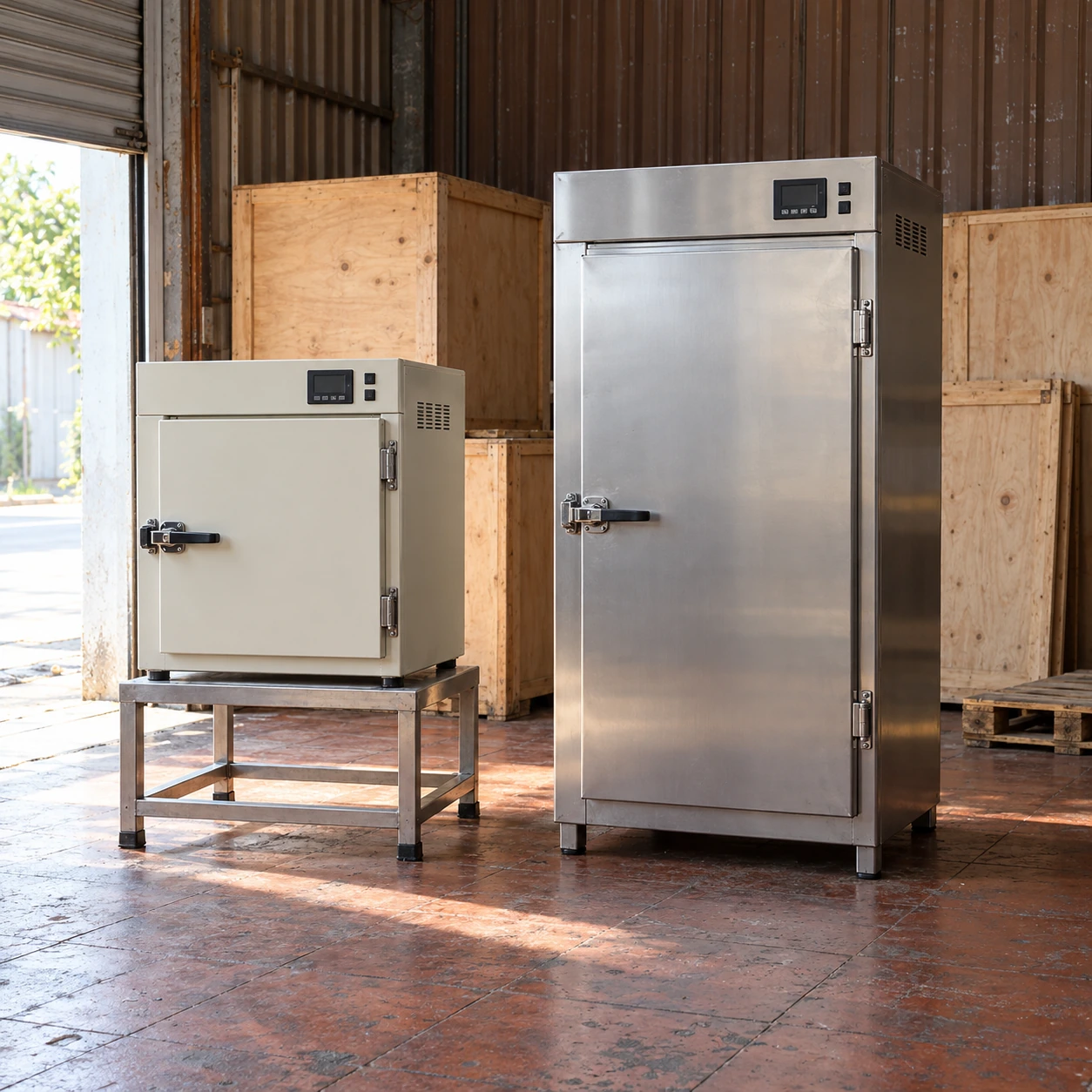
Dry Heat Sterilizers
dry heat sterilizer manufacturers
| Brand | shengtongJH |
|---|---|
| Equipment families | General laboratory batch cabinets or purpose-built filtered clean-air systems |
| Laboratory chamber options (mm) | 450 × 490 × 450; 600 × 540 × 500; 600 × 500 × 1000, W × D × H |
| Matched cabinet envelopes (mm) | 560 × 600 × 820; 710 × 650 × 870; 710 × 650 × 1640, W × D × H |
| Configuration choices | Natural or forced air; shelf and carrier arrangement |
| Control package | Basic programmed cycles or additional recording and access-control functions |
| Supply boundary | Cabinet, selected accessories, documentation and installation interfaces |
| Site-specific selection | Electrical supply, unloading space, service access and required qualification scope |
Compare complete configurations with the same load definition. Clean-air and pass-through equipment require their own approved dimensions and technical scope.
Equipment configuration, accessories and procurement scope can be customized around the application and installation.
Dry heat sterilizer manufacturers may quote similar chamber volumes while supplying different airflow systems, loading arrangements and documentation. A useful comparison puts those differences against one defined process and installation. shengtongJH supports equipment and accessory sourcing with the selected supply scope stated clearly.
Put each quotation on the same basis
The lowest cabinet price can exclude the items that make a purchase workable. A shelf rack, recorder, installation trim or documented acceptance test may appear as an option in one offer and be included in another. Defining the batch, loading method, site utilities and required records first makes these differences visible.
| Comparison point | What it means in use |
|---|---|
| Nominal volume versus loaded capacity | A chamber can fit the items geometrically while leaving insufficient circulation space. Compare the proposed arrangement of the actual load. |
| Temperature setting versus load behaviour | A controller range describes a setting capability. It does not establish loaded uniformity, heating time or process effectiveness. |
| Holding time versus batch turnaround | Heating, cooling, door handling and unloading all occupy the equipment. Compare a complete batch under stated conditions. |
| Standard documentation versus application evidence | A manual explains equipment operation. Qualification and validation establish whether the installed equipment and process meet the intended requirements. |
Some offers belong to different equipment families
A straightforward laboratory hot-air cabinet and a filtered clean-air sterilizer solve different problems. The latter adds a defined particle-control requirement to the thermal process, often with more demanding door seals, air handling and measurement access. Paying for filters without specifying the chamber cleanliness requirement can add cost without establishing the result the buyer needs.
Door configuration also changes the installation. Single-door equipment loads and unloads from one side. A pass-through arrangement connects two spaces and needs a coordinated wall interface, door logic and handling route. Compare these as complete installation choices rather than as interchangeable cabinet accessories.
Keep service details visible
Heating elements, door seals, fans, sensors and controllers do not all have the same replacement requirements. A component description and a usable parts list can matter more than a general statement that spares are available. Ask how calibration, controller settings and cycle records are recovered after a relevant replacement.
Service access should be drawn in the installation layout. A low purchase price does not compensate for a cabinet that must be disconnected and moved whenever a routine component needs attention.
Identify who owns each task
Manufacturing, export packing, delivery, positioning, connection, commissioning and process qualification are separate activities. Assigning each one in the purchase scope prevents gaps between the equipment supplier, building contractor and process owner.
For shengtongJH sourcing, the offered equipment and supplier documentation should be reviewed together. Any certificate or test report must identify the actual supplied scope; another manufacturer's general brochure cannot certify a different cabinet.
Make the final comparison usable
A practical comparison consists of the selected load arrangement, a dimensioned equipment layout, a clear list of included items and an agreed acceptance scope. For the construction details behind those choices, see dry heat sterilizer manufacturer requirements. Include the required destination, batch information and room layout in the quotation enquiry so that proposals address the same job.
Equipment configuration, accessories and procurement scope can be customized around the application and installation.