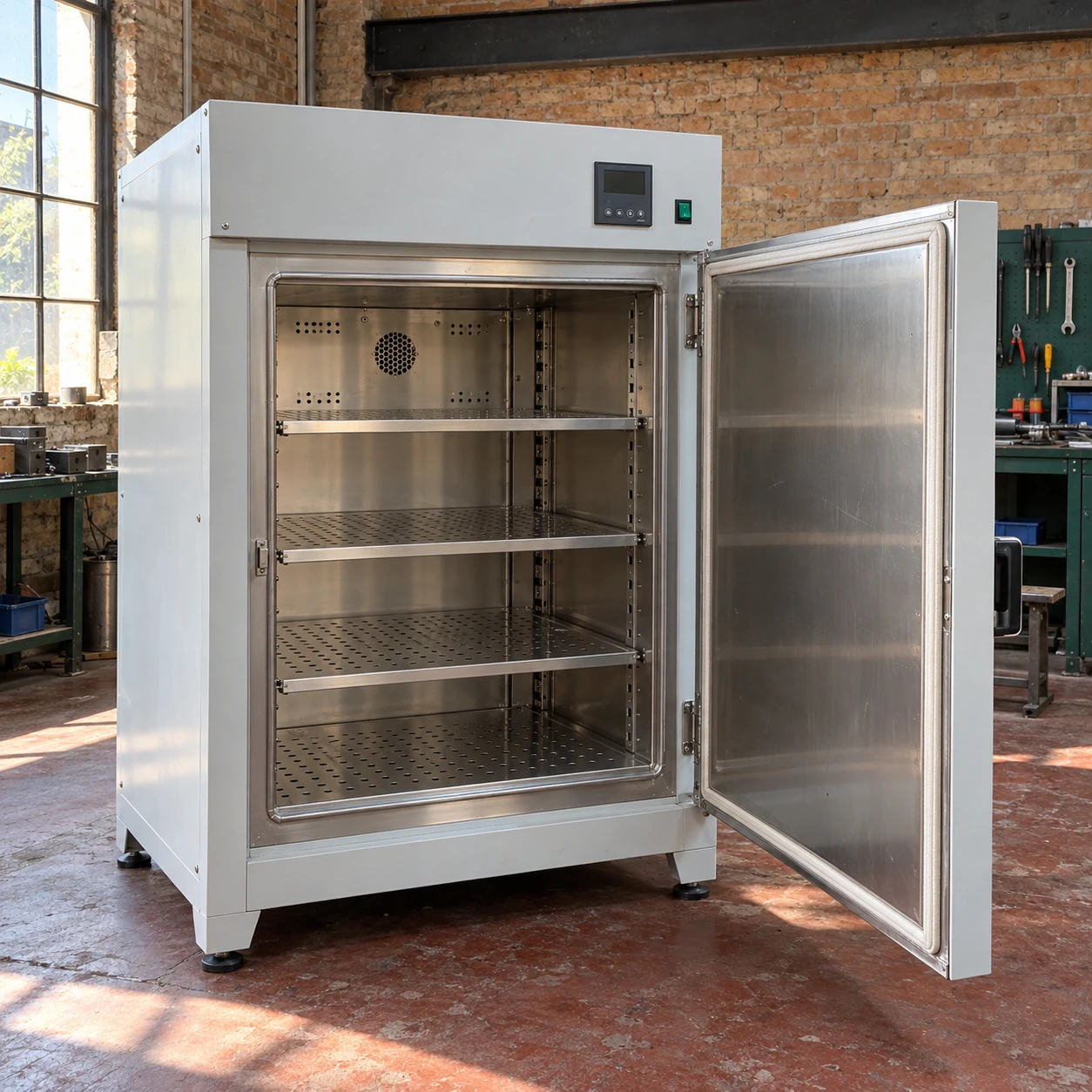
Dry Heat Sterilizers
dry heat sterilizer manufacturer
| Brand | shengtongJH |
|---|---|
| Equipment options | Bench-top or floorstanding batch hot-air cabinet |
| Chamber W × D × H (mm) | 450 × 490 × 450; 600 × 540 × 500; 600 × 500 × 1000 |
| Matching outer W × D × H (mm) | 560 × 600 × 820; 710 × 650 × 870; 710 × 650 × 1640, respectively |
| Air circulation | Natural or forced convection, selected with the load and temperature specification |
| Construction | Stainless chamber and removable shelves; painted steel or stainless outer casing |
| Control options | Programmable temperature control, independent over-temperature protection and cycle recording |
| Electrical configuration | 115 V or 220 V versions; heater rating and destination supply matched during selection |
Configuration options are selected as a complete equipment package. Final drawings define the usable loading area, overall envelope and service clearances.
Cabinet size, shelf arrangement, controls and installation interfaces can be customized to suit the intended load and application.
A dry heat sterilizer manufacturer needs more than a target temperature to build the right cabinet. Tray layout, component mass, heat tolerance and the way the load enters and leaves the chamber shape the equipment. shengtongJH coordinates equipment sourcing around these requirements, with the selected supplier's drawings and technical scope defining the offered configuration.
Build the chamber around the load
A tall glass vessel, a shallow tray of metal parts and a dense fixture can occupy the same nominal volume while heating very differently. The useful starting point is a load arrangement: item dimensions, the number of items per shelf, their material and how much air space remains around them. A larger chamber has little value if the selected rack forces parts together or blocks the return-air path.
The fabrication brief should therefore connect the shelf supports, door opening and airflow route. A wider door may simplify loading but require more aisle space. More shelf positions increase flexibility, while closely packed solid trays can obstruct circulation. The final loading pattern should remain reproducible so that later batches are comparable.
Details that affect heat delivery
Insulation, door compression and the location of the air inlet and return influence how the chamber behaves around its edges. A well-positioned sensor can support stable control, but its reading represents its own location. It does not automatically describe the slowest-heating part of a loaded cabinet.
For procurement, request temperature-distribution information for the proposed chamber and a plan for evaluating the intended load. Changing shelves, fans or loading accessories after that work may change the result and should be assessed before use.
Details that affect daily work
Removable shelves and accessible corners make routine cleaning easier. Door handles should be usable without reaching across the opening, and maintenance panels need space to open after installation. A heater that can only be replaced by pulling the cabinet out of a tightly fitted room can turn a small service task into an extended shutdown.
Material selection also belongs in the brief. A stainless chamber and a painted exterior may suit a general laboratory; frequent exterior washdown or a controlled-area interface requires a different review of finishes, joints and electrical protection.
Make the acceptance scope part of the order
Drawings should state what is measured, what is included and where the installation boundary lies. Separate temperature control, temperature uniformity, load heating and recording functions rather than accepting a single ambiguous accuracy figure. A factory test with an empty chamber is useful equipment evidence, but it cannot replace qualification of the actual loaded process at the installation site.
For a regulated sterilization application, the process owner defines the required validation and routine control. ISO 20857 addresses dry-heat sterilization process requirements for medical devices; a temperature controller or a supplier's general quality certificate is not equivalent to a validated process.
Coordinate the cabinet and its supporting items
Include shelves, load carriers, recording needs, critical replacement parts and site access in the same sourcing discussion. This reduces the chance that a cabinet arrives with a suitable chamber but without the carrier or documentation needed to use it. For a clean-air chamber, review the dedicated ISO Class 5 equipment requirements before choosing an ordinary laboratory oven.
Cabinet size, shelf arrangement, controls and installation interfaces can be customized to suit the intended load and application.