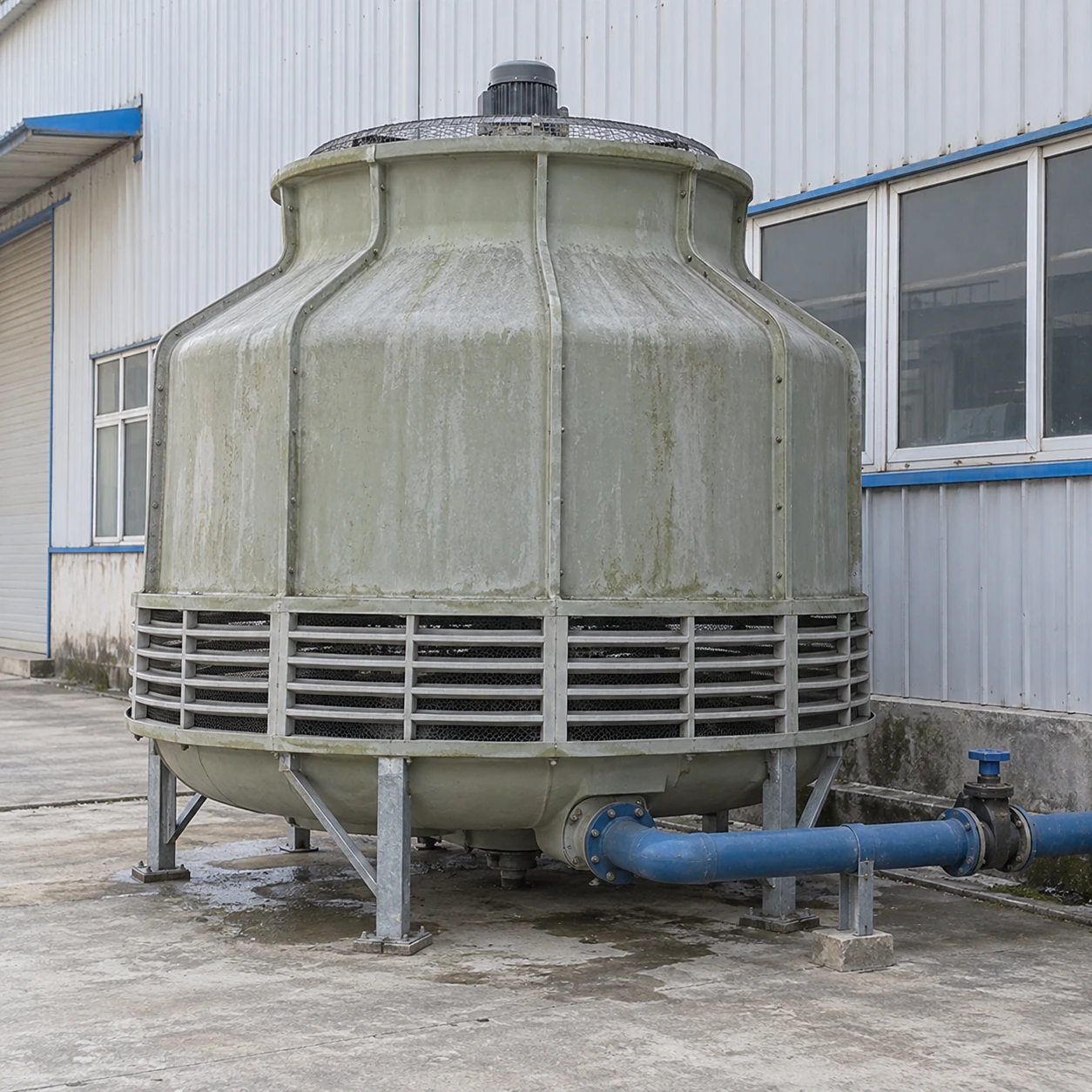
Cooling Towers
industrial cooling tower
| Brand | shengtongJH |
|---|---|
| Equipment format | Conventional single-cell FRP tower; additional cells only when required |
| Common flow selections | 30 / 50 / 100 m³/h at the specified process conditions |
| Thermal duty | Selected from return-water temperature, required supply temperature and site wet bulb |
| Tower size classes | Round: approx. Ø1,400 × 2,400 / Ø2,100 × 2,550 / Ø2,950 × 3,800 mm, diameter × height |
| Fan motor options | 0.55 / 1.1 / 2.2 kW; higher duty by selection |
| Construction | FRP enclosure and basin; galvanized or stainless frame |
| Process isolation | Direct tower-water circuit or separating heat exchanger |
| Electrical supply | 380–415 V, 3-phase, 50 Hz; destination options |
| Service connections | Water inlet/outlet, make-up, drain, overflow and sampling point |
| Options | Pump set, coarse strainer, temperature control and accessible treatment connections |
Process compatibility and thermal selection take priority over nominal tower size. Flow, motor and outer dimensions must be matched; foundation loads follow the selected unit.
The industrial tower and its pump, piping and control interfaces can be customized to the production process and factory layout.
An industrial cooling tower can provide practical heat rejection for machinery and factory utilities without an unnecessarily complicated installation. The useful starting point is the production process: its temperature tolerance, operating schedule and water quality.
Start with the machine's acceptable water temperature
Some equipment needs only moderate cooling to remove operating heat; other processes require tightly controlled chilled water. A cooling tower is appropriate only when its achievable supply temperature is compatible with the machine. Check peak-season conditions before replacing a refrigeration system with a tower for lower apparent running cost.
The required flow also comes from the process. Increasing pump output without checking machine pressure limits or tower distribution can create leakage or poor operation instead of improving production.
Factory utilities
Water-cooled compressors and heat exchangers can suit a conventional tower circuit where the equipment accepts the water conditions. Include fouling resistance and accessible strainers in selection.
Plastics processing
Hydraulic cooling and mould temperature control may have different temperature needs. Do not assume one common circuit should serve both without checking the machine requirements.
Intermittent production
Batch operation produces a different load pattern from continuous shifts. Storage volume and fan control can help manage cycling, but do not remove the need for adequate peak heat rejection.
Choose simplicity where it helps maintenance
For a modest factory, an accessible single-cell tower with ordinary service parts can be more practical than an elaborate arrangement that nobody can maintain. Keep the basin reachable, arrange a drain that can actually empty the system and leave a route for fan or fill replacement.
If cooling cannot stop for service, discuss a standby arrangement against the actual production consequence of downtime. Extra equipment adds valves, controls and maintenance duties; redundancy should solve a defined problem rather than merely make the installation look larger.
Keep the supply scope clear
A tower quotation does not automatically include pumps, a heat exchanger, treatment, foundations or site pipework. Identify these interfaces when asking shengtongJH to source equipment. Existing water temperatures during a full production shift, the piping route and any recurring blockage give a more useful basis for selection than a photograph alone.
Where relocation is a recurring need, consider the portable cooling tower arrangement rather than moving a fixed installation without suitable handling provisions.
The industrial tower and its pump, piping and control interfaces can be customized to the production process and factory layout.