Cooling Towers
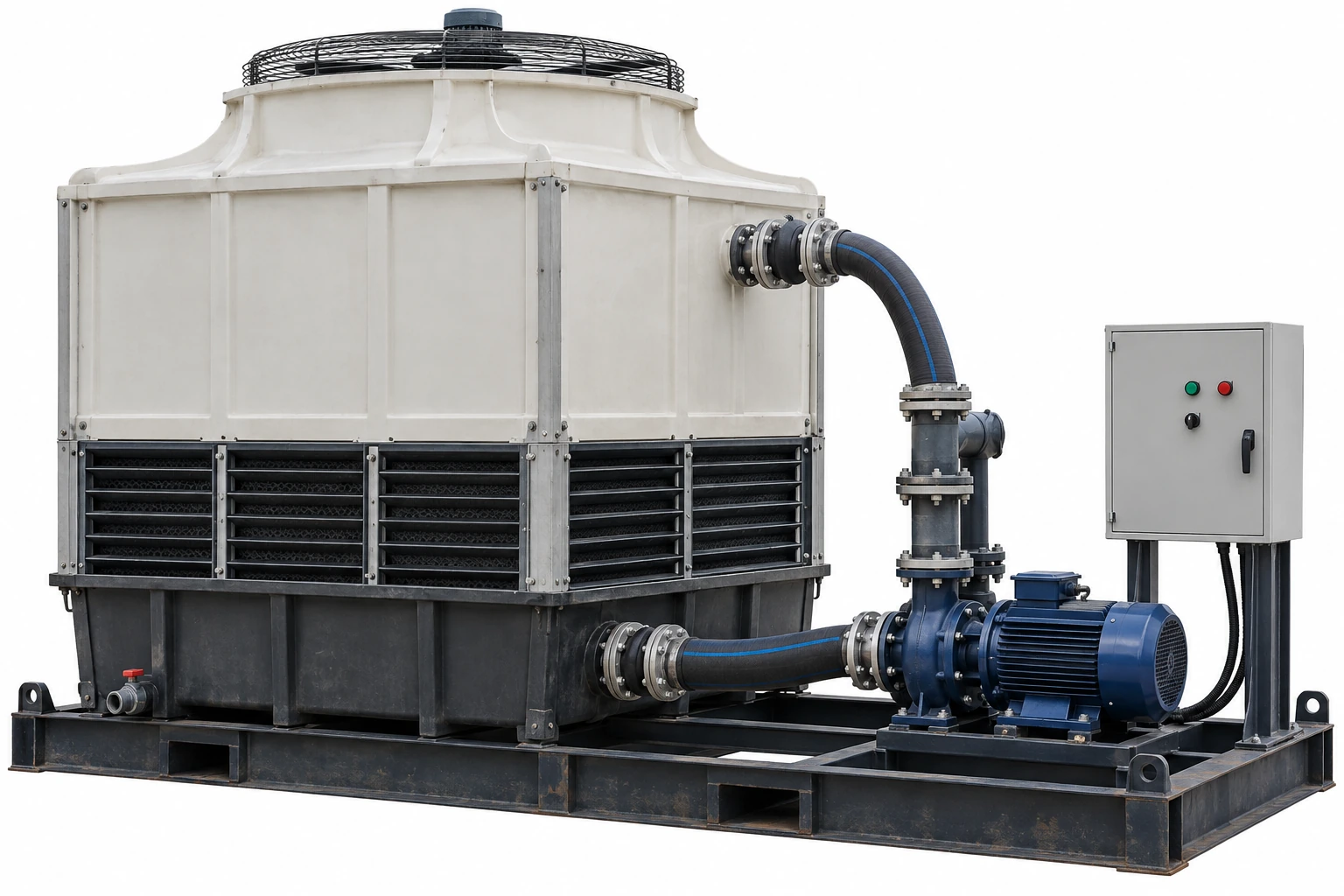
portable cooling tower
| Brand | shengtongJH |
|---|---|
| Package type | Small skid-mounted tower; separate pump skid when needed |
| Requested flow classes | 10 / 20 / 40 m³/h, thermally selected to site conditions |
| Handling | Forkliftable base or rated lifting points; move empty and isolated |
| Equipment arrangement | Tower and basin, circulation pump, isolation valves and control panel |
| Skid dimensions | W × D × H in mm set by tower, pump and transport envelope; compact or split package |
| Connections | Flanged or pressure-rated quick connections with supported hoses |
| Electrical supply | 380–415 V, 3-phase, 50 Hz; controls matched to destination |
| Pump duty | Flow and head selected for hose length, elevation and process pressure loss |
| Controls | Fan temperature control, low-water protection and pump interlock |
| Water services | Make-up supply, overflow, drain and treatment provision |
A portable package still needs a stable operating base and clear airflow. Confirm transport dimensions and empty lifting weight for the selected assembly before shipment.
The tower, pump, connections and transport arrangement can be customized for temporary industrial use and site access.
A portable cooling tower is a relocatable industrial package for temporary cooling, equipment trials or a planned changeover. Portability means a manageable transport and connection arrangement; it does not turn a water-cooling installation into a plug-in household appliance.
A temporary connection can become the weak point
Long hoses, tight bends and small couplings add pressure loss. A package that performs beside a test rig may deliver less water when placed across a factory yard. Choose the pump for the complete route, including the process equipment, rather than using the tower flow label as a pump specification.
Hoses also need mechanical support and protection from vehicles. Keep the return route, drains and electrical isolation accessible, so a leak or equipment change does not require unsafe work around operating machinery.
Planned maintenance
A temporary tower may support production while fixed equipment is serviced. Establish the minimum cooling duty and the changeover sequence before disconnecting the existing plant.
Trials and test equipment
Trial loads may fluctuate sharply. A buffer arrangement or suitable control sequence can help when the process produces intermittent heat rather than a steady load.
Relocation between work areas
Reusable connection points and clearly defined supply requirements simplify repeat installations. Each new position still needs an airflow, drainage and support review.
Separate sensitive process water
Open tower water picks up material from its surroundings. If the machine needs a closed clean-water circuit, use a suitable separating heat exchanger and dedicated process pump. Allow for the additional temperature difference; isolation protects the circuit but does not improve the tower's thermodynamic limit.
Specify what arrives with the package
List hoses, couplings, strainers, pump controls, make-up fittings and drain connections in the supply scope. Otherwise a complete-looking skid may arrive without the small interfaces needed to run it. For remote locations, also consider available electrical supply and access to replacement consumables.
Before moving the unit, isolate power, drain water and follow the lifting arrangement for the actual assembly. A small package can still be too heavy for manual movement. shengtongJH can coordinate a conventional tower-and-pump selection around the temporary duty without representing it as a trailer rental service or promising immediate availability.
The tower, pump, connections and transport arrangement can be customized for temporary industrial use and site access.