Cooling Towers
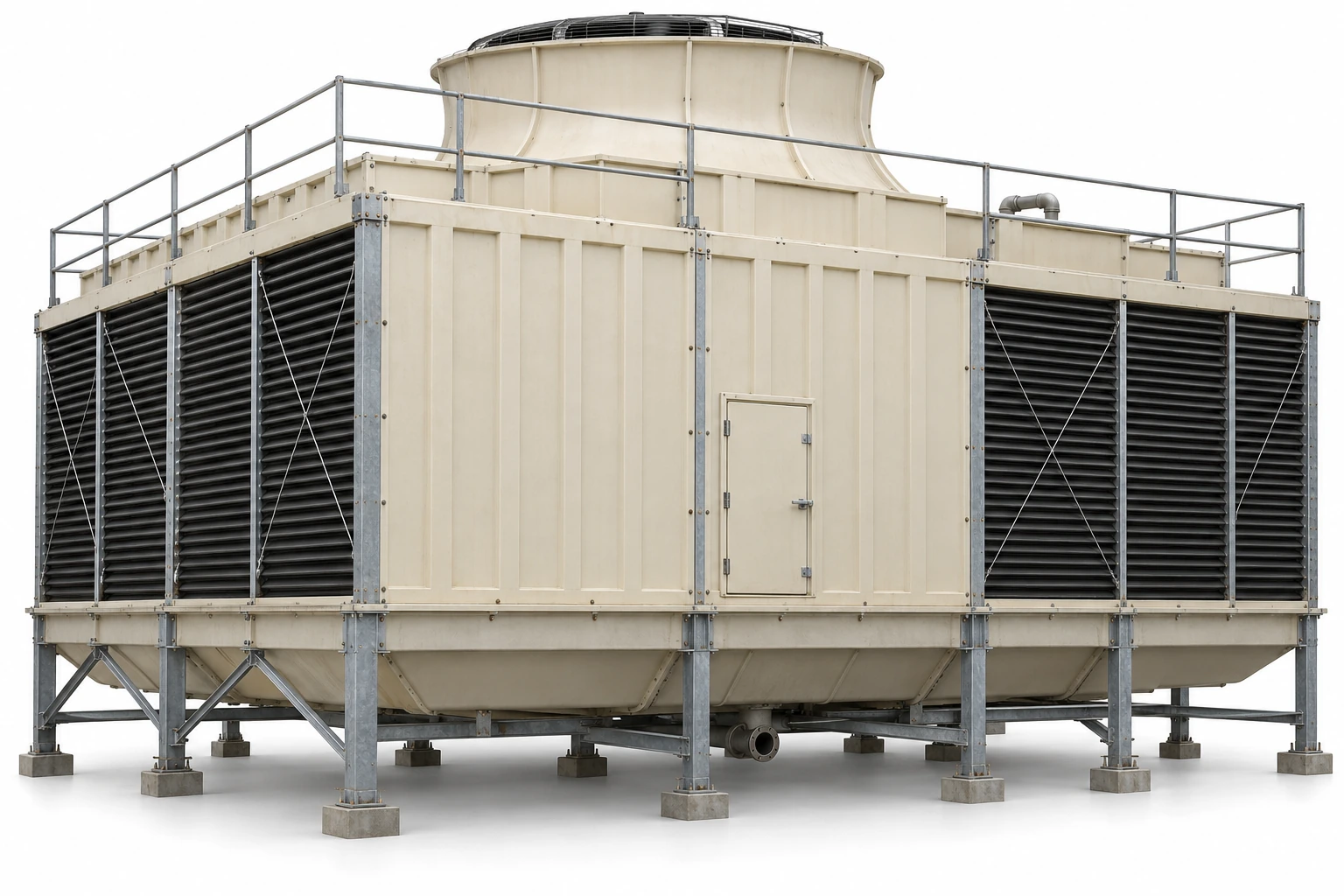
cross flow cooling tower
| Brand | shengtongJH |
|---|---|
| Flow arrangement | Open-circuit crossflow; induced-draft axial fan |
| Water distribution | Gravity-fed upper distribution basin and metering nozzles |
| Cell size classes | Approx. 3,300 × 1,800 × 3,500 / 3,300 × 2,000 × 3,700 / 4,100 × 2,600 × 4,100 mm, W × D × H |
| Fan motor options | 1.5 / 2.2 / 4 / 5.5 kW, selected with airflow duty |
| Fill options | Film fill for suitable water; wider passages or splash fill for higher fouling risk |
| Enclosure | FRP panels with galvanized structure; stainless steel options |
| Power | 380–415 V, 3-phase, 50 Hz; VFD option |
| Water connections | Flanged inlet and outlet; separate make-up, drain and overflow |
| Access | Distribution deck, basin access and fan maintenance provision |
| Selection inputs | Circulating flow, hot/cold water temperatures and entering-air wet bulb |
Cell sizes and fan outputs describe selectable equipment classes. Required thermal duty and water quality determine the matched configuration and minimum operating flow.
The crossflow tower can be customized for available space, water quality, connection positions and maintenance access.
A cross flow cooling tower moves air sideways through falling water. Its open distribution deck and accessible internal arrangement can suit facilities that want straightforward inspection, provided the layout leaves enough room for the side air inlets.
Why the distribution deck matters
Water entering the upper basin is divided across the fill through openings or nozzles. Even distribution makes the heat-transfer surface useful. Blocked openings leave some areas dry while other areas carry excess water, so the condition of the deck matters as much as the condition of the fan.
Accessible distribution can make inspection easier during scheduled service. The chosen deck arrangement should still protect operators and allow cleaning without improvised access over the tower.
Allow the side inlets to breathe
The broad sides are working air inlets, not spare faces that can be placed against a wall. Compare the footprint together with inlet clearance, neighboring equipment and the route for removing fill packs. A tower that fits the foundation may still be unsuitable for a tightly enclosed yard.
Variable water flow needs the right distribution
Reducing pump flow can change the depth of water in the distribution basin. Below the permitted range, some openings may no longer distribute evenly. Select nozzles and a cell operating sequence for the real minimum flow instead of assuming that a variable-speed pump can run at any setting.
Fan speed can then respond to leaving-water temperature within the equipment limits. Where more than one cell is selected, bringing cells in and out of service must keep both water distribution and basin levels under control.
Match fill to the maintenance burden
Closely spaced film fill provides a large wetted area, but contaminated circulating water can obstruct it. A more open fill arrangement may be preferable where solids cannot be adequately controlled. This changes the thermal selection; substituting fill later is not simply a like-for-like repair.
For an enquiry, identify the water source, expected dirt, operating hours and available clearance on both inlet sides. Include any restriction on fan replacement access. These details allow shengtongJH to compare ordinary equipment options on practical serviceability rather than treating crossflow as automatically superior to every other tower type.
For a broader selection, compare the general cooling tower options using the same flow and temperature conditions.
The crossflow tower can be customized for available space, water quality, connection positions and maintenance access.