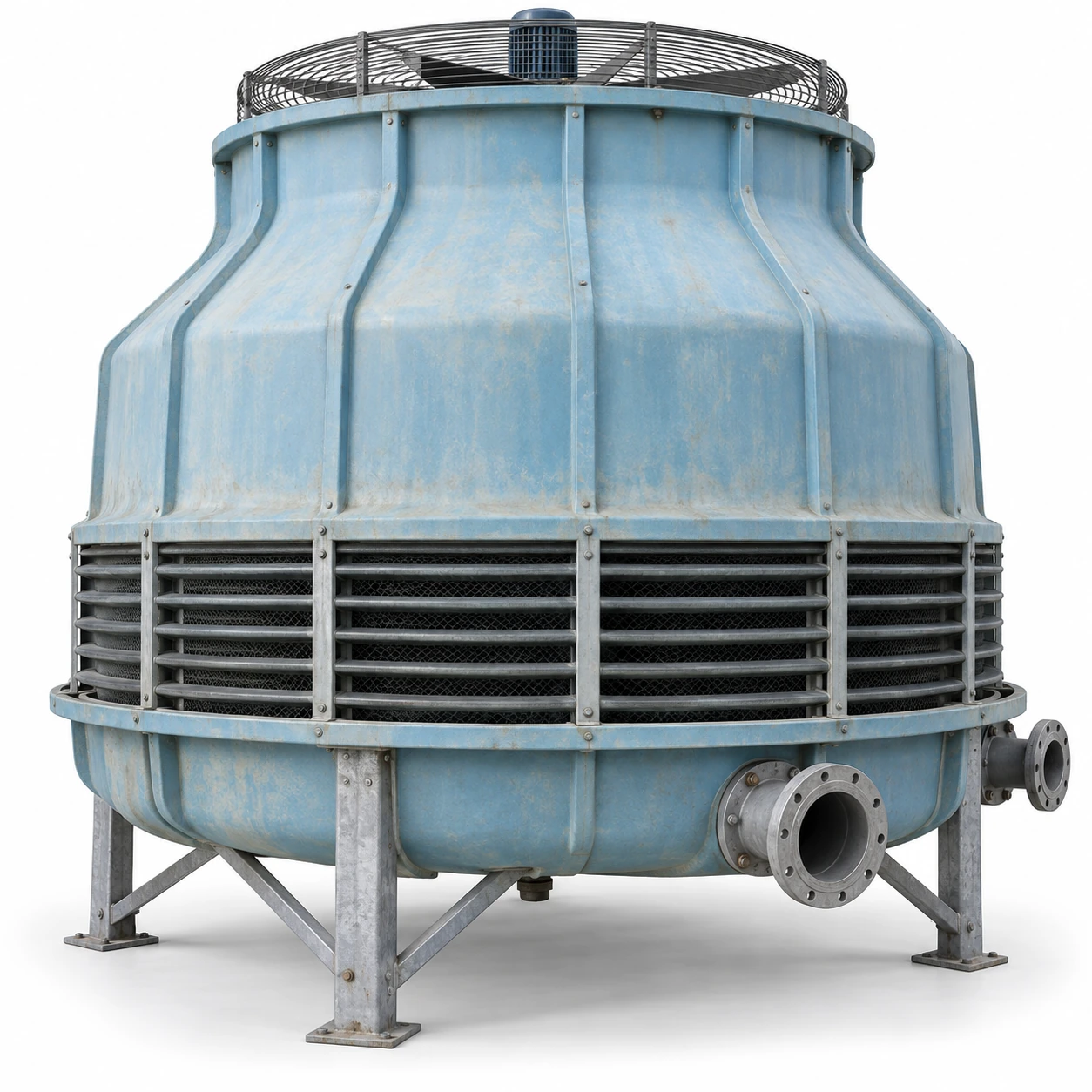
Cooling Towers
cooling tower
| Brand | shengtongJH |
|---|---|
| Equipment | Open-circuit, induced-draft industrial cooling tower |
| Construction | FRP casing and basin; galvanized steel or stainless steel support |
| Water-flow selection | 25 / 50 / 100 m³/h duty points; thermal selection at specified water and air conditions |
| Water temperatures | Common selection duty: 37°C inlet / 32°C outlet at 28°C entering-air wet bulb |
| Round tower size classes | Approx. Ø1,400 × 2,400 / Ø1,800 × 2,500 / Ø2,500 × 3,100 mm, diameter × height |
| Fan motor options | 0.55 / 1.1 / 2.2 kW; matched to selected tower |
| Electrical supply | 380–415 V, 3-phase, 50 Hz; destination supply options |
| Included tower components | Fill, water distributor, basin, fan assembly and drift eliminator |
| System options | Circulation pump, strainer, level control, VFD and treatment connections |
Dimensions are equipment size classes, not installation clearances. Flow, motor and dimensions form a matched selection; the options are not interchangeable ratings for one model.
Tower construction, capacity, connections and controls can be customized to the application and installation site.
A cooling tower releases unwanted heat from a circulating water system so production equipment or a condenser can keep operating within its temperature limits. shengtongJH coordinates industrial equipment selection around the water circuit, site conditions and installation requirements.
Selection starts with the circuit
Keep the process temperature stable
A larger fan alone will not correct every cooling problem. Start with the heat entering the water, the required leaving temperature and the summer wet-bulb condition. A tower can cool below outdoor dry-bulb temperature through evaporation, but its leaving water remains above the entering-air wet-bulb temperature in normal operation.
The gap between those temperatures is the approach. Asking for a smaller approach generally requires more heat-transfer capability. A tower selected for a mild climate may therefore disappoint at a humid factory site even when its advertised water flow appears sufficient.
Choose the water boundary
An open tower is a practical choice when the circulating water can be exposed to air and managed accordingly. Sensitive machine passages may benefit from a heat exchanger separating the process circuit from tower water. Account for the exchanger temperature difference and pressure loss rather than treating it as a free addition.
Leave room for the tower to work
A narrow equipment yard can restrict incoming air or draw warm discharge back into the inlet. Keep neighboring walls, pipe bridges and other towers in the layout review. Access to the basin, fan and fill also determines how readily the equipment can be cleaned and repaired.
Buy the interfaces with the equipment
The pump must serve the actual piping route and required distributor pressure; connection diameter alone does not establish pump head. Agree who supplies the strainer, make-up line, overflow, drain and control interlocks. Wet operating weight and support reactions belong in the foundation review before installation.
For procurement, provide the heat source, water-flow range, inlet and outlet temperatures, location and available footprint. Include existing equipment drawings when replacing a tower. For operational water quality, review the associated cooling tower water treatment configuration alongside the mechanical selection.
Tower construction, capacity, connections and controls can be customized to the application and installation site.