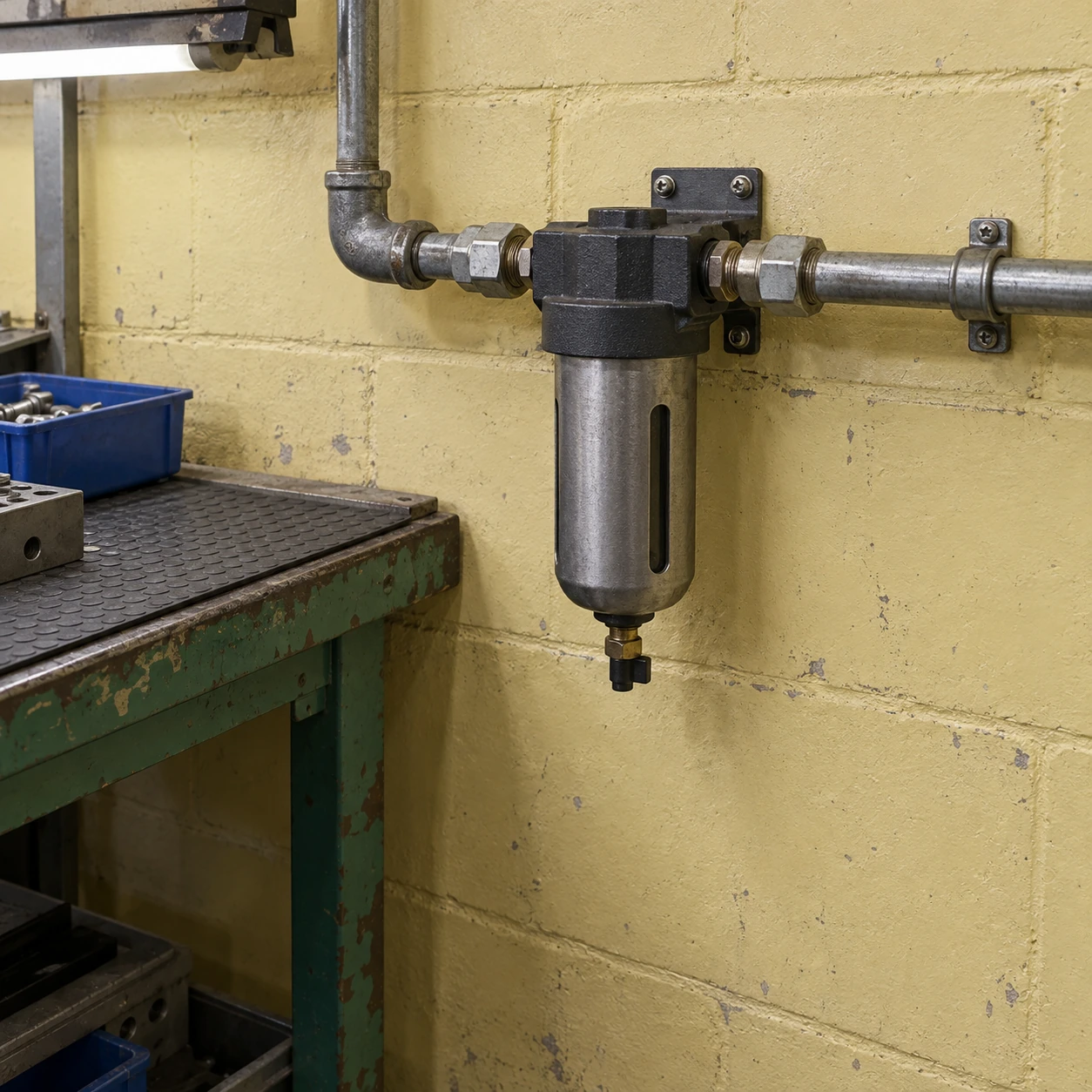
Compressed Air Filters
inline compressed air filter
| Nominal pipe connections | 1/4, 3/8, 1/2, 3/4 and 1 in threaded options |
|---|---|
| Compact external sizes | 89 × 191; 114 × 292; 114 × 343 mm, width × height for selected housing and drain combinations |
| Thread choice | BSP or NPT; adapters selected for the actual mating connection |
| Mounting | Wall bracket, machine service panel or supported pipe installation |
| Element duty | General particulate removal or coalescing aerosol removal |
| Working orientation | Vertical drain bowl for liquid-removal configurations |
| Body and drain | Coated metal housing; manual, float or compatible electronic drain |
| Pressure and capacity | Matched to the assembly rating and peak flow at minimum working pressure |
Dimensions describe the filter body assembly, not the space needed to withdraw the bowl or fit unions. The installation drawing defines those additional clearances.
The inline filter, bracket, ports and drainage arrangement can be customized for your machine and service space.
An inline compressed air filter fits directly into the supply path to a machine or branch. Its value is local protection: it can intercept contamination introduced by the distribution pipework after central treatment, provided the filter is fitted where it can drain and be serviced.
A useful final barrier after distribution
A well-treated compressor outlet does not prevent an older steel branch from shedding rust. A local filter near an instrument panel or assembly machine can catch solids from that last section of pipe. Keep the downstream connection suitably clean and short where practical; a dirty hose added after the filter can undo the benefit.
The chosen element should match the machine requirement. A general-purpose particle filter may be sufficient for one pneumatic device, while a process nozzle needs finer aerosol control. An inline filter is not inherently a regulator, dryer or lubricator, even when these functions share a mounting rail.
Fit the air path, not only the thread
A matching port does not establish enough capacity. Small adapters, restrictive quick couplings and long flexible hoses can dominate the pressure loss around an otherwise adequate filter. Review the complete branch while the machine is consuming air, especially where several actuators operate together.
Use the filter's indicated direction of flow. For coalescing units, the internal element and drainage path are designed for a particular direction; reversing the housing is not a harmless way to simplify the pipe run.
Three installation decisions that prevent awkward maintenance
Place the bowl above clear space
Allow the full removal path, including the drain. A filter directly over a fixed bench may fit on day one but require pipework dismantling at every element change.
Use proper support and isolation
A wall bracket or service panel should carry the assembly. Provide the specified isolation and depressurisation arrangement, and avoid transferring hose pull or machine vibration into the head.
Route the discharge deliberately
Condensate belongs in a suitable collection system. A drain line hidden behind a machine is hard to inspect, and a blocked line can let captured liquid build up in the bowl.
When a local filter cannot solve the fault
If water appears only after a long cold pipe run, moisture may be condensing from water vapour that passed through the filter. The upstream drying duty and local temperature need attention. If oil odour persists, investigate vapour treatment rather than repeatedly installing finer coalescing elements.
Read the differential pressure at a meaningful operating flow and keep to the selected element's service interval. An idle gauge reading alone cannot show remaining useful capacity, and a pressure indication cannot establish every aspect of air purity.
For a single branch, start with the machine's required air quality, peak consumption and available service space. For connected treatment stages, review a complete compressed air filter system so that local protection complements the central equipment.
The inline filter, bracket, ports and drainage arrangement can be customized for your machine and service space.