Compressed Air Filters
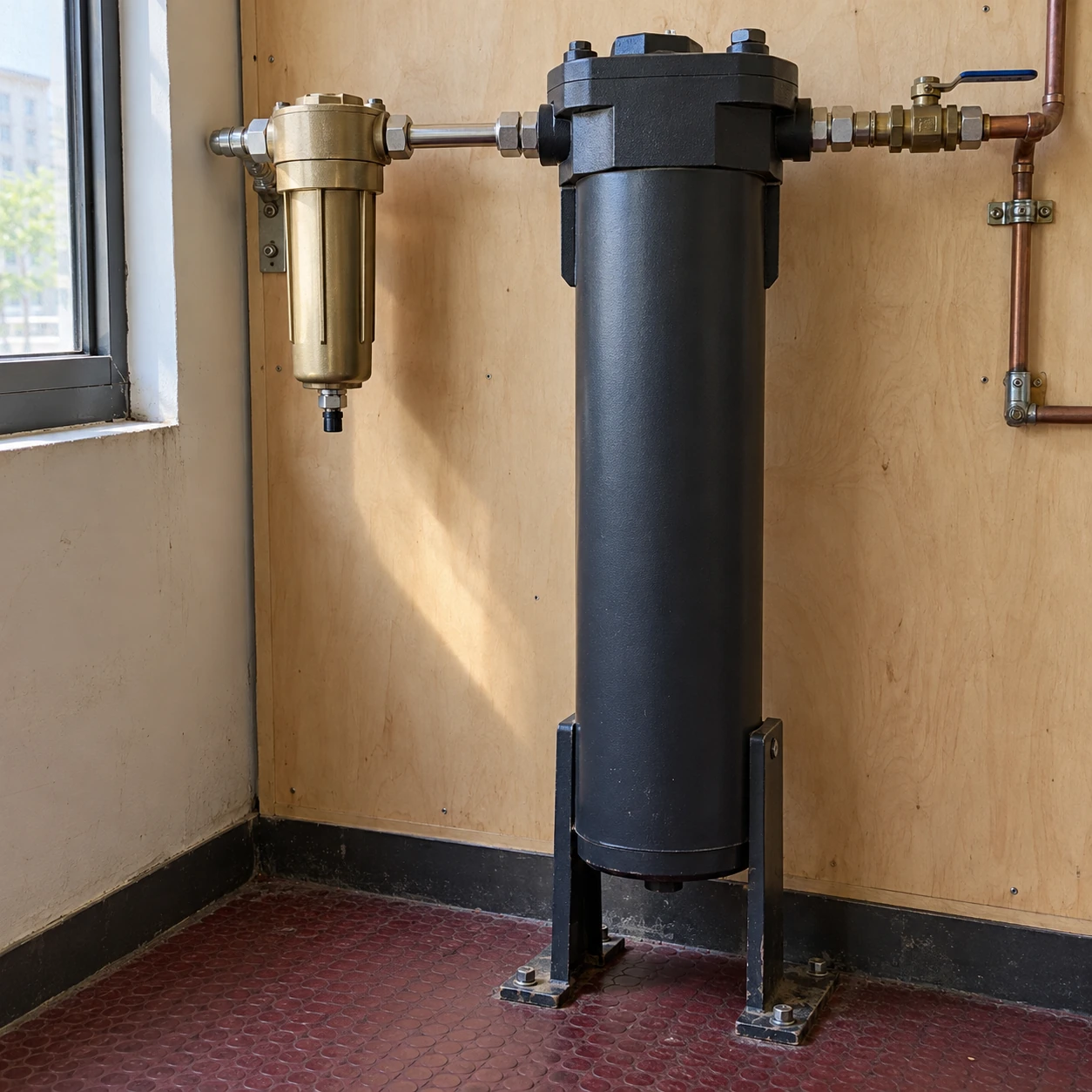
activated carbon compressed air filter
| Adsorbent arrangement | Replaceable carbon element or larger filled adsorption vessel |
|---|---|
| Threaded line sizes | 3/8, 1/2, 3/4, 1, 1½, 2 and 3 in nominal connections, depending on housing family |
| Higher-capacity connections | Flanged vessel configurations selected separately for the air demand |
| Housing options | Coated aluminium for compact cartridges; coated steel or stainless vessel arrangements |
| Required inlet conditioning | Effective liquid separation, coalescing prefiltration and drying matched to the chosen adsorbent |
| Outlet arrangement | Particulate afterfilter where required to retain carbon fines |
| Operating limits | Flow, temperature, inlet oil loading and humidity defined for the selected carbon assembly |
| Service provision | Cartridge withdrawal or vessel media-change access; oil-vapour monitoring provision as required |
Connection sizes are nominal pipe sizes. Vessel dimensions and carbon capacity depend on the selected duty; a larger port alone does not establish adsorption capacity or service life.
Carbon capacity, housing arrangement, connections and monitoring provisions can be customized to your inlet conditions and outlet oil requirement.
An activated carbon compressed air filter uses an adsorbent to reduce oil vapour carried in the air stream. It belongs after suitable conditioning of the incoming air. Its capacity is finite, so both inlet conditions and a replacement plan matter as much as the initial outlet result.
Oil vapour needs a different removal mechanism
A coalescer brings liquid droplets together so they can drain out. Oil vapour remains in the gas phase and needs a suitable adsorption medium. Activated carbon provides a large internal surface on which hydrocarbons can be retained until the available capacity is consumed. This is why adding a carbon stage addresses a different problem from fitting another coalescing element.
The selection should state the oil component being controlled and the required measurement method. Total oil includes more than vapour alone. A low reported oil-aerosol concentration upstream does not prove that the final total-oil requirement has been met.
Protect the carbon before asking it to work
Liquid water and excessive oil aerosol loading shorten useful adsorption life. Place appropriate liquid separation and coalescing treatment ahead of the carbon, and provide drying compatible with the chosen unit's humidity limit. The needed drying arrangement depends on air temperature, pressure and operating variation.
For an existing line, investigate what happens at startup and during the warmest part of the operating day. A stable average reading can hide a short period of high inlet loading that consumes much of the carbon capacity.
Choose cartridge or vessel around the duty
A compact carbon element suits some modest, controlled demands where replacement access is simple. A larger carbon bed can provide more adsorbent capacity for sustained service, but needs space and a defined media-change method. Compare the specified working conditions and adsorption capacity, rather than assuming a taller cylinder always lasts longer.
Flow rate influences contact with the adsorbent. Keep the selected assembly within its approved operating range, including any minimum or maximum flow requirement. Distribution through a bed matters as well as the amount of carbon it contains.
Finish the treatment path
Where the carbon arrangement can release fines, fit the specified downstream particulate filter. Keep replacement media, seals and downstream pipework clean during service. The complete assembly must be isolated and depressurised before it is opened, using the equipment instructions and site procedures.
For coating and other oil-sensitive industrial processes, define the air quality at the point of use and evaluate the entire route after treatment. The presence of carbon does not establish breathing-air quality, sterility or suitability for direct food or pharmaceutical contact; those uses need their own documented requirements and validation.
shengtongJH can coordinate the adsorption unit with the surrounding filter system. Useful selection information includes normal and peak demand, air temperature, pressure, upstream drying, inlet oil loading and the required outlet measurement.
Carbon capacity, housing arrangement, connections and monitoring provisions can be customized to your inlet conditions and outlet oil requirement.