Cleanroom Trolleys & Storage Racks
heavy duty stainless steel shelving
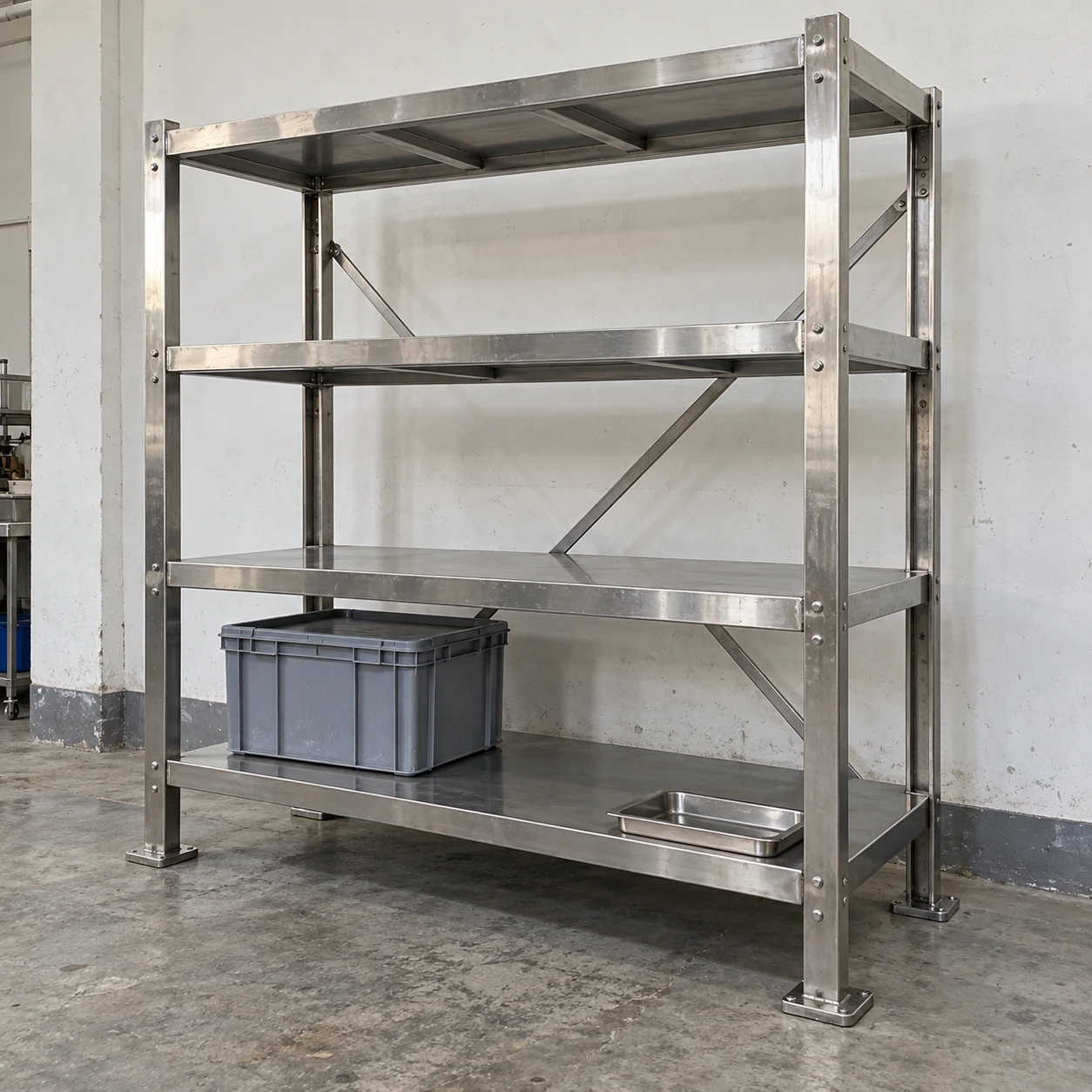
| External W × D × H | 900 × 600 × 1800; 1200 × 600 × 1800; 1500 × 600 × 1800 mm |
|---|---|
| Deck and supports | Solid sheet with folded reinforcement, cross-members or designed local support |
| Shelf arrangement | Four or five levels; support spacing coordinated with the load |
| Frame material | 304 stainless steel; 316 selected for corrosion exposure |
| Shelf load basis | Uniformly distributed load; point or line loads specified separately |
| Complete-bay rating | Assigned to the assembled frame, connections, base and installation |
| Base and restraint | Stationary feet or baseplates; floor or wall restraint where required |
| Movement | Separate mobile specification with matched frame and caster ratings |
Dimensions are the nominal external rack size on a stationary base. Capacity and usable deck space are confirmed for the chosen structure; changing width, shelf positions or wheels requires review.
Bay dimensions, reinforcement, shelf spacing and restraint arrangements can be customized around the stored load and installation conditions.
Heavy duty stainless steel shelving is selected around the load path from the stored item to the floor. Reinforced decks, supporting beams, connections and uprights work together. A thicker-looking shelf or a stronger material description alone cannot establish the capacity of the complete bay.
Follow the load from the contact patch to the floor
A heavy box with a flat base spreads its weight differently from a machine component standing on two narrow feet. Both may have the same mass, yet the second can bend a small part of the deck before the whole shelf approaches its distributed-load limit. Start with the contact shape and position, then select the supporting structure beneath it.
Deck and stiffeners
The deck supports the immediate contact area. Folded edges and under-shelf members help transfer that force, but their position must suit the item. A tray or spreader plate is useful only when it is designed to carry the load to adequate supports.
Beams and joints
Longitudinal beams carry force toward the frame. Increasing the unsupported span changes their bending and deflection. Connector engagement, weld detail or bolted brackets must suit the same load rather than being treated as incidental fittings.
Uprights and base
Posts carry the combined load from multiple levels. Bracing controls movement of the assembly, while the feet transmit force into the floor. These parts set limits that cannot be found by adding together the advertised capacities of individual shelves.
Shorter bays can be the more practical heavy-load choice
A longer shelf gives an uninterrupted opening for wide items. It also increases the distance the structure must bridge unless an intermediate support is added. For batches of dense components in small containers, several shorter bays may provide a more efficient supporting arrangement than one long span.
An intermediate post or support can reduce the clear opening, so check how the item is inserted and removed. Reinforcement that prevents a lifting trolley from entering beneath a load can make a technically strong rack difficult to use.
Compare like-for-like ratings
A quotation should identify the allowed load on each level and on the complete bay, together with the load distribution, shelf positions and stationary or mobile condition. A uniformly distributed load means weight spread over the supported surface; it is not permission to place the entire allowance at the centre or front edge.
Material grade is a separate decision. More corrosion-resistant stainless steel does not automatically increase the allowable load of a rack with the same geometry. Compare the actual structure and documented capacity.
Installation controls sway, access and impact
A rack can sit unevenly on a sloping or damaged floor even when all its parts are correctly assembled. Follow the selected system's installation instructions for leveling, base bearing and required restraints. Floor or wall fixings must be compatible with the supporting construction; an arbitrary attachment to a light partition does not establish stability.
Keep dense stock on suitably accessible lower levels and maintain the approved loading pattern. In a trolley or forklift route, arrange handling space and suitable impact protection. This shelving is for the specified storage method; it should not be treated as pallet racking or as a lifting fixture unless it has been designed for that duty.
If movement is required, define the route and the loaded travel condition before choosing casters. Threshold impact, wheel loading and the rack's centre of gravity affect a mobile assembly. Wheel brakes hold position but do not increase the frame's capacity.
What to check when loads change
Moving a shelf, substituting a heavy metal bin for a light plastic container or storing parts on a smaller footprint changes the original assumptions. Review those changes before loading. Do not compensate for a bent deck by adding an unapproved support underneath it.
During routine use, look for permanent sag, loose connections, cracked welds, displaced bracing or damaged feet. Isolate a damaged bay from use until it has been assessed. Cleaning and corrosion inspection matter because hidden deterioration can affect the same joints that carry the load.
Build the quotation around the heaviest normal item
Send its mass, footprint, contact points and intended shelf position, plus the total contents of a loaded bay. Include handling equipment and floor details. shengtongJH uses this information to coordinate a suitable supply specification and the supporting load documentation.
For bulky items stored close to the floor, a stainless steel dunnage rack may suit the handling task better. Use the quotation enquiry to compare the required storage arrangements.
Bay dimensions, reinforcement, shelf spacing and restraint arrangements can be customized around the stored load and installation conditions.