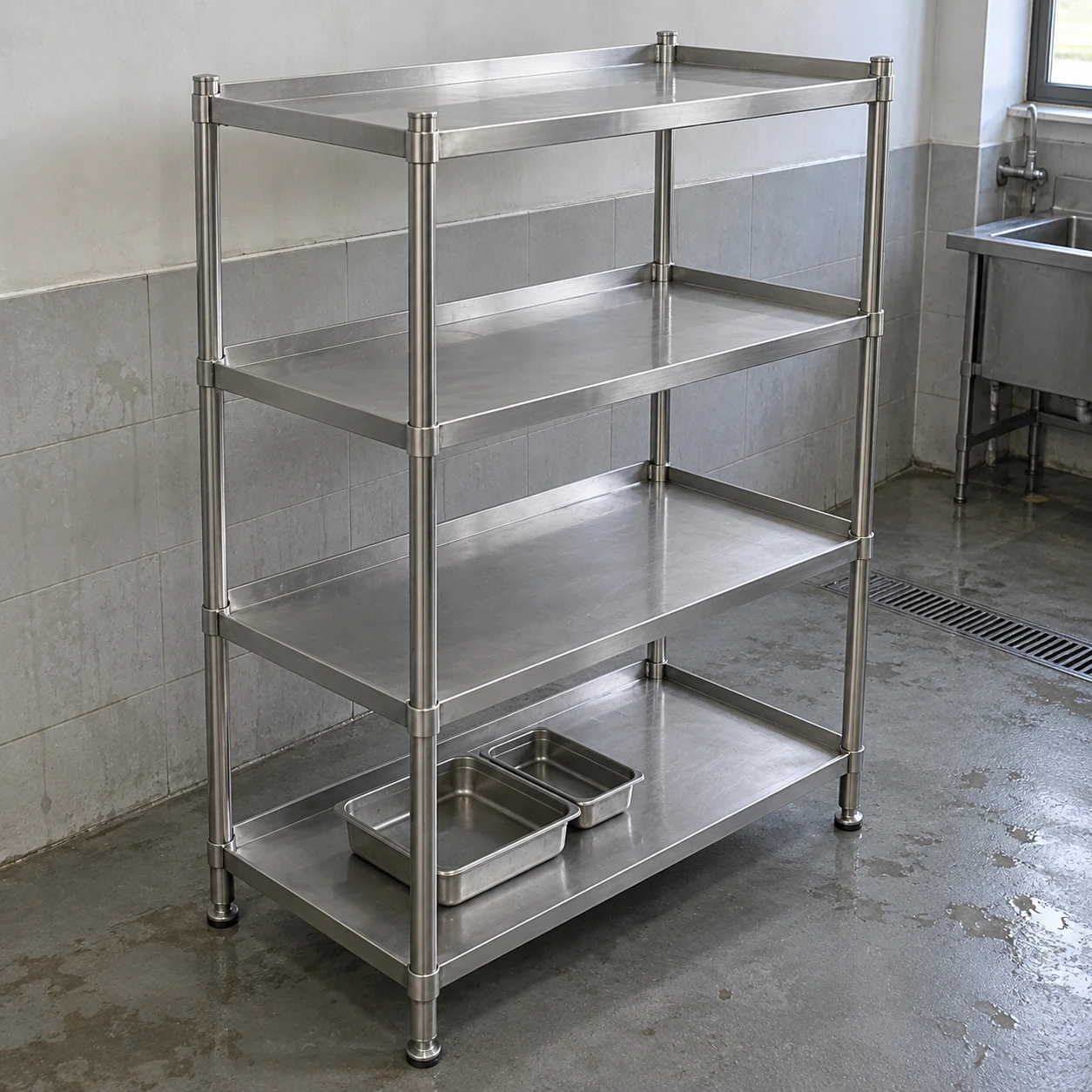
Cleanroom Trolleys & Storage Racks
316 stainless steel shelving
| External W × D × H | 900 × 450 × 1800 or 1200 × 600 × 1800 mm; other sizes to suit the installation |
|---|---|
| Shelf material | 316 stainless steel; 316L available as a specified fabrication requirement |
| Frame and hardware | Material grade listed separately for posts, supports, fasteners and feet |
| Shelf arrangement | Four or five levels; solid or perforated decks |
| Edge detail | Flat access edge, rear stop or shallow raised edges |
| Surface | Smooth mill or brushed finish; weld cleaning and finishing specified with the order |
| Base | Adjustable stationary feet; mobile option assessed for the wash and travel conditions |
| Load specification | Selected shelf and bay ratings; material grade alone is not a capacity rating |
| Documentation | Material identification and traceability requirements agreed before procurement |
W × D × H describes the external rack envelope on feet, not usable shelf area. Final protrusions, clear openings and component grades are recorded in the agreed configuration.
The shelf layout, component material schedule, surface finish and dimensions can be customized to suit the exposure, cleaning routine and stored items.
316 stainless steel shelving is a material choice for storage exposed to more demanding moisture, salts or process residues. Its value depends on the complete material specification and the way the rack is cleaned. A 316 shelf on an unspecified frame can leave important parts of the installation outside the intended corrosion resistance.
Choose the grade for what reaches the surface
316 contains molybdenum, which improves resistance to chloride-related localized corrosion compared with ordinary 304. It can be worth considering around salty residues, repeated wet cleaning or demanding process support duties. The relevant question is what remains on the metal between cleaning cycles.
Wet deposits can concentrate as water evaporates. Material trapped under a container or inside a tight joint may stay in contact with the surface much longer than an occasional splash. Temperature, chemical concentration and contact time therefore matter as much as the broad name of the industry.
Where the limits still matter
316 is not immune to corrosion and is not compatible with every acid, disinfectant or industrial chemical. Provide the actual exposure and cleaning chemistry when specifying the rack. For a dry, regularly cleaned store, general stainless steel shelving may provide an appropriate configuration without upgrading every component.
The grade also does not establish food-contact approval, sterilization suitability or a load rating. Those requirements need their own product evidence and operating conditions.
Define the material of the complete assembly
The shelf surface is only one part of the rack. A purchase description should make it clear whether 316 applies to the deck alone or to a wider set of exposed components. Mixed-grade construction can be a deliberate cost decision, but it should be visible in the specification.
Decks and supports
Identify the sheet material and the under-shelf members separately. Specify the welded assembly and its finishing requirements where wet residues can collect around the support joints.
Posts and connections
Include uprights, connectors, bolts and washers. These are often less visible during a quotation review but remain exposed when the rack is washed or splashed.
Feet and moving parts
Check the leveling screw and foot assembly. If wheels are required, identify the bracket, axle and wheel material as well as compatibility with the cleaning environment.
For welded fabrication, 316L offers a lower-carbon option intended to improve resistance to intergranular corrosion after welding. It still needs appropriate fabrication and surface treatment; choosing the suffix does not remove those requirements.
Remove places where water and residue remain
A shallow raised edge can keep small items from sliding off, yet it may also retain wash water. Match the edge arrangement to the cleaning method and provide access to remove residues. Where drainage through a deck is useful, consider perforated construction alongside the support needed for the stored containers.
Smooth, accessible joints are easier to clean than narrow overlaps and inaccessible recesses. Leave working access around the rack and avoid packing stock tightly against surfaces that must dry. A brushed finish is a surface appearance; it is not a guarantee of a particular roughness or hygienic performance.
Keep the cleaning method compatible
Use the chemical supplier's instructions and the selected equipment's material guidance. Do not leave chloride-rich cleaner or bleach residue on the surface. Use suitable noncontaminating cleaning tools, remove residues and allow the assembly to dry where the process permits. A recurring stain should prompt examination of its source rather than progressively harsher scrubbing.
Buy a documented material specification
Surface colour and shine cannot distinguish 304 from 316. Agree the required material records and how they connect to the supplied components before ordering. Where material verification is part of your quality system, include its scope in the procurement requirement rather than relying on a generic product label.
Also define the stored load, container size and cleaning access. Corrosion resistance protects a different aspect of service life from structural capacity; both must suit the duty.
Coordinate the order around the exposure
shengtongJH can coordinate the requested material schedule, rack layout and supply documentation. Send the cleaning agents, wet-contact conditions, largest container and required capacity through the quotation enquiry. This helps identify where the higher alloy is needed and where construction details deserve more attention.
The shelf layout, component material schedule, surface finish and dimensions can be customized to suit the exposure, cleaning routine and stored items.