Cleanroom Tables, Benches & Stools
Cleanroom Step Stools
| Single-step L × W × H (mm) | 600 × 300 × 200 |
|---|---|
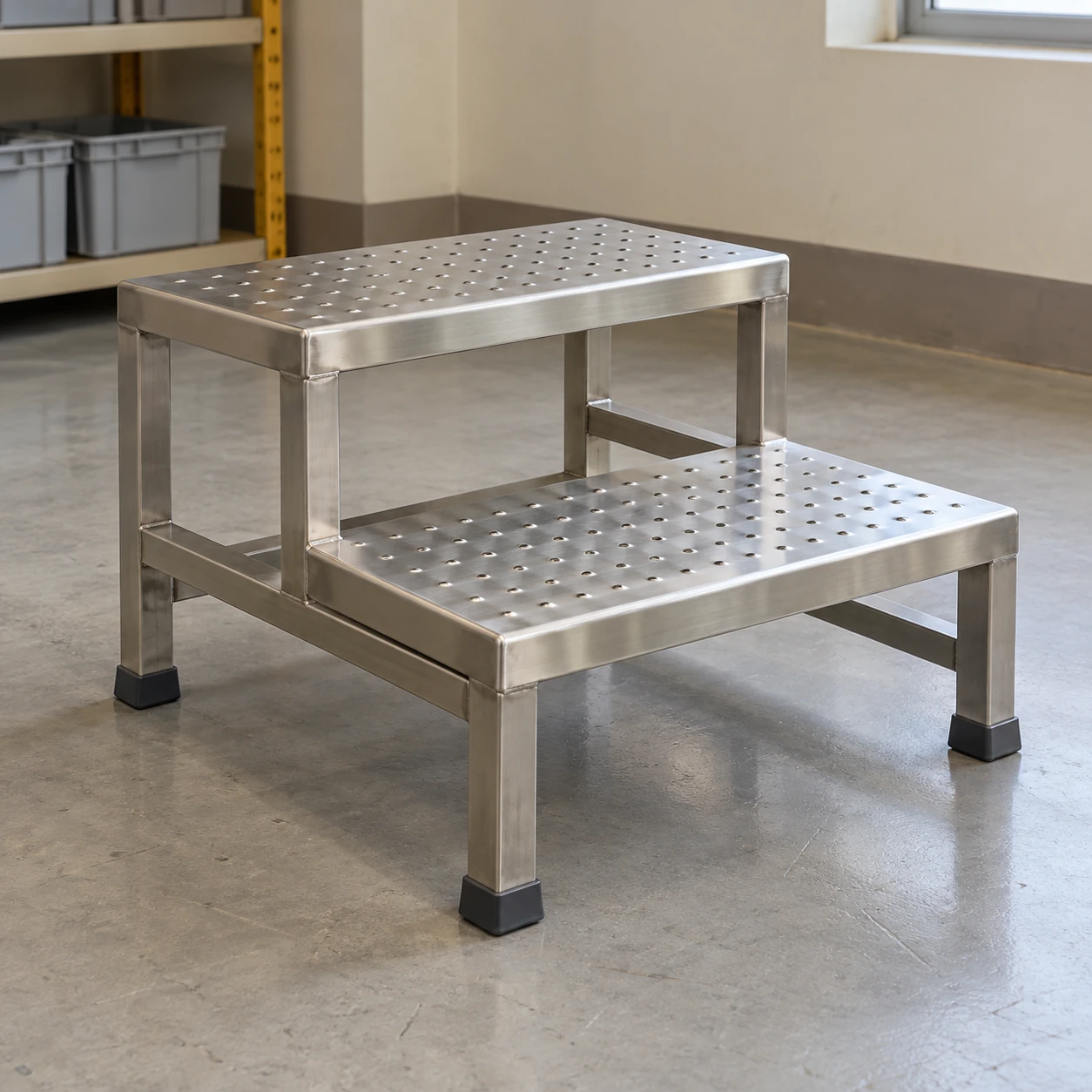
| Two-step W × D × H (mm) | 610 × 610 × 356; 610 × 610 × 508 |
| Frame and finish | Welded 304 stainless steel; brushed or electropolished finish |
| Tread options | Perforated or textured metal; slip resistance selected for footwear and cleaning conditions |
| Floor contact | Leveling feet with compatible pads; retractable-caster configuration available for selection |
| Hand support | Handrail arrangement selected with the rise, access direction and task |
| Rated load | Declared for the complete unit, including the user and carried items |
Dimensions describe the unit envelope. L × W identifies the single-step footprint; W × D identifies the two-step footprint. Inch-derived sizes are rounded to millimetres. Confirm the top standing level, any handrail height and the selected foot mechanism on the approved drawing.
Cleanroom step stools can be customized in footprint, step arrangement, tread finish and hand support to suit your access task and cleaning requirements.
Cleanroom step stools provide a compact raised standing position for brief access to shelves, inspection points and equipment controls. A suitable stool combines a usable tread, stable floor contact and surfaces that fit the room's cleaning routine. Choose the height and support arrangement around the actual task and footwear.
A short lift for a defined task
Small height differences can make a shelf or inspection point difficult to reach from the floor. A compact step stool brings the standing position closer to the work, provided the person can remain centred on its usable surface. Identify where the hands need to be and what must be handled before selecting the number of steps.
A light visual check differs from lifting a bulky container or applying force to a machine fitting. If the task requires leaning sideways, prolonged work or moving onto another elevated surface, assess a purpose-designed platform instead. The existing Stainless Steel Access Steps range addresses larger access arrangements. A seating stool is a different product and should not be used as an improvised step.
Read the standing level and envelope separately
- Top standing level
- The height of the approved standing surface establishes the lift available to the user. A dimension measured to the top of a handrail does not describe that lift.
- Footprint on the floor
- Allow for the full support base, including feet and any caster mechanism. A tread that fits beside a machine does not prove that the base fits there or that nearby doors can open.
- Clear tread area
- Check the area available to the actual shoes or cleanroom overshoes. Rails, edges and adjacent structure can reduce usable space even when the overall stool width appears adequate.
Use the access direction on the layout as well as the dimensions. The stool needs a clear approach and a place to stand after descending; it should not force the user into a busy aisle or an opening door.
Choose how it moves and how it stops
Fixed feet for a regular position
A fixed-foot stool has a simple support arrangement for a station where movement is occasional. Select foot pads for the floor finish, cleaning agents and contamination controls. Levelers can accommodate the adjustment permitted by the design; they do not make a stool suitable for an unstable surface.
Retractable casters for repositioning
Some mobile designs roll while unloaded and retract their casters under the user's weight so designated supports contact the floor. The mechanism, supported loading range and floor conditions must be specified together. Confirm correct operation under the manufacturer's procedure; ordinary swivel casters are not equivalent.
Reposition the stool only when unoccupied. Provide a parking position that keeps it available without obstructing a walkway, exit or material-transfer route.
Grip must survive the cleaning routine
Tread texture needs to work with the footwear actually worn, including overshoes where used. Perforations can provide drainage and access through the surface, but holes alone do not establish slip resistance. Evaluate the tread treatment and the expected dry or damp conditions together.
Cleaning also reaches the underside of each tread, weld junctions, braces and foot assemblies. Residue can collect in recesses or interfere with moving parts. Choose compatible cleaners and make these areas accessible without dismantling the structural frame. Electropolishing is a surface-finish option; it does not by itself certify the stool's load capacity, slip resistance or suitability for a particular cleanroom process.
Specify the load and the work together
The intended load includes the user and anything carried. Obtain the rating and instructions for the complete selected stool, including feet, casters and handrail fittings. A steel grade or tube size cannot establish that rating on its own.
Discuss the need for hand support before ordering, especially when the task involves climbing with items or reaching beyond the standing position. Keep bulky loads out of the climbing sequence and consider a separate material-transfer method. Apply the site's access assessment and the requirements relevant to the installation.
Return a serviceable stool to the work area
- Remove cleaning residues and check the treads, joints, feet and any moving mechanism before use.
- Withdraw a stool with loose, damaged or worn supports rather than compensating with temporary packing.
- Position it on the suitable stable, level surface and follow the selected design's setup instructions.
For a quotation, send shengtongjh the required standing level, available floor space, task, footwear, cleaning method and intended load. Include the frequency of repositioning and any need for hand support so the stool can be specified as one complete access product.
Cleanroom step stools can be customized in footprint, step arrangement, tread finish and hand support to suit your access task and cleaning requirements.