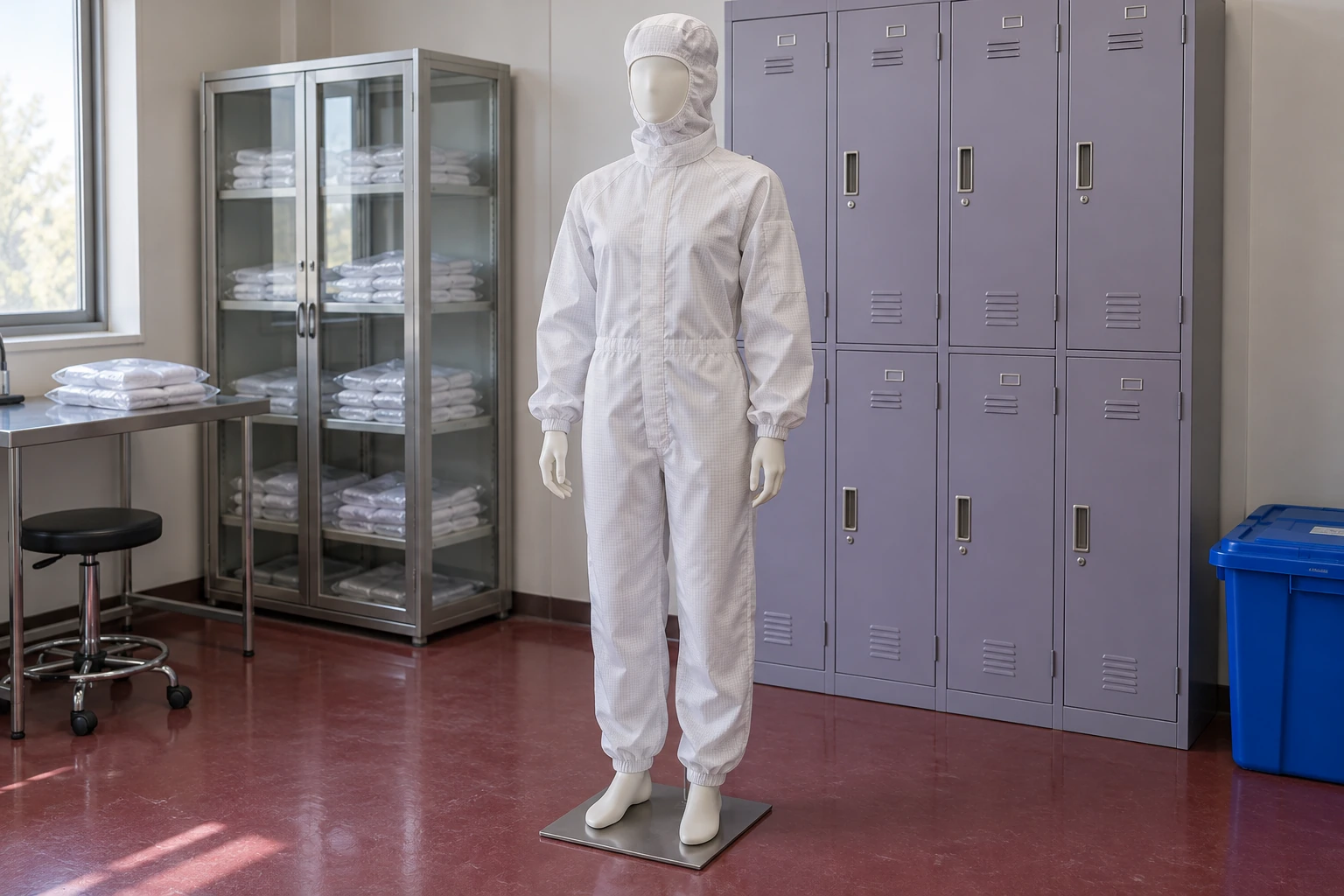
Cleanroom Suits
cleanroom suit semiconductor
| Clothing arrangement | Reusable coverall, hood and overboots; integral hood alternative |
|---|---|
| Fabric selection | Polyester filament with conductive yarn; selected fabric and seam build retained for repeat supply |
| Size assortment | XS–3XL; short, regular and tall requirements assigned by wearer |
| Sizing records | Body measurements and agreed garment dimensions in cm; head and footwear fit recorded separately |
| Identification | Wash-compatible internal identifier; garment or wearer tracking to the site procedure |
| Issue condition | Clean processed, checked and packed for the designated change area |
| ESD coordination | Garment and grounding method selected and verified as part of the approved site programme |
| Replacement control | Repair, processing and retirement criteria agreed for the chosen garment |
A size label or visual appearance does not prove that a replacement garment has the same construction or qualified service condition.
Garment identification, fit assortment, packing and replacement arrangements can be tailored to your semiconductor operation.
Semiconductor garment control continues after the suit has been selected. Different shifts, service engineers, laundry returns and replacement orders must all use the intended clothing arrangement. This page focuses on putting a cleanroom suit into daily production service and keeping its construction, condition and fit consistent.
Build the clothing issue around actual shifts
- Assign a workable size mix. Record the wearer population and the tasks they perform. Include service engineers and approved visitors, rather than sizing only the permanent production team.
- Allow for the complete return cycle. Working garments, garments awaiting collection, items being processed and clean reserve stock all draw on the same pool. Plan availability by size because a surplus in one size cannot resolve a shortage in another.
- Separate clean issue from return. Give used garments a defined collection point and protect clean packs until dressing. A clean garment cupboard should support the issue process; it does not make an unprocessed garment ready for use.
- Keep exceptions visible. Damaged garments, unapproved substitutions and missing identifiers should have a route outside normal clean issue. Staff need a usable replacement without having to improvise a repair at the workstation.
Use the work task as the fitting test
For inspection and assembly, evaluate seated work and forward reach. For tool maintenance, include kneeling, turning in restricted space and reaching to service points. Assess coverage with the normal gloves, hood and footwear, rather than trying the coverall alone.
A pattern that fits standing operators can pull at the wrists or crotch in another posture. Repeated pulling and adjustment can bring the garment into contact with surrounding surfaces. Record why a length or cut was selected so the next order preserves that fit.
When maintenance exposes chemical, hot or electrical hazards, select the appropriate task-specific protective clothing and verify its compatibility. The production cleanroom suit is not a universal maintenance protective garment.
Keep qualification attached to the garment being used
Construction continuity
Retain the approved fabric, thread, seam, zip, cuff and accessory arrangement. An apparently minor component substitution can change laundering behaviour or fit. A replacement order should identify the accepted construction rather than asking only for the same colour and size.
Processing continuity
Keep the laundry and inspection method connected to the garment record. Establish which repairs are allowed, how the repaired construction is assessed and when an item must leave service. A fixed wash count without evidence for the garment and process is not a reliable lifetime guarantee.
Changes in electrical performance require review under the site's ESD programme. A garment that is visually intact may still need testing; a clean appearance alone does not establish its electrical condition.
Use reorders to preserve a controlled system
For a repeat purchase, provide the accepted garment specification, size distribution, processing method and any observed fit or service problems. State whether the order adds users, replaces retired items or supports a new process. Those situations need different quantities and may need different qualification work.
shengtongJH acts as a sourcing and procurement partner. We coordinate the selected supply configuration and available documentation; site acceptance remains tied to the actual garment and its operating conditions. For the initial technical choice, see semiconductor cleanroom suit selection. For storage interfaces, browse cleanroom garment cabinets.
Garment identification, fit assortment, packing and replacement arrangements can be tailored to your semiconductor operation.