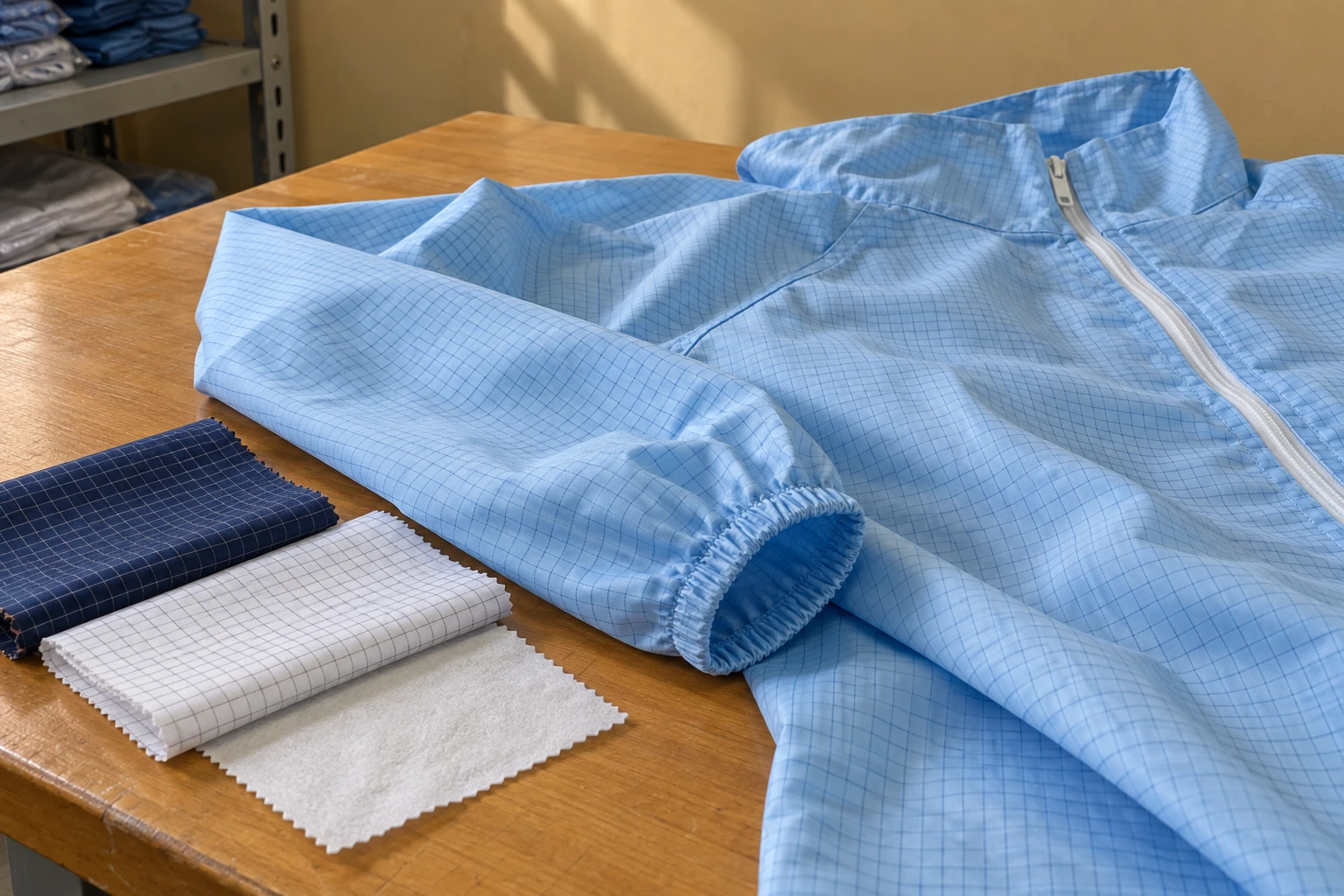
Cleanroom Suits
cleanroom suit material
| Reusable textile | Polyester filament with conductive yarn; 98% polyester / 2% conductive fibre or 99% / 1% options |
|---|---|
| Fabric mass | 105, 110 or 125 g/m², depending on the selected fabric construction |
| Weave and grid | Plain or twill weave; conductive grid options including 5 mm spacing |
| Single-use alternative | Low-lint nonwoven or laminated construction; assess the specific supplied material |
| Garment sizes | XS–3XL and selected short/tall patterns; body and garment dimensions specified in cm |
| Construction details | Finished cut edges, enclosed or covered seams, compatible zipper and cuff materials |
| Colour selection | White, light blue, navy, grey or green, subject to selected textile |
| Qualification | Particle release, retention and electrical properties assessed with the intended care process |
Composition, mass and grid spacing describe different fabric constructions. They are not interchangeable performance ratings, and not every combination is available in every garment.
Material, seam construction and garment sizing can be coordinated around your contamination-control and processing requirements.
Cleanroom suit material is selected for what the finished garment must control and how it will be used. Fibre composition is only one part of that choice. Weave, fabric mass, conductive yarn, surface finish, garment construction and repeated processing can all change the behaviour of a suit that looks similar on a hanger.
Start with the textile structure
- Filament fabric
- Reusable cleanroom garments commonly use woven polyester filament yarn. The continuous-filament construction avoids the same abundance of short free fibre ends found in many everyday fabrics. The finished cloth and garment still need evaluation: abrasion, cut edges, thread and repairs can introduce contamination sources.
- Conductive yarn
- A carbon-containing yarn can form a distributed electrical network through the cloth. Its presence, spacing and continuity matter, but a grid pattern is not a measured ESD result. Seams, connections and the way the garment is worn also affect the finished assembly.
- Nonwoven construction
- Single-use garments use different nonwoven structures, sometimes with a film or other barrier layer. These cannot be treated as one generic material. The construction affects flexibility, heat and moisture transfer, particle behaviour and suitability for particular exposures.
Fabric weight is not a cleanliness grade
Mass per area tells the buyer how much fabric material is present over a given area. It does not identify pore structure, particle retention or the number of particles a moving garment releases. Two textiles with the same mass can behave differently because their yarns, weave and finishing differ.
A tighter or heavier cloth can change comfort and movement. A more comfortable garment can be easier to wear correctly, but that does not justify sacrificing the process's contamination limits. Evaluate the actual exposure time, work rate and clothing worn underneath when comparing options.
Seams turn fabric into a garment
Cutting exposes edges; stitching joins panels and introduces thread and needle holes. Finished edges and suitable seam construction help control loose fibres and produce a more manageable interior. A good material joined with unsuitable thread or poorly finished seams can undermine the reason for choosing that material.
Inspect the zipper cover, cuff and ankle assembly as well as the main panels. Soft components and fasteners must tolerate the same care process as the body fabric. A textile data sheet does not establish the service life of an elastic cuff or a zip.
Compare evidence on a like-for-like basis
Ask what was tested, in which condition and by which method. A clean new swatch, a finished garment after washing and a person moving in a complete clothing system answer different questions. Results are useful only when the tested construction and processing condition match the intended purchase.
- Particle shedding: how much contamination the material or finished garment releases under the specified test.
- Particle retention: how the textile or garment system limits transfer from the wearer toward the surrounding environment.
- Electrical behaviour: the relevant resistance or charge-control measurement, test conditions and garment connections.
- Durability: whether the relevant properties remain acceptable after the agreed laundering, wear and, where applicable, sterilization process.
Do not rank suppliers by a single percentage or resistance number taken from different test conditions. For semiconductor use, the fabric choice must fit the complete garment and ESD arrangement.
Approve processing before approving a repeat order
Laundry chemistry, mechanical action and drying conditions can affect the textile and its components. Finishes can change; abrasion can damage the surface; unsuitable repairs can alter the construction. Establish an approved process and replacement criteria with the garment source and processor.
Autoclave or irradiation suitability must belong to the selected garment build, including closures and identification labels. It cannot be inferred from the word “polyester.” For a disposable build, do not assume that processing intended for reusable garments is acceptable.
This page concerns material selection within the cleanroom suit supply. State whether the enquiry is for finished garments or textile supply, since roll specifications, conversion and garment acceptance are different purchasing scopes.
Material, seam construction and garment sizing can be coordinated around your contamination-control and processing requirements.