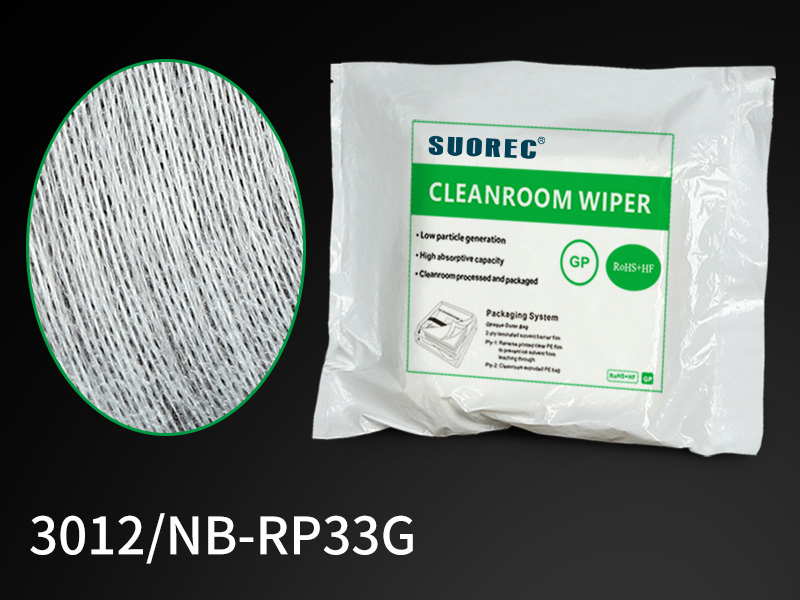
RP33G pack and material texture
Cleanroom Paper Wipes
Cleanroom Paper Wipes RP33G
| Model | RP33G |
|---|---|
| Material / construction | Spunlace nonwoven |
| Edge treatment | Cold cut |
| Basis weight | 33 g/m² |
| Water absorption index | ≥230 — unit and test method not stated |
| Cleaning designation | Class 1,000 processing |
| Sheet size | Nominal 4, 6, 9 or 12 in; custom sizes |
| Packaging | 150 sheets/inner pack; 10 packs/carton; custom packing |
| Application sectors | medical inspection; food processing; chemical production; assembly; glass products; pharmaceutical production; biomedical production; new energy |
| Product reports | Specify required test reports with your enquiry |
The absorption index has no stated unit or test method; it is not a percentage. The cleaning designation describes processing and is not a sterility claim.
Sheet dimensions and packaging can be customized to suit the application.
RP33G is a lightweight spunlace wiping sheet with an open texture visible in the product close-up. It is a candidate for disposable surface cleaning where the sheet needs to fold around the contact area and be replaced regularly as residue accumulates.
Understand the open texture
The visible pattern describes the sheet's structure. Spunlace identifies how a nonwoven is formed; it does not by itself identify the fiber blend. If a process excludes cellulose or requires a specific polymer, include that composition requirement in the purchasing specification.
Texture may affect contact with loose residue, but an open appearance is not a measured dust-capture rating. Evaluate pickup and any material left behind on the surface you intend to clean.
Use folds to control contact
Fold the sheet into a manageable face, keeping unused portions available for the next pass. At edges or narrow features, avoid pulling the wipe across sharp burrs. A torn sheet makes both cleaning and removal harder to control.
Dry particles and wet residues need different checks
For loose particles, observe whether the operation collects the contamination or merely pushes it toward an opening. For a wet task, assess the sheet after exposure to the selected liquid, including how it handles when loaded. Keep the amount of liquid and the wiping motion consistent during comparisons.
The source gallery includes a loose-particle wiping operation and a manual handling view. They illustrate use and form; they are not a guarantee of tensile strength, particle counts or suitability for an exposed precision surface.
Control disposable consumption
A lightweight sheet can be practical for frequently repeated small tasks, but its value depends on how many sheets are required to complete each one. Record fresh-face changes and discarded sheets during a short production trial. The result is more useful than comparing carton prices alone.
Choose the pack arrangement around protected dispensing and daily consumption. When the process needs formal acceptance data, request the relevant material and contamination tests with the quotation.
Sheet dimensions and packaging can be customized to suit the application.