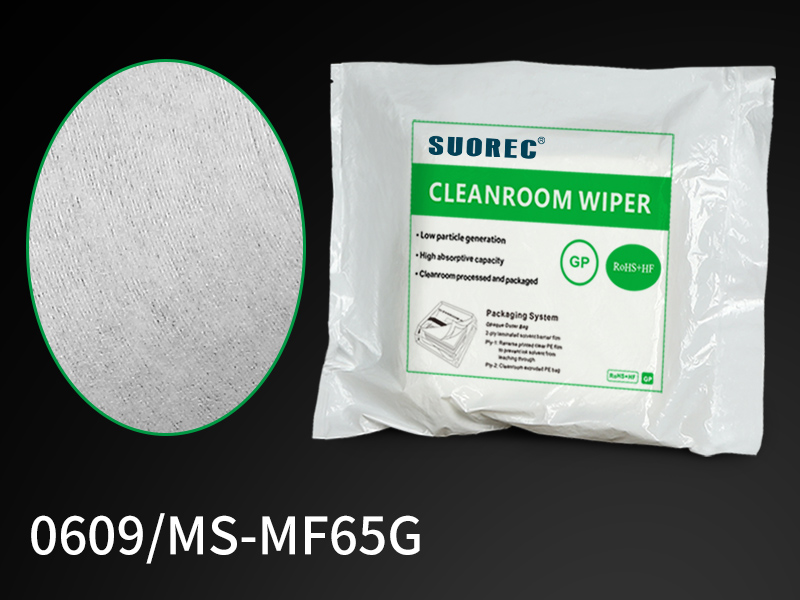
MF65G pack and material texture
Cleanroom Paper Wipes
Cleanroom Paper Wipes MF65G
| Model | MF65G |
|---|---|
| Material / construction | Wood-pulp-based material |
| Edge treatment | Cold cut |
| Basis weight | 65 g/m² |
| Water absorption index | ≥230 — unit and test method not stated |
| Cleaning designation | Class 1,000 processing |
| Sheet size | Nominal 4, 6, 9 or 12 in; custom sizes |
| Packaging | 150 sheets/inner pack; 10 packs/carton; custom packing |
| Application sectors | medical inspection; food processing; chemical production; assembly; glass products; pharmaceutical production; biomedical production; new energy; automotive production |
| Product reports | Specify required test reports with your enquiry |
The absorption index has no stated unit or test method; it is not a percentage. The cleaning designation describes processing and is not a sterility claim.
Sheet dimensions and packaging can be customized to suit the application.
MF65G is a wood-pulp-based paper wipe for planned cleaning of production equipment and work surfaces. It is a candidate for tasks involving liquid residues and repeated changes of wiping face, with the cleaning method selected around the equipment and the residue.
Plan the route across the equipment
Start with the accessible, cleaner surfaces before moving to areas with heavier deposits. Keep used sheets away from components that have already passed inspection. Working in this order reduces the chance of carrying collected soil back onto a cleaned surface.
Flat covers and broad fixtures can be cleaned with a folded face. Around fasteners, corners and openings, change the fold or use a more appropriate cleaning tool instead of pushing the sheet into a gap where material could catch.
Weight is one part of the choice
The material weight helps identify the ordered construction, but a higher number is not an automatic guarantee of better cleaning. Residue type, surface finish, edge handling and the cleaning liquid also affect the outcome. Compare MF65G on the task that creates most of the cleaning difficulty, not only on an easy flat sample.
For a wet operation, observe how the sheet behaves after it has been exposed to the liquid for the normal working period. A quick dry-hand demonstration cannot replace that check.
Before the shift
Keep a defined quantity of clean material at the station, protected from spray and loose dust.
During the task
Use fresh faces and retire sheets before they redistribute collected residue.
At changeover
Remove used wipes and clean the holder or dispensing area before opening another pack.
Specify the acceptance point
Describe what a completed cleaning operation must achieve: an oil-free appearance, no visible fiber under inspection, or a documented contamination limit. These are different acceptance criteria and may require different evidence. If the component enters a critical assembly or regulated process, include that downstream use when discussing the wipe.
Sheet size and carton packing can be aligned with consumption at the station. Retaining the accepted size, material and pack identity makes replenishment easier to control.
Sheet dimensions and packaging can be customized to suit the application.