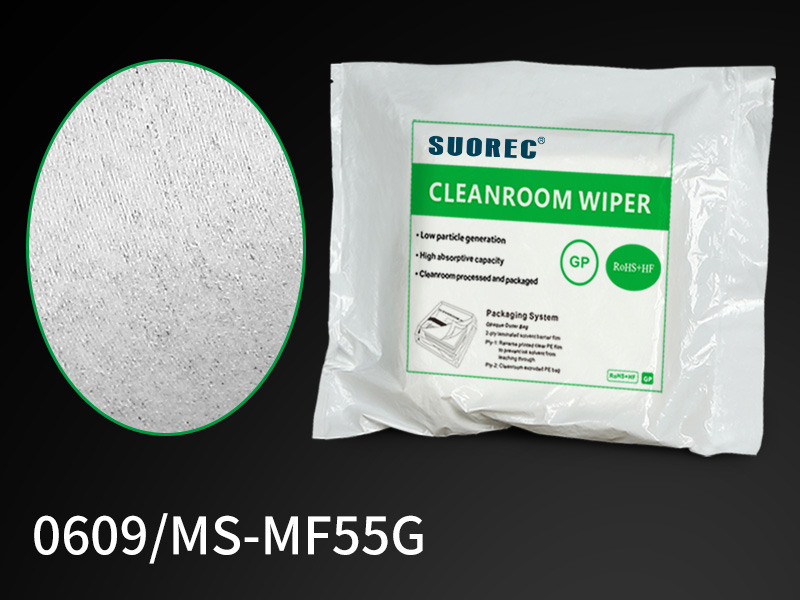
MF55G pack and material texture
Cleanroom Paper Wipes
Cleanroom Paper Wipes MF55G
| Model | MF55G |
|---|---|
| Material / construction | Wood-pulp-based material |
| Edge treatment | Cold cut |
| Basis weight | 55 g/m² |
| Water absorption index | ≥230 — unit and test method not stated |
| Cleaning designation | Class 1,000 processing |
| Sheet size | Nominal 4, 6, 9 or 12 in; custom sizes |
| Packaging | 150 sheets/inner pack; 10 packs/carton; custom packing |
| Application sectors | medical inspection; food processing; chemical production; assembly; glass products; pharmaceutical production; biomedical production; new energy; automotive production |
| Product reports | Specify required test reports with your enquiry |
The absorption index has no stated unit or test method; it is not a percentage. The cleaning designation describes processing and is not a sterility claim.
Sheet dimensions and packaging can be customized to suit the application.
MF55G provides a wood-pulp-based sheet format for wiping workstations, fixtures and accessible equipment surfaces. Its selection is most useful when cleaning is treated as a complete operation: apply the right liquid, lift the residue and remove the used sheet from the work area.
Separate soil removal from the finishing pass
Oil or paste can leave a thin film after the visible deposit has gone. Use the first sheet to collect the bulk residue, then assess whether a separate clean face or fresh sheet is needed for the finish. Increasing wiping pressure on an already loaded sheet can spread contamination and make the result less repeatable.
At a fixture-cleaning station, keep the cleaned component away from the dirty-wipe container. Organizing these two destinations prevents a successful wiping step from being undone during handling.
Wetting
Apply the chosen cleaning liquid in a controlled amount. Flooding the work can carry loosened residue into openings that are harder to clean.
Contact
Fold the sheet to suit the accessible face. A flat contact area is easier to control than a loose ball of material around a small part.
Replacement
Change the sheet when its working face becomes loaded or stops lifting residue. Set this point through the actual cleaning task.
Evaluate the complete cleaning cost
Basis weight describes material per unit area; it does not by itself predict how many parts one sheet will clean. Compare MF55G using the same liquid, part geometry and acceptance check as other candidates. Record sheets consumed, time taken and any repeat cleaning required.
The source photographs include manual stretching and surface wiping. Use them to understand the form of the material, while relying on task trials for wet handling and on an applicable report for quantitative strength or cleanliness requirements.
Build the order around the workstation
Include sheet dimensions, pack quantity, the surface being cleaned and the cleaning chemistry in your enquiry. For food, pharmaceutical or medical production areas, define whether the wipe contacts the product; a general industrial wiping application does not establish direct-contact or sterile suitability.
Sheet dimensions and packaging can be customized to suit the application.