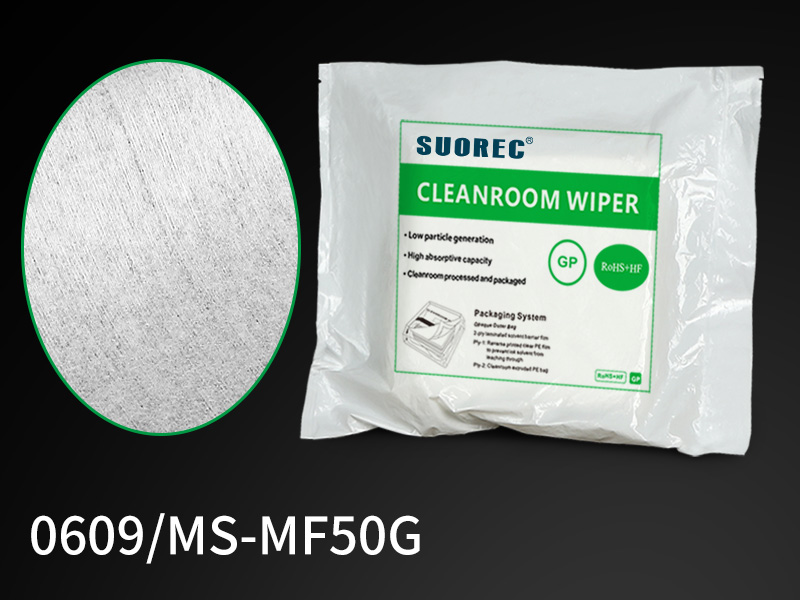
MF50G pack and material texture
Cleanroom Paper Wipes
Cleanroom Paper Wipes MF50G
| Model | MF50G |
|---|---|
| Material / construction | Wood-pulp-based material |
| Edge treatment | Cold cut |
| Basis weight | 50 g/m² |
| Water absorption index | ≥230 — unit and test method not stated |
| Cleaning designation | Class 1,000 processing |
| Sheet size | Nominal 4, 6, 9 or 12 in; custom sizes |
| Packaging | 150 sheets/inner pack; 10 packs/carton; custom packing |
| Application sectors | medical inspection; food processing; chemical production; assembly; glass products; pharmaceutical production; biomedical production; new energy; automotive production |
| Product reports | Specify required test reports with your enquiry |
The absorption index has no stated unit or test method; it is not a percentage. The cleaning designation describes processing and is not a sterility claim.
Sheet dimensions and packaging can be customized to suit the application.
MF50G is a wood-pulp-based wiping sheet for routine cleaning around assembly benches, equipment and glass products. Choose it around the residue to be removed and the condition of the finished surface, with sheet handling and replacement frequency built into the cleaning method.
A fresh wiping face for each pass
When a wipe is carried from one component to another, the collected residue can travel with it. Fold MF50G to give a flat contact face, move across the surface in a controlled direction and expose a fresh face before the next pass. Replace a loaded sheet instead of repeatedly spreading the same liquid film.
The photographs show the sheet texture, folded form and an oil-wiping operation. These views help explain how the material is handled; they do not establish a measured absorption capacity or particle-release limit for your process.
Match the liquid to the surface
A dry sheet can collect loose residue or remove liquid left by an earlier cleaning step. Where a cleaning solution is needed, its compatibility must cover both the wipe and the component coating. Check a small representative area before extending the method to finished parts.
Keep the edge out of critical contact
A cut edge is convenient for sheet conversion, but it is not a sealed border. For surfaces that are sensitive to fibers, fold the edges inward and assess residue under the actual wiping pressure. The word cleanroom alone does not establish suitability for exposed optics or wafer surfaces.
Buying for repeatable daily use
Specify the working area to be cleaned, the liquid used and the number of fresh wiping faces needed. This makes sheet format and pack size a practical decision rather than a choice based only on unit price. Separate unopened packs from used wipes, and keep opened material covered between operations.
For approval, compare residue removal, visible streaks, wet handling and the number of sheets consumed per completed task. Include any required particle, extractable or material documentation in the enquiry so the supplied configuration can be matched to the acceptance procedure.
Sheet dimensions and packaging can be customized to suit the application.