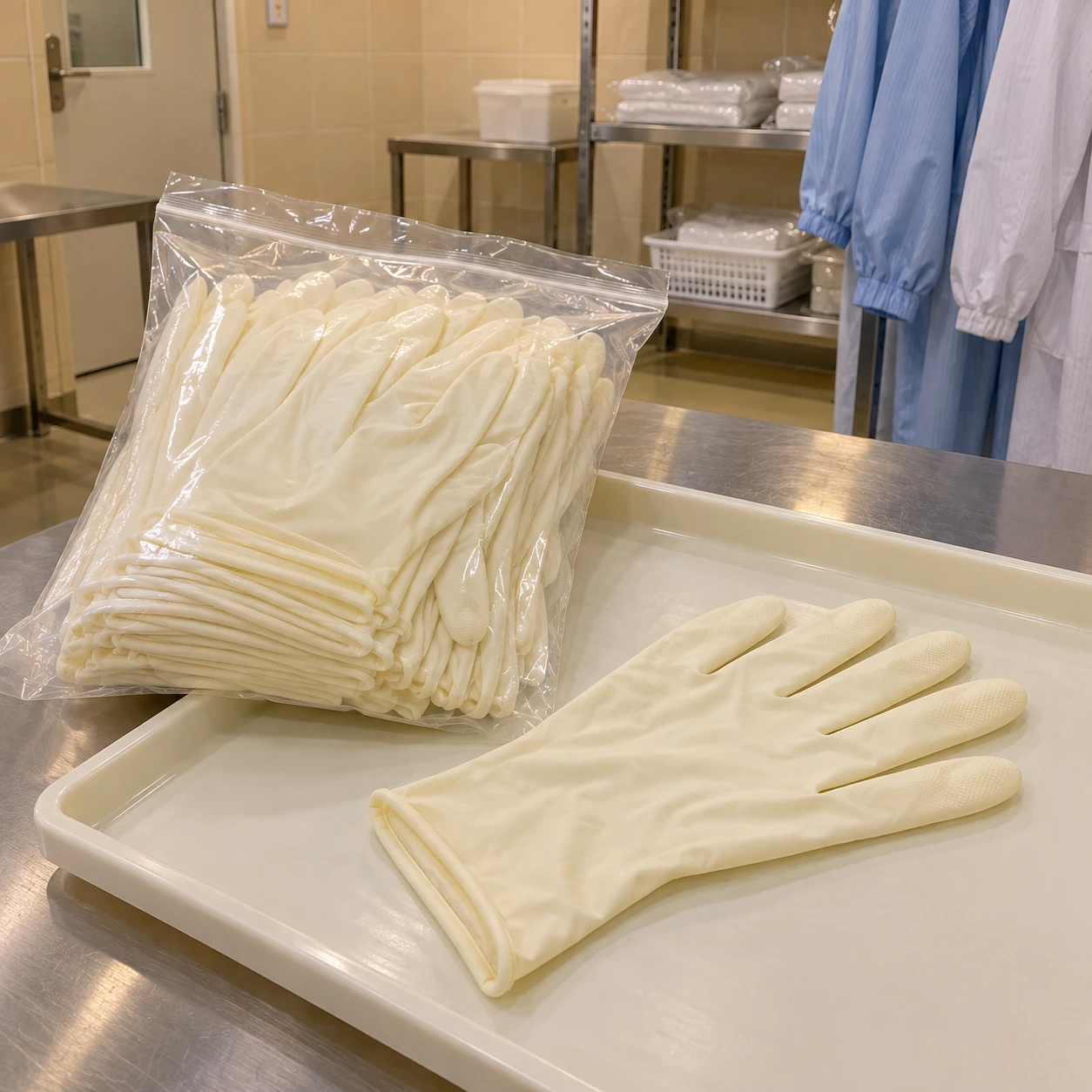
Cleanroom Gloves
latex cleanroom gloves
| Material | Natural rubber latex; powder-free |
|---|---|
| Size options | XS, S, M, L, XL, XXL for selected ambidextrous families; 6.0–10.0 for selected hand-specific families |
| Total glove length (mm) | 300 ambidextrous or 305 hand-specific options |
| Single-wall palm thickness (mm) | 0.18 or 0.20, according to construction |
| Surface | Textured working surface; grip pattern according to selected glove |
| Cuff | Beaded extended cuff |
| Sterility choice | Non-sterile or validated sterile presentation, ordered separately |
| Packing | Double PE bags or individually walleted pairs with protective pouches |
Natural rubber latex contains proteins that can cause allergy. Use an appropriate alternative for a latex-sensitive wearer; powder-free processing is not an allergy-free claim.
Glove shape, hand-size quantities and the approved packing format can be customized for your controlled handling workflow.
Latex cleanroom gloves use natural rubber elasticity to support a close, flexible fit. They can suit detailed manual handling where the selected product meets the process requirements and natural rubber latex is acceptable for the wearer.
Where elastic recovery helps
During a pinch grip or repeated tool movement, the glove needs to follow the fingers without collecting loose folds. Natural rubber elasticity can support this close fit and give useful feedback when handling small parts. The result still depends on the actual size, film construction and surface finish.
Try the glove through the full task, including reaching and removing the hand from a fixture. A good stationary fit does not settle how the cuff behaves when the wrist bends or how the palm feels during repeated gripping.
Texture needs to match the contact surface
A textured working surface can help control a small component, but the most pronounced texture is not always the best choice. Consider delicate finishes, snagging points and any cleaning fluid permitted in the procedure. Check that the chosen glove does not introduce unacceptable marks or residues.
Use the glove's documented cleanliness results for the selected process. Elasticity and grip do not provide evidence about particle release, extractables or barrier integrity.
Make natural rubber acceptance an explicit decision
Powder-free latex still contains natural rubber proteins. A worker with known latex sensitivity needs an appropriate non-latex alternative and the site's occupational-health guidance. Do not describe a processed latex glove as suitable for every wearer.
Nitrile cleanroom gloves are one material alternative, but changing polymer requires a fresh fit and task comparison. Synthetic materials can also contain additives that matter to skin compatibility or the process; “non-latex” is not the same as “free of all sensitivities.”
Keep use conditions within the selected specification
Specify sterile and non-sterile supply separately. If a process requires sterile gloves, use a validated product and its intended presentation rather than trying to create that status through routine wiping. Chemical exposure also requires the actual glove's compatibility data; neither a thicker film nor natural elasticity establishes universal resistance.
For repeat supply, retain the approved shape, texture, packing and size distribution. shengtongJH can source against those requirements without substituting another natural-colour glove solely because it looks similar.
Glove shape, hand-size quantities and the approved packing format can be customized for your controlled handling workflow.