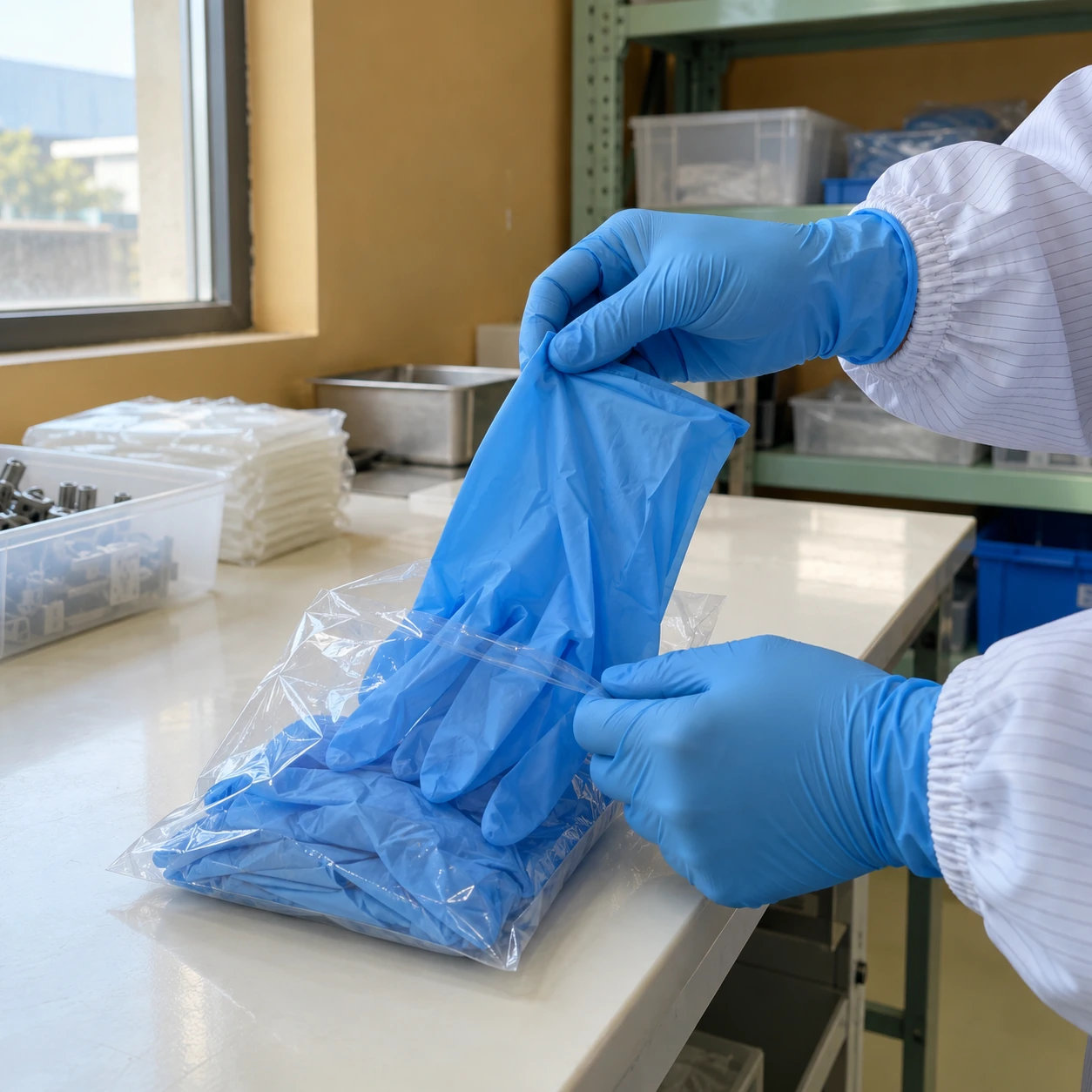
Cleanroom Gloves
cleanroom gloves nitrile
| Material selection | Powder-free nitrile cleanroom barrier glove |
|---|---|
| Hand sizes | XS–XXL in selected ambidextrous families |
| Nominal flat palm width (mm) | 75, 85, 95, 105, 115 or 125 |
| Total length (mm) | 300 or 305 according to selected family |
| Palm thickness options (mm) | 0.10–0.12 or 0.13 single-wall construction |
| Contact finish | Fingertip-textured or other qualified working surface |
| Required evidence | Cleanliness, barrier integrity and task-specific compatibility for the proposed glove |
| Order format | Size-separated bags or qualified pair presentation; lot identification |
A similar size letter, colour or nominal thickness does not establish interchangeability between glove families. Compare dimensions, tolerances and documented use together.
The nitrile glove selection, size quantities and packing arrangement can be customized to support your approved changeover and replenishment process.
Changing a controlled-area glove to nitrile is a supply and process decision. The replacement needs to preserve the useful properties of the current glove while meeting the reasons for the change.
Define the reason for changing material
A facility may consider nitrile because of natural-rubber concerns, a different handling task or a change in the approved supply range. State the reason clearly. Without it, a replacement can solve one issue while creating another, such as a glove that feels different during detailed work or arrives in an unsuitable pack.
Keep the current glove's useful requirements visible: product-contact cleanliness, cuff arrangement, grip and the operator's actual movement. Do not treat the change as a simple exchange of one polymer name for another.
Compare a replacement at three points
- Before use: compare product identity, dimensions, material information, packing and the required lot evidence. Resolve any differences between nominal and minimum dimensions.
- During a controlled trial: assess the actual component handling, tool use, sleeve interface and approved exposure conditions. Include the staff sizes that will be ordered.
- At replenishment: confirm that issuing units and stock locations still work. Packs counted as individual gloves and packs counted as pairs need different quantity planning.
Do not inherit unverified claims
A nitrile replacement does not inherit the old glove's chemical data, ESD behaviour or sterile status. Evaluate these properties for the proposed item. Even another nitrile glove can use a different formulation, surface treatment or cleaning process.
For chemical exposure, use the exact substance and conditions in the comparison. Laboratory breakthrough results should not be used as a direct wearing-time schedule.
Keep the change controlled after approval
Record what was accepted and which substitutions need review. A small change to a bag, cuff or size family can affect daily handling even if the invoice description remains unchanged.
Agree how a lot is identified and how feedback such as difficult donning or unexpected tearing reaches the purchasing decision. Repeated issues should be investigated rather than hidden by issuing a different size indiscriminately.
Request a like-for-like comparison
Send shengtongJH the current approved glove description, the reason for change and the task requirements. We coordinate a proposed supply selection and its supporting information. For the underlying material and application choices, use the nitrile cleanroom gloves overview.
The nitrile glove selection, size quantities and packing arrangement can be customized to support your approved changeover and replenishment process.