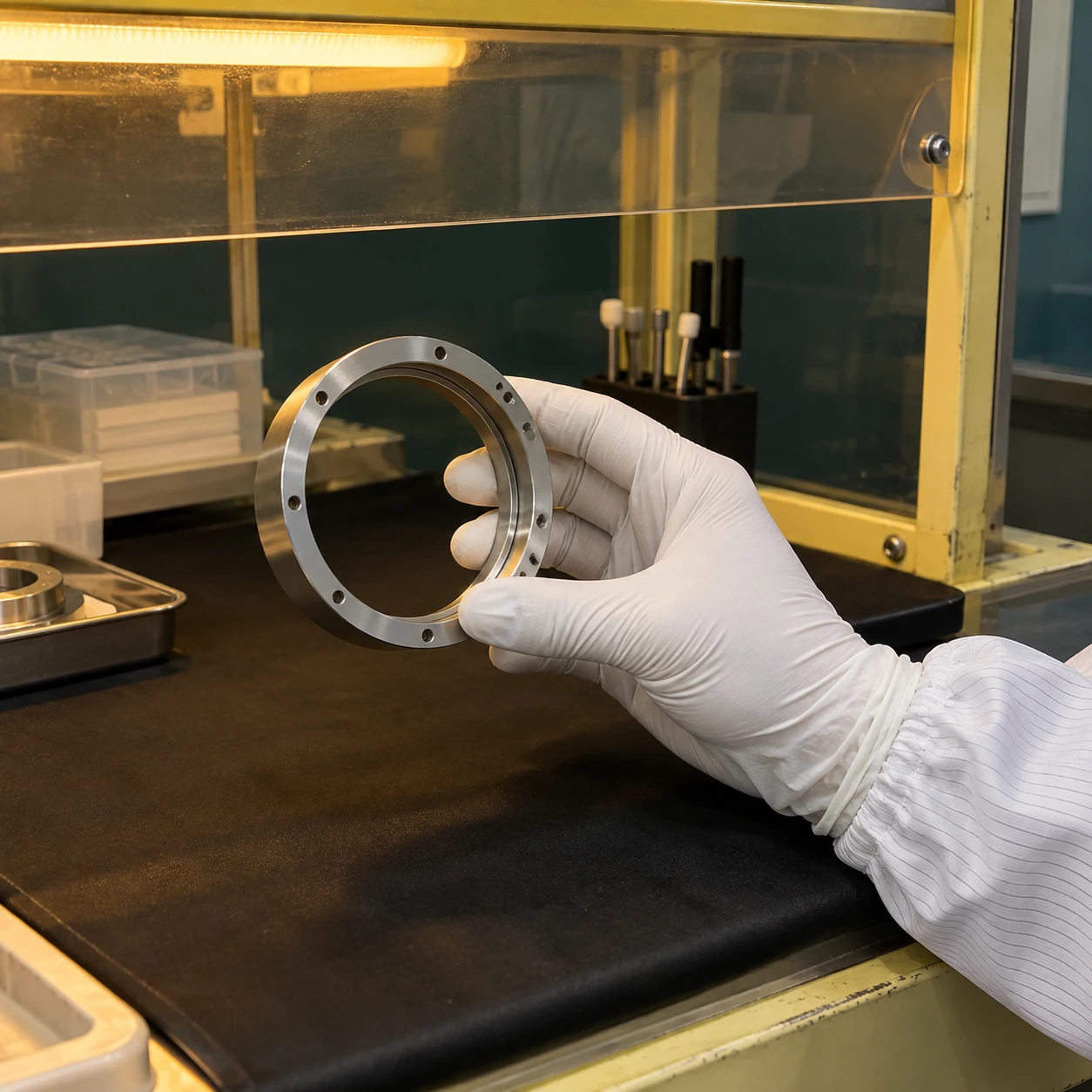
Cleanroom Gloves
class 10 cleanroom gloves
| Intended cleanliness context | Class 10 / ISO 4; selected glove compatibility requires supporting data |
|---|---|
| Material option | Powder-free nitrile |
| Hand sizes | XS, S, M, L, XL and XXL |
| Nominal flat palm widths (mm) | 75 / 85 / 95 / 105 / 115 / 125 by size |
| Total glove length (mm) | 300 nominal in the selected extended-cuff construction |
| Single-wall thickness (mm) | Palm 0.11; fingertip 0.16 for the listed construction |
| Form | Ambidextrous, textured fingers, beaded cuff |
| Supply state and packing | Non-sterile option in nested PE bags; sterile requirements assessed separately |
A Class 10 / ISO 4 compatibility description is not evidence of sterility or a universal glove particle limit. Check the proposed glove's test method, reporting units and process acceptance criteria.
The size assortment and qualified packaging arrangement can be customized for your sensitive-component handling and transfer procedure.
Class 10 cleanroom gloves are selected for operations with demanding contamination limits. The useful question is how the proposed glove behaves at the product surface, through transfer and during the actual handling task.
Focus on the contamination that causes a defect
A visible particle on an optical surface and an ionic residue on an electronic component are different problems. A glove selected for a sensitive operation needs evidence relevant to the failure mechanism, not simply the most demanding cleanliness label available on a catalogue page.
Class 10 is legacy terminology commonly associated with ISO 4. The room classification concerns airborne contamination; the glove still needs its own suitability assessment. Upgrading the glove description does not upgrade an uncontrolled workstation or compensate for poor handling.
Make particle comparisons meaningful
A glove particle result normally comes from a defined evaluation of the glove, such as an extraction-based test. Check the particle threshold, extraction conditions and area or item basis before comparing values. Smaller-looking numbers can describe different tests rather than cleaner products.
Where residues matter, add the relevant extractables or non-volatile-residue requirements. Do not use a favourable particle result as a substitute for an unreported property.
Protect the surface after the test
Transport, outer-pack removal and withdrawal from a partly used bag can introduce contamination after manufacturing. Establish which package layer may enter each area and provide an appropriate place for the remaining stock.
Choose a pack presentation that suits the frequency of use. An operation handling a few sensitive parts should not leave an unsuitable open supply beside an active workstation simply to avoid opening another bag.
Qualify the task, then control substitutions
Trial the actual grip, sleeve interface and any approved cleaning exposure. Poor fingertip fit can encourage extra manipulation of the component, while a troublesome cuff can lead to repeated adjustment. These handling effects belong in the selection alongside the laboratory data.
Once a product is approved, retain its identity, packing and critical specification in the reorder record. A change of formulation, size family or cleaning process should not pass unnoticed behind an unchanged generic description.
For an operation with a different cleanliness requirement, compare cleanroom gloves class 100. shengtongJH helps align the proposed supply and documentation with the requirement you actually need.
The size assortment and qualified packaging arrangement can be customized for your sensitive-component handling and transfer procedure.