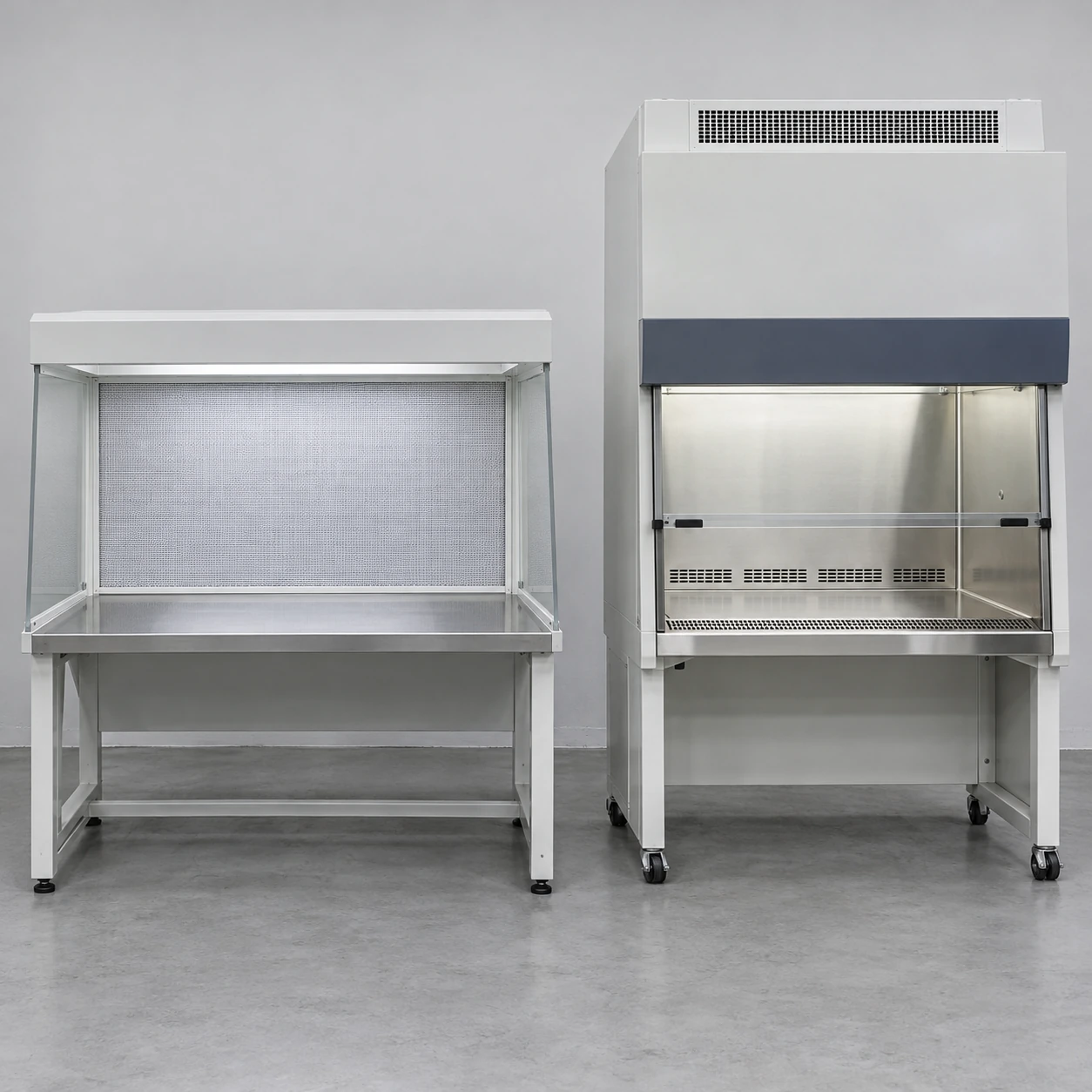
Clean Benches & Local Clean Air Systems
laminar flow hood vs biosafety cabinet
| Brand | shengtongJH |
|---|---|
| Clean-bench formats | Horizontal rear supply or vertical overhead supply |
| Horizontal work zone W × D × H | 1200 × 500 × 570 / 1700 × 500 × 570 mm |
| Vertical work zone W × D × H | 935 × 530 × 650 / 1335 × 530 × 650 mm |
| Clean-bench materials | Coated steel enclosure and stainless work surface |
| Clean-bench filtration | Inlet prefilter and final HEPA supply filter |
| Personnel/environmental containment | Not provided by an ordinary laminar-flow clean bench |
| Biosafety alternative | Separately specified Class II cabinet with inward front airflow and filtered exhaust |
| Power options | Matched 220 V or destination-specific configuration |
| Selection basis | Process risk, exposed product, equipment layout and installation services |
Work-zone sizes above belong to clean-bench configurations. The biological safety cabinet is selected and documented separately.
Clean-bench layout and cabinet installation interfaces can be configured for the assessed application.
The key difference is the protection objective. A laminar-flow clean bench supplies clean air to the work. A suitable biological safety cabinet adds containment features for assessed biological procedures.
When the product needs clean air
In precision-parts preparation, contamination may mean dust on a surface that must later be assembled or inspected. A clean bench can direct filtered air towards that surface while the work remains nonhazardous.
Its open airflow normally returns to the room. It is therefore inappropriate when the operation releases material that must be kept away from the user or environment.
When the procedure needs containment
Biological work can create an exposure concern as well as a contamination concern. A correctly selected and verified Class II cabinet uses an inward air stream at the front opening, filtered downflow and filtered exhaust to address both objectives.
The required cabinet type follows the biological procedure, associated substances and laboratory assessment. It cannot be chosen from the appearance of the cabinet alone.
Three misleading similarities
- Both may contain HEPA filters
- The filter describes particle removal in its air path. It does not define whether the equipment contains material released at the front opening.
- Both may have a sliding window
- A sash can improve access or influence airflow. Only its role within the complete designed and verified cabinet establishes a containment function.
- Both may use downward air
- A vertical clean bench and a Class II cabinet can both deliver air from above, but their front inflow, return and exhaust systems serve different purposes.
Choose from the task, not the more reassuring name
A biosafety cabinet is not automatically the correct solution for every chemical operation. HEPA filters do not remove vapours, and recirculation or exhaust arrangements impose use limits. Conversely, the simpler clean bench is a practical choice when only product protection is required and the task is assessed as nonhazardous.
For mammalian cell culture or potentially infectious work, an ordinary clean bench is not a substitute for the appropriate biological safety cabinet. For chemical fumes, determine the required extraction system separately.
Once the protection objective is clear, compare working area, access, service space and the installed verification scope. See the biological safety cabinet range for the containment route, or choose a clean bench around the nonhazardous work layout.
Clean-bench layout and cabinet installation interfaces can be configured for the assessed application.