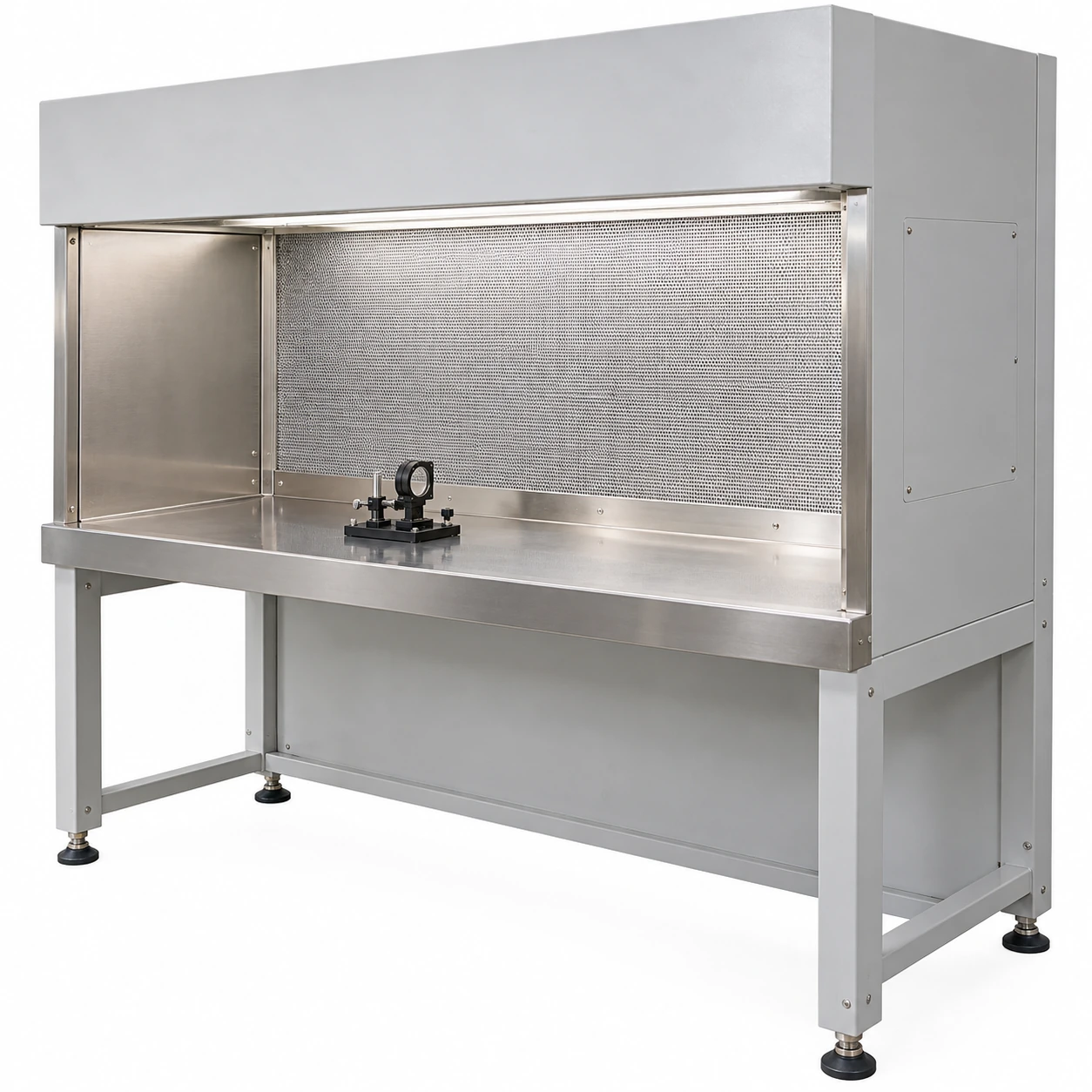
Clean Benches & Local Clean Air Systems
laminar air flow clean bench
| Brand | shengtongJH |
|---|---|
| Air arrangement | Horizontal, rear filter to front work opening |
| Work-zone W × D × H | 1200 × 500 × 570 / 1700 × 500 × 570 mm |
| Cabinet W × D × H | 1300 × 820 × 2040 / 1800 × 820 × 2070 mm, including stand |
| Work surface / housing | 304 stainless steel / powder-coated steel; stainless enclosure option |
| Final filtration | HEPA; H14 selection with matching filter test documentation |
| Air velocity setting | 0.3–0.5 m/s average, selected and checked for the working arrangement |
| Cabinet electrical input | 400 / 500 W configurations; connected instrument loads additional |
| Supply options | 220 V, 50/60 Hz; 110 V, 60 Hz by matched configuration |
| Controls and lighting | Fan adjustment, LED task light; airflow indication option |
| Access and service | Open working face; accessible prefilter and replaceable final filter |
Select one matched cabinet configuration. Working space, outside size and service clearance are different; final dimensions and electrical loads follow the approved equipment schedule.
Airflow direction, enclosure dimensions, work surface and operating accessories can be customized to the product and process.
A laminar air flow clean bench aims to deliver a consistent, predominantly one-directional stream of filtered air through the working zone. The practical result depends on the enclosure and what is placed in that stream.
Follow the air through the operation
The blower supplies air through a final filter and diffuser. From there it travels towards the work and leaves the enclosure. A useful layout preserves that route to the surface that needs protection. The presence of a HEPA filter does not make every pocket behind a fixture equally supplied.
The term laminar is commonly used for this directional clean-air arrangement. In practical use, hands, equipment and thermal effects can disturb the stream. The operating layout and its performance checks are therefore more informative than the label on its own.
Choose direction from the product geometry
Horizontal delivery can provide a direct route to low-profile parts placed in front of a rear filter. It also sends air towards the user, which limits it to appropriate nonhazardous work. A tall object may cast a sheltered region downstream and require a different fixture or orientation.
Vertical delivery approaches from above and can suit a different table layout. An overhanging instrument or shelf may interrupt it. Choose the direction that gives the important exposed surfaces the clearest supply while keeping the task accessible.
Keep loading deliberate
Install only the equipment needed for the operation. Plan a location for covered incoming items and completed work, and leave paths for cleaning. Crowding the cabinet changes both air distribution and the way hands move through the zone.
Do not assume that raising fan speed compensates for an unsuitable layout. Stronger air may disturb the product while leaving the same shielded surfaces.
Account for the room
Doors, nearby supply grilles and traffic can influence an open-front cabinet. A station that works in a quiet corner may behave differently beside a frequently used aisle. Locate the bench with these disturbances in mind.
Because the bench normally circulates room air, it does not independently control room temperature, humidity or pressure. Those requirements belong to the surrounding environmental system.
Define what will be demonstrated
Agree the operating state, representative equipment and the relevant airflow, integrity and particle checks for the purchase. Keep their results distinct: air-speed distribution, filter sealing and airborne concentration are different aspects of performance.
Use the resulting records as a baseline for service and process changes. For a target clean-air class, the classification requirement should state its measurement basis. No ordinary clean bench should be substituted for containment where the work can release hazardous biological or chemical material.
Airflow direction, enclosure dimensions, work surface and operating accessories can be customized to the product and process.