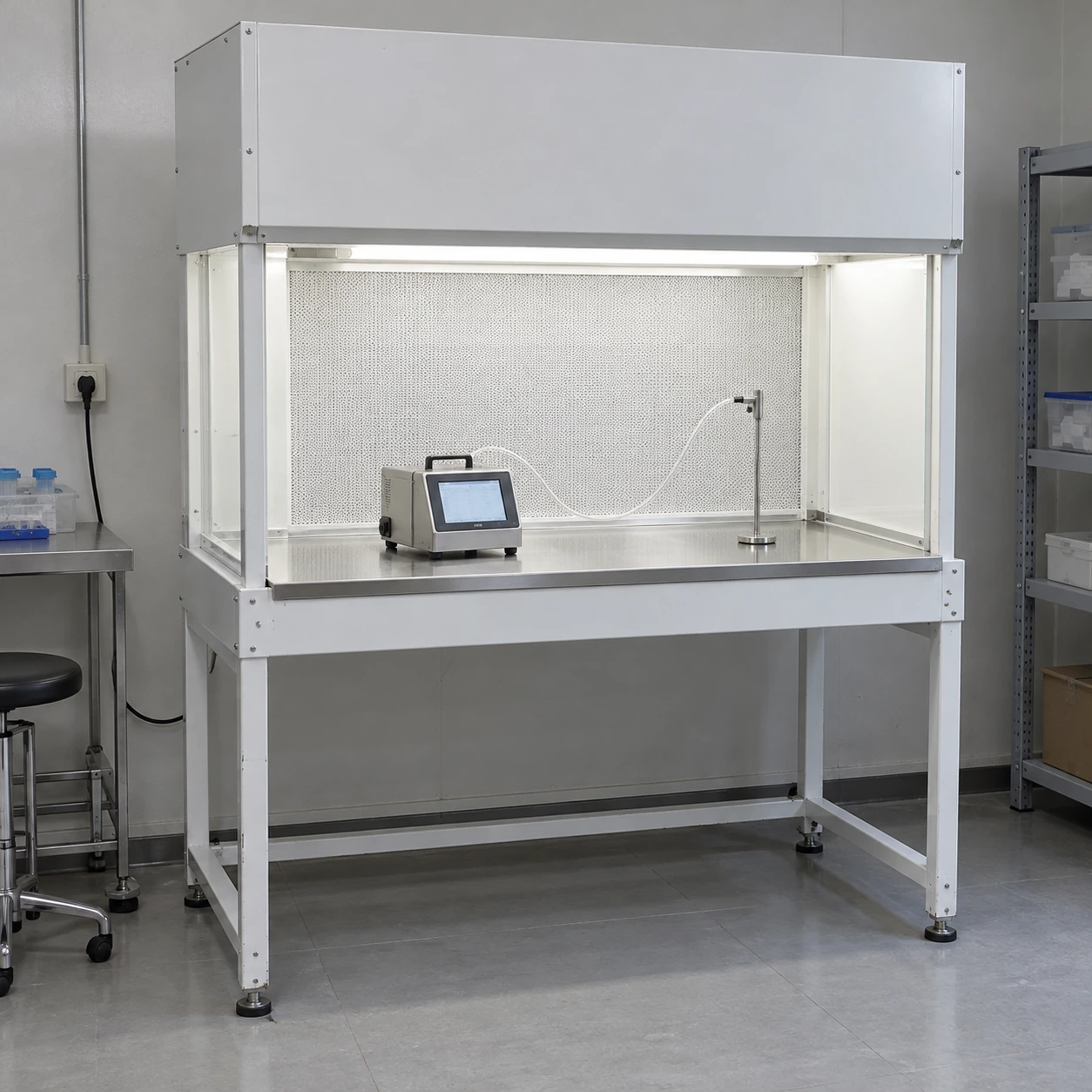
Clean Benches & Local Clean Air Systems
class 100 clean bench
| Brand | shengtongJH |
|---|---|
| Air arrangement | Vertical filtered downflow over the work zone |
| Work-zone W × D × H | 1200 × 645 × 610 / 1700 × 645 × 610 mm |
| Cabinet W × D × H | 1300 × 750 × 2040 / 1800 × 750 × 2040 mm, including stand |
| Work surface / housing | 304 stainless steel / powder-coated steel; stainless enclosure option |
| Final filtration | HEPA; H14 selection with matching filter test documentation |
| Air velocity setting | 0.3–0.5 m/s average, selected and checked for the working arrangement |
| Cabinet electrical input | 400 / 450 W configurations; connected instrument loads additional |
| Supply options | 220 V, 50/60 Hz; 110 V, 60 Hz by matched configuration |
| Controls and lighting | Fan adjustment and LED task light; airflow monitor option |
| Work opening | Glass side screens; sash and opening height selected for the task |
| Clean-zone requirement | ISO Class 5 target where specified; achieved condition requires an applicable test report |
Select one matched cabinet configuration. Working space, outside size and service clearance are different; final dimensions and electrical loads follow the approved equipment schedule.
Working dimensions, filter selection, monitoring and acceptance documentation can be customized to your process and quality requirements.
Class 100 is a legacy clean-air designation commonly associated with ISO Class 5 at the 0.5 µm particle threshold. A purchase specification should state the current test basis and the condition in which the working zone must meet it.
Turn the class name into a testable requirement
The historical Class 100 designation uses a limit of 100 particles per cubic foot at and above 0.5 µm. The corresponding commonly used ISO Class 5 limit at that threshold is 3,520 particles per cubic metre. These values describe an airborne concentration criterion; they are not a filter removal percentage.
The ISO 14644-1 classification framework addresses particle concentration in defined clean zones. Its classification does not identify whether particles are viable, chemically harmful or otherwise suitable for a particular process. A class result is therefore one part of the evidence needed for the work.
Define the working condition
State whether the required result applies to an empty cabinet, installed equipment at rest or a representative operating activity. Include the relevant work opening, normal fan setting and sampling arrangement in the agreed test plan.
A result obtained before a bulky fixture is installed does not describe the airflow around that fixture. For a new production task, representative loading helps relate the measurement to the exposed operation.
Separate panel evidence from bench evidence
A final-filter report addresses the identified filter and its test method. Installed integrity checks address the assembly and seals where specified. Particle measurements assess the air at the chosen locations and condition.
These checks answer different questions. A high-efficiency panel can still be installed with a poor seal, and a suitable filter assembly can still be obstructed by the work layout.
Agree acceptance before equipment is ordered
A useful purchase requirement names the target class, particle threshold, operating state, applicable method and documents to be delivered. It also identifies who performs installation checks and how a result outside the requirement is investigated. This is more useful than accepting an unqualified Class 100 label on a quotation.
The stated target is not a claim that every possible cabinet configuration has already been tested. The supplied assembly and its installed condition need evidence appropriate to the project. The ASHRAE clean-space classification table provides context for comparing the concentration limits.
Maintain the condition after acceptance
Changes to filters, equipment loading or room air can affect the work zone. Keep the accepted setup and results with the equipment record, then define the checks required after relevant changes. A particle-clean work area does not sterilize objects and does not make an ordinary bench suitable for hazardous biological or chemical work.
Working dimensions, filter selection, monitoring and acceptance documentation can be customized to your process and quality requirements.