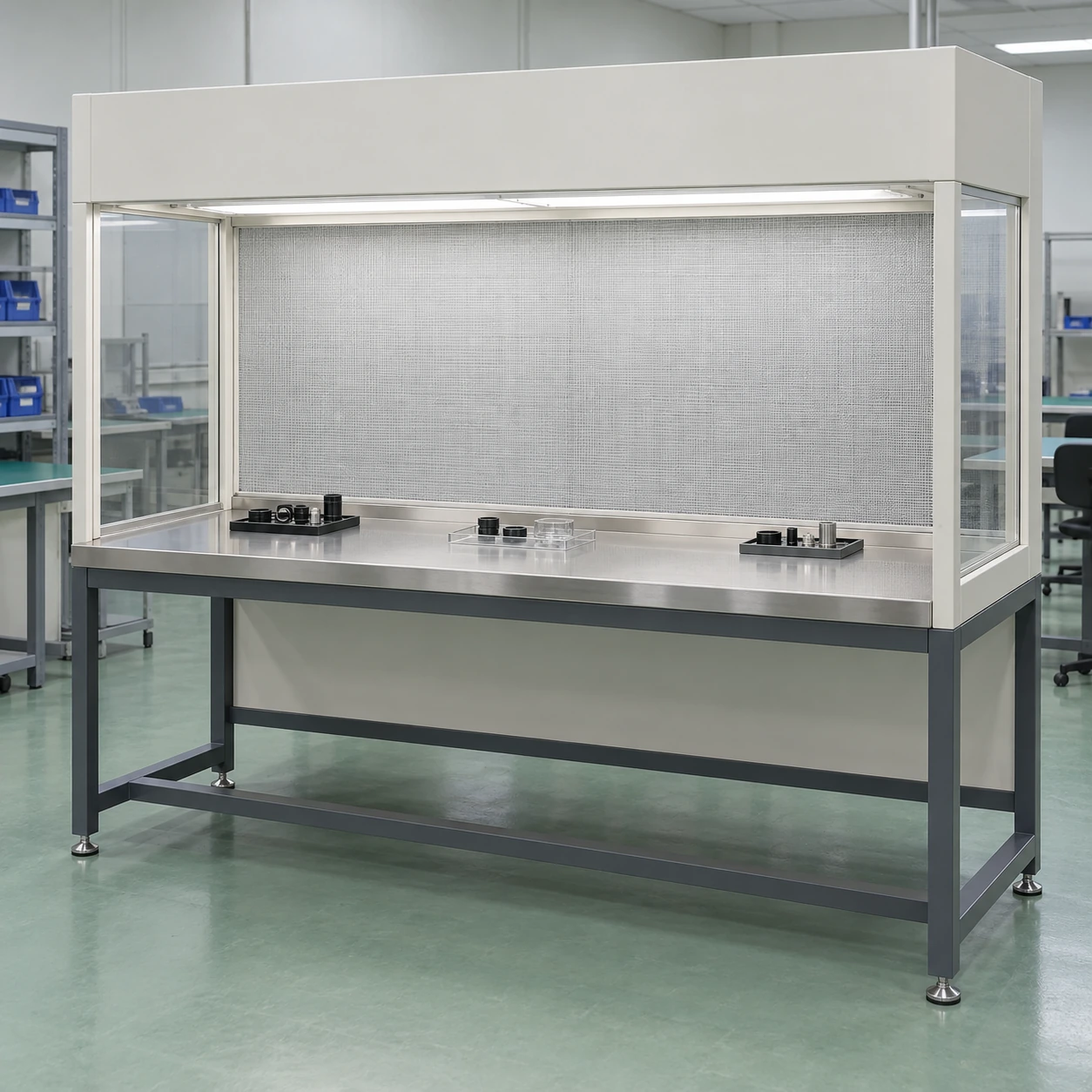
Clean Benches & Local Clean Air Systems
horizontal laminar flow hood
| Brand | shengtongJH |
|---|---|
| Air direction | Horizontal, from rear filter towards the open front |
| Overall W × D × H | 1300 × 820 × 2040 / 1800 × 820 × 2070 mm, including stand |
| Work zone W × D × H | 1200 × 500 × 570 / 1700 × 500 × 570 mm, paired with the respective cabinet |
| Construction | Powder-coated steel enclosure; stainless steel worktop; glazed sides |
| Filtration | Inlet prefilter and sealed final HEPA filter |
| Air speed selection | Adjustable; typical working setting 0.3–0.5 m/s, verified across the defined plane |
| Electrical selection | 220 V, 50/60 Hz; 110 V, 60 Hz configuration by selection |
| Cabinet input selection | 400 / 500 W configurations; internal equipment loads specified separately |
| Controls and access | Fan adjustment, work lighting, accessible prefilter and service panels |
Dimensions and electrical figures describe selectable configurations, not interchangeable parts. Final drawings and the complete supplied configuration determine fit and operating duty.
Working width, side screens, seating arrangement and material interfaces can be customized for the process.
A horizontal laminar flow hood sends filtered air from a rear supply face across the work surface. It is useful when the exposed components can remain in a clear, direct air path.
Arrange work by its position in the air stream
The filter sits behind the task. Air first reaches the upstream objects and then continues towards the operator. This makes the position of a hand, tray or component as important as the overall bench width.
Put the exposed product where it receives air directly from the supply face. Keep used packaging and particle-shedding items outside that path. A tool placed between the filter and a sensitive surface can transfer its contamination downstream even when the surrounding enclosure looks clean.
Low-profile inspection and component assembly are often easier to organize this way than tasks using large vessels. The open front also gives convenient lateral access, provided movement does not repeatedly disturb the critical work position.
More width does not solve an obstructed work zone
A wider unit gives room for separated tasks and fixtures, but a tall instrument directly in front of the rear filter can create a substantial wake. Moving the instrument sideways or selecting vertical flow may be more useful than buying additional width.
Work depth should include the component, tools and the operator's comfortable reach. If the critical area is too far back, the user may lean into the stream or repeatedly pass hands over the product. Check a representative task layout before choosing a cabinet.
Small fixtures
Use supports that keep the supply face open and make cleaning possible around the base. Avoid turning the bench into permanent storage.
Shared working width
Two people need an agreed handling sequence. Crossing arms and passing material through another work position can interfere with its clean-air path.
Understand where the outgoing air goes
The flow leaves through the open front, towards the operator and room. This is product-protection equipment, not a containment cabinet for infectious samples or hazardous substances. Where personnel or environmental protection is required, review the biological safety cabinet or appropriate extraction option instead.
Keep the rear supply accessible
Inlet clearance and the replacement path depend on the selected housing. Allow servicing without moving unrelated utilities or damaging the final filter. After filter work or relocation, verify airflow and the applicable cleanliness criteria before returning the station to production.
Working width, side screens, seating arrangement and material interfaces can be customized for the process.