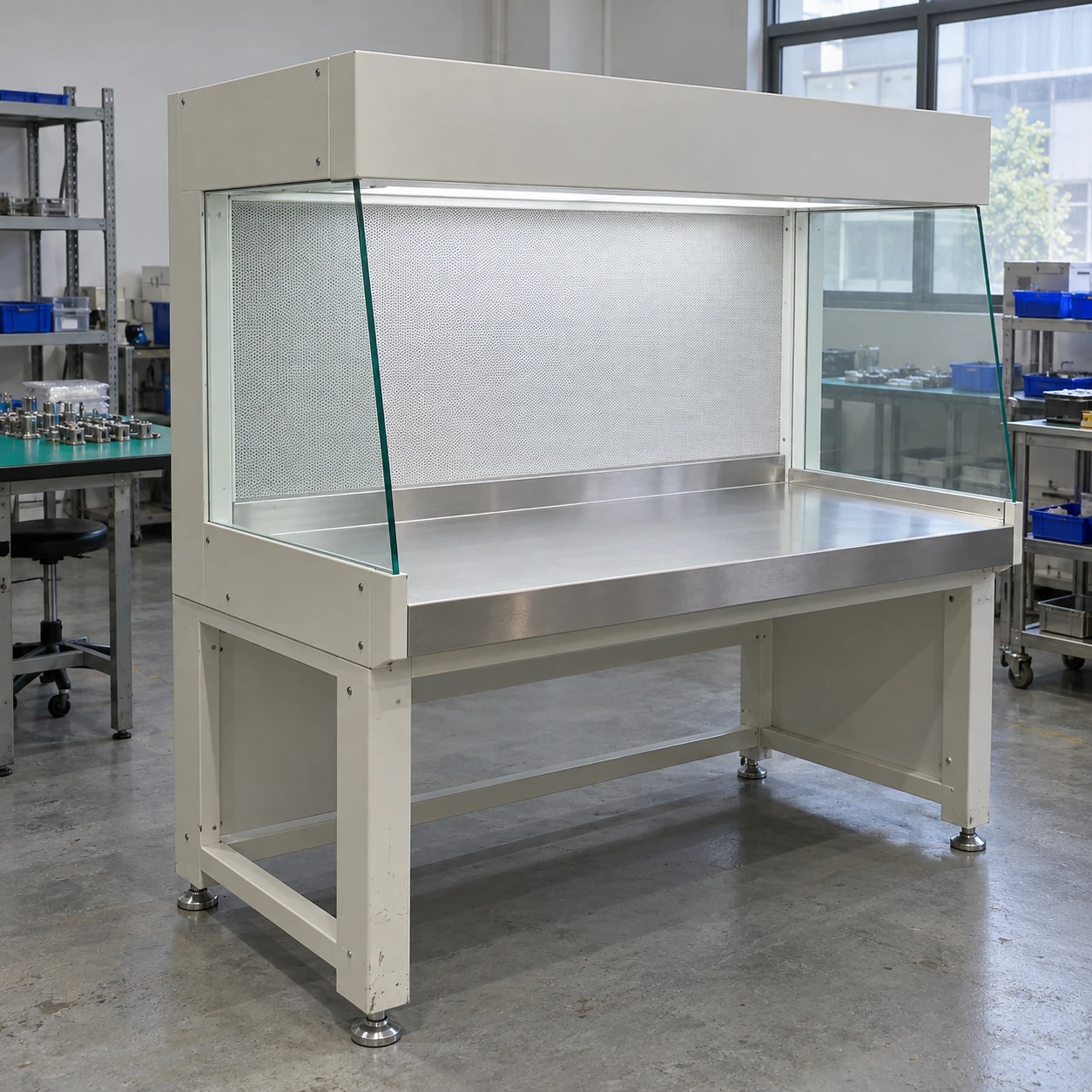
Clean Benches & Local Clean Air Systems
horizontal laminar flow clean bench
| Brand | shengtongJH |
|---|---|
| Air arrangement | Horizontal, rear filter to front work opening |
| Work-zone W × D × H | 1200 × 500 × 570 / 1700 × 500 × 570 mm |
| Cabinet W × D × H | 1300 × 820 × 2040 / 1800 × 820 × 2070 mm, including stand |
| Work surface / housing | 304 stainless steel / powder-coated steel; stainless enclosure option |
| Final filtration | HEPA; H14 selection with matching filter test documentation |
| Air velocity setting | 0.3–0.5 m/s average, selected and checked for the working arrangement |
| Cabinet electrical input | 400 / 500 W configurations; connected instrument loads additional |
| Supply options | 220 V, 50/60 Hz; 110 V, 60 Hz by matched configuration |
| Controls and lighting | Fan adjustment, LED task light; airflow indication option |
| Access and service | Open working face; accessible prefilter and replaceable final filter |
Select one matched cabinet configuration. Working space, outside size and service clearance are different; final dimensions and electrical loads follow the approved equipment schedule.
Working width, rear-filter arrangement, fixture space and stand height can be customized for your assembly or inspection task.
A horizontal laminar flow clean bench supplies filtered air from the rear of the enclosure towards its front opening. Low-profile, nonhazardous work benefits when the critical surface has a clear path to the final-filter face.
Keep a clear path from filter to part
The most useful feature of horizontal flow is the direct relationship between the rear supply face and the exposed product. A small assembly placed in that path receives filtered air before it passes across downstream items. If a container, tool rack or hand is positioned between the filter and the sensitive surface, the local flow is altered even though the blower continues to run.
Lay out the work so frequently handled supplies do not sit directly upstream of the critical operation. Keep the rear filter protected from impacts and leave its active face unobstructed. The filter grille is not a shelf or a surface against which parts should be stacked.
A simple fixture often works better than a taller enclosure
When a component blocks the stream, increasing cabinet height may add unused air space without improving delivery around that component. A lower fixture, a change in orientation or separate handling stages may provide a more direct route. The choice should follow the exposed surfaces rather than the overall height of the machine.
For inspection under a microscope, account for the microscope body, supports and the operator's hands. A clear area around the base does not prove that the surface beneath the optical head receives the desired air. Establish the working arrangement with the equipment in place.
Loading
Remove transport packaging outside the bench. Introduce the items needed for the current operation without filling the whole worktop with spare stock.
Handling
Arrange tools so they can be reached from the side. Repeated movement across an exposed part can interrupt the protective air path.
Removal
Close or cover finished work before moving it out into the room. Protection within the bench does not continue automatically along the transfer route.
Choose it for work that can tolerate outward air
The air leaves the front towards the operator and room. This geometry is suitable only when the materials and operations do not need hazardous-emission containment. It can also disturb very light pieces or an open weighing task; a quiet-looking stream can still affect the process.
Where tall equipment makes the rear-to-front path impractical, consider a vertical laminar flow clean bench. Where hazardous vapour or aerosols are generated, changing airflow direction alone is insufficient; the enclosure must be selected for containment.
Specify the test condition with the purchase: an empty work zone and the normal operating layout answer different questions. Airflow and particle checks should relate to the way the bench will actually be used.
Working width, rear-filter arrangement, fixture space and stand height can be customized for your assembly or inspection task.