Clean Benches & Local Clean Air Systems
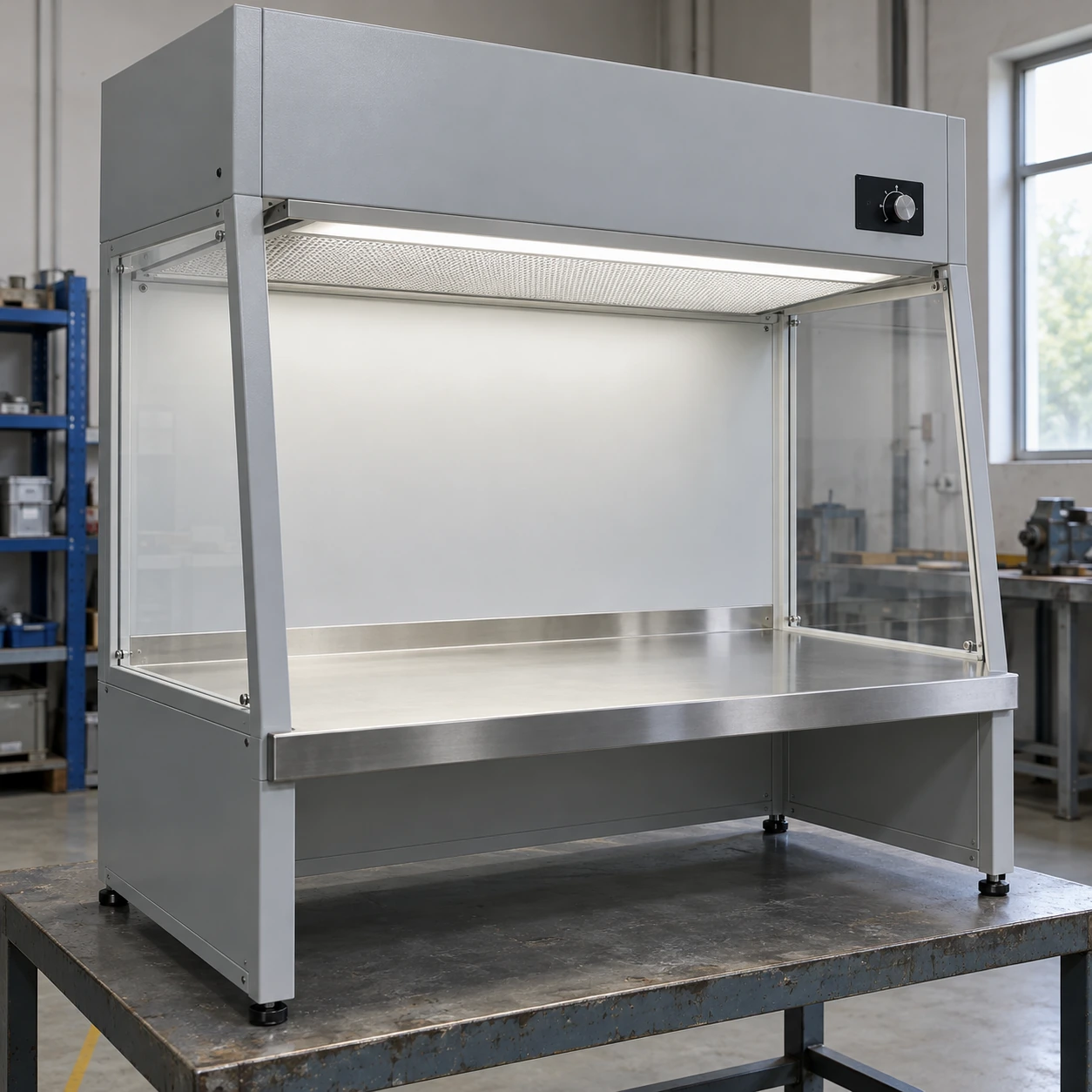
hepa laminar flow hood
| Brand | shengtongJH |
|---|---|
| Air direction | Vertical downflow; product protection only |
| Overall W × D × H | 1060 × 620 × 1850 / 1460 × 620 × 1850 mm, including stand |
| Work zone W × D × H | 935 × 530 × 650 / 1335 × 530 × 650 mm, paired with the respective cabinet |
| Materials | Coated steel body, stainless work surface and glazed sides |
| Final filtration | Sealed HEPA cassette with upstream prefilter |
| Working airflow | Adjustable; 0.3–0.45 m/s setting range selected with the filter and work layout |
| Electrical supply | 220 V, 50/60 Hz; destination-specific supply option |
| Cabinet input selection | 150 / 250 W configurations, excluding equipment plugged into the work area |
| Controls | Fan speed, lighting and manual front access; airflow monitoring option |
Dimensions and electrical figures describe selectable configurations, not interchangeable parts. Final drawings and the complete supplied configuration determine fit and operating duty.
Filter access, work-zone dimensions and airflow monitoring can be customized for the industrial process.
A HEPA laminar flow hood should maintain a useful clean-air path as its filters accumulate dust and its workload changes. The filter, fan and enclosure need to be selected as a working system.
Uniform delivery matters more than one fast reading
A velocity reading at the centre of a hood cannot describe the whole work zone. A fan outlet, uneven plenum or partly obstructed filter can create a fast area beside a much slower one. Sensitive work located in the slower area may receive a different level of protection.
Define the measurement plane and operating arrangement, then evaluate distribution across the relevant area. Increasing the controller setting until one point meets a target can hide rather than resolve an uneven pattern.
What changes as filters load?
Dust adds resistance to the inlet prefilter and final stage. Depending on the fan and control system, airflow may fall or the fan may work harder to maintain output. The operating response should be understood before choosing a maintenance method.
Keep accessible prefilters in the service plan. Neglecting an inexpensive inlet stage can reduce available airflow and increase the load on the final filter.
What changes when equipment moves?
A new fixture may shelter an exposed part or redirect the stream. A large object can also alter how air exits the enclosure. These effects are separate from filter loading.
Record the approved work arrangement so a production change can be assessed against it. Moving an obstruction can be more effective than replacing a filter that is still performing correctly.
Give the operator useful information
Fan status only shows that a motor is commanded to run. An airflow or pressure indication can give more information, but its location and interpretation must match the equipment. A pressure alarm does not independently verify filter integrity or particle cleanliness.
Choose monitoring around the consequence of a change. A repetitive precision task may benefit from a clear operating range and response procedure; an elaborate display adds little if its readings have no defined meaning.
Plan for a repeatable return to service
Store filter dimensions, sealing details and the normal operating baseline with the cabinet record. After work affecting the air path, verify the applicable integrity, airflow and work-zone criteria before production resumes.
This remains product-protection equipment for nonhazardous work. HEPA filtration alone does not provide biological containment or chemical-vapour removal. For a replacement cassette, use the filter compatibility information rather than selecting from nominal hood width.
Filter access, work-zone dimensions and airflow monitoring can be customized for the industrial process.