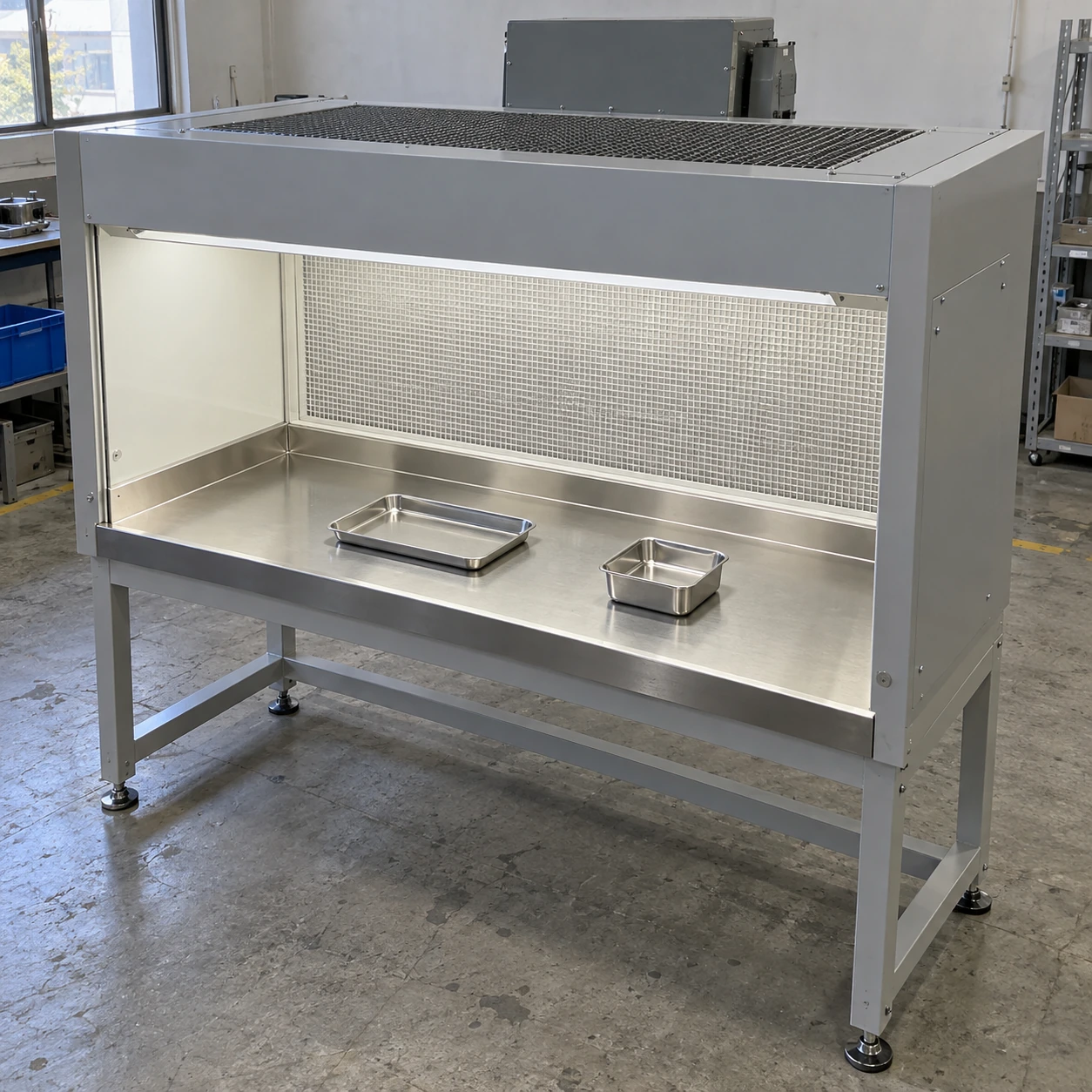
Clean Benches & Local Clean Air Systems
hepa filtered clean bench
| Brand | shengtongJH |
|---|---|
| Air arrangement | Horizontal, rear filter to front work opening |
| Work-zone W × D × H | 1200 × 500 × 570 / 1700 × 500 × 570 mm |
| Cabinet W × D × H | 1300 × 820 × 2040 / 1800 × 820 × 2070 mm, including stand |
| Work surface / housing | 304 stainless steel / powder-coated steel; stainless enclosure option |
| Final filtration | HEPA; H14 selection with matching filter test documentation |
| Air velocity setting | 0.3–0.5 m/s average, selected and checked for the working arrangement |
| Cabinet electrical input | 400 / 500 W configurations; connected instrument loads additional |
| Supply options | 220 V, 50/60 Hz; 110 V, 60 Hz by matched configuration |
| Controls and lighting | Fan adjustment, LED task light; airflow indication option |
| Access and service | Open working face; accessible prefilter and replaceable final filter |
Select one matched cabinet configuration. Working space, outside size and service clearance are different; final dimensions and electrical loads follow the approved equipment schedule.
Prefilter access, monitoring, final-filter interfaces and cabinet dimensions can be customized for your maintenance and operating needs.
A HEPA filtered clean bench needs a service routine that keeps air moving through the intended filter path. Useful maintenance starts with a known working condition and follows changes in the inlet, filter, fan and surrounding room.
Record the condition you want to keep
After installation, retain the fan setting, relevant airflow measurements and the normal equipment layout. If a pressure indicator is fitted, record its reading under that same condition. These records provide a comparison for later changes; an isolated gauge reading without its measurement points or fan setting has limited meaning.
A pressure gauge does not directly count particles or prove the absence of a filter leak. Use each check for its intended purpose. A change in resistance, a change in delivered flow and a failed cleanliness check require related but different investigations.
When airflow falls, start at the accessible inlet
A dirty or obstructed prefilter can restrict the supply before air reaches the final filter. Check that packaging, nearby furniture or stored material has not blocked the inlet. Service the prefilter according to its construction; washable and disposable types need different treatment.
If the inlet is clear, review the fan setting, diffuser condition and final-filter resistance. Do not repeatedly increase fan speed without establishing why performance changed. A loaded filter, a loose fan connection and a new obstruction in the work zone will not be corrected in the same way.
After cleaning
Ensure covers and prefilters are correctly refitted. A cleaning task should not leave an unintended bypass path or liquid near electrical controls.
After relocation
Reassess drafts from doors, diffusers and traffic. A bench can perform differently in a new position even when its hardware is unchanged.
After filter work
Check the installed seal, airflow and required performance evidence. Replacement is a service event, not proof that the work zone is ready.
Clean the surfaces, protect the media
Use a compatible method for the stainless worktop, glass and accessible cabinet surfaces. Avoid spraying liquid into the filter face or brushing contamination onto it. A disposable final filter should not be washed or vacuumed as an improvised way to restore performance.
Keep a damaged panel out of service pending assessment. A dented frame or a torn media area can matter even if the fan still feels strong.
Order a matched spare
Identify frame dimensions, depth, seal arrangement and the pressure characteristic at the intended flow. Compare those details with the offered replacement, rather than ordering from the word HEPA alone.
For a new workstation, the complete fan and filter selection should make future servicing practical. shengtongJH can coordinate compatible components and the documents needed for an informed purchase, without treating ordinary particle filtration as hazardous-emission containment.
Prefilter access, monitoring, final-filter interfaces and cabinet dimensions can be customized for your maintenance and operating needs.