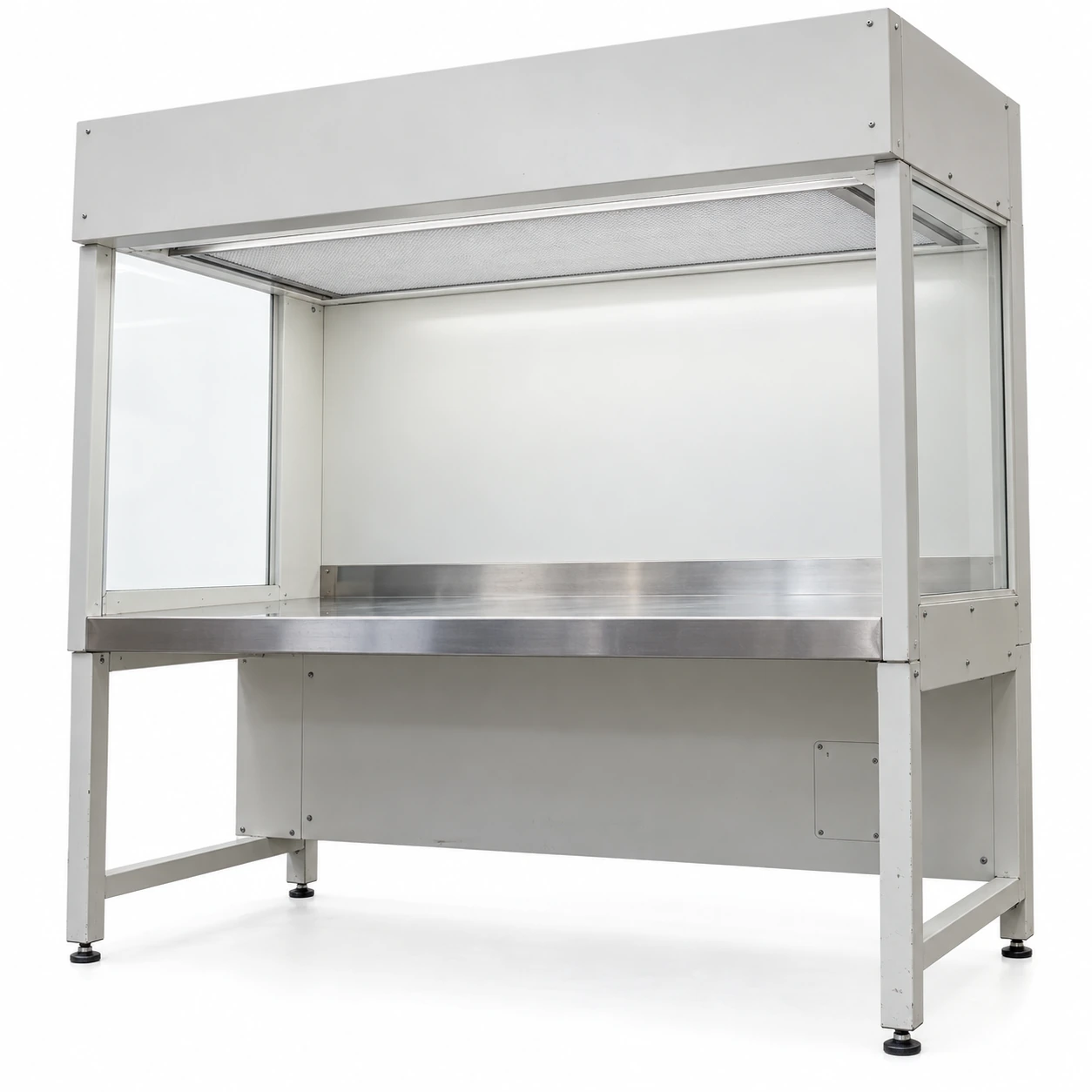
Clean Benches & Local Clean Air Systems
hepa clean bench
| Brand | shengtongJH |
|---|---|
| Air arrangement | Vertical filtered downflow over the work zone |
| Work-zone W × D × H | 1200 × 645 × 610 / 1700 × 645 × 610 mm |
| Cabinet W × D × H | 1300 × 750 × 2040 / 1800 × 750 × 2040 mm, including stand |
| Work surface / housing | 304 stainless steel / powder-coated steel; stainless enclosure option |
| Final filtration | HEPA; H14 selection with matching filter test documentation |
| Air velocity setting | 0.3–0.5 m/s average, selected and checked for the working arrangement |
| Cabinet electrical input | 400 / 450 W configurations; connected instrument loads additional |
| Supply options | 220 V, 50/60 Hz; 110 V, 60 Hz by matched configuration |
| Controls and lighting | Fan adjustment and LED task light; airflow monitor option |
| Work opening | Glass side screens; sash and opening height selected for the task |
Select one matched cabinet configuration. Working space, outside size and service clearance are different; final dimensions and electrical loads follow the approved equipment schedule.
Filter grade, cabinet dimensions, sealing details and monitoring options can be customized to the process and maintenance requirements.
The HEPA filter is the final particle barrier in a HEPA clean bench. The blower, filter seal, diffuser and enclosure must work together to deliver useful filtered air across the exposed task.
The filter rating describes one part of the assembly
A HEPA panel captures particles as air passes through its media. A bench also needs to ensure that the air follows that route. Gaps around the frame, a damaged gasket or a distorted retaining surface can allow bypass, so a high filter rating alone cannot establish the cleanliness of the working zone.
Specify the required filter classification and its corresponding test documentation. Ratings stated at a particular particle size and classifications based on the most penetrating particle size should not be treated as interchangeable labels. The offered panel, frame and test identity need to agree.
Match the blower to the filter resistance
Replacing a panel with a higher-resistance construction can reduce the air delivered by the same fan. Increasing the control setting may restore some flow, but it can also raise noise and power demand, and it cannot exceed the fan's operating capability.
Choose a fan/filter combination with a useful service range. Compare the pressure and airflow condition at the intended duty, including the upstream prefilter. A physically fitting panel is not automatically an equivalent replacement.
Use the diffuser to supply the work
The diffuser distributes air leaving the filter. Downstream fixtures, lights or screens can then change that pattern. The relevant question is whether the working surface receives the intended flow with the normal equipment present.
Protection is local to that arrangement. A clear test area and a crowded production setup can behave differently even with the same filter. Avoid treating a nominal filter grade as a guarantee for every loading condition.
HEPA filtration does not remove every contaminant
A particle filter is not a general gas-treatment system. Ordinary clean benches do not capture hazardous vapours or provide biological containment. They also do not control every source of contamination already on the product, tools or operator's gloves.
Keep the replacement interface traceable
Record the final filter's outside dimensions, depth, frame construction, gasket location and retaining method. Keep its identification with the equipment records. This reduces the risk of ordering a visually similar panel that cannot seal correctly or requires a different fan duty.
Support the frame during handling and protect the media from fingers, tools and cleaning liquids. Following replacement, verify the installed condition and any specified integrity and work-zone checks before restarting sensitive operations. The HEPA filtered clean bench maintenance guide explains how prefilter condition, settings and service history help distinguish the likely causes of reduced performance.
Filter grade, cabinet dimensions, sealing details and monitoring options can be customized to the process and maintenance requirements.