Clean Benches & Local Clean Air Systems
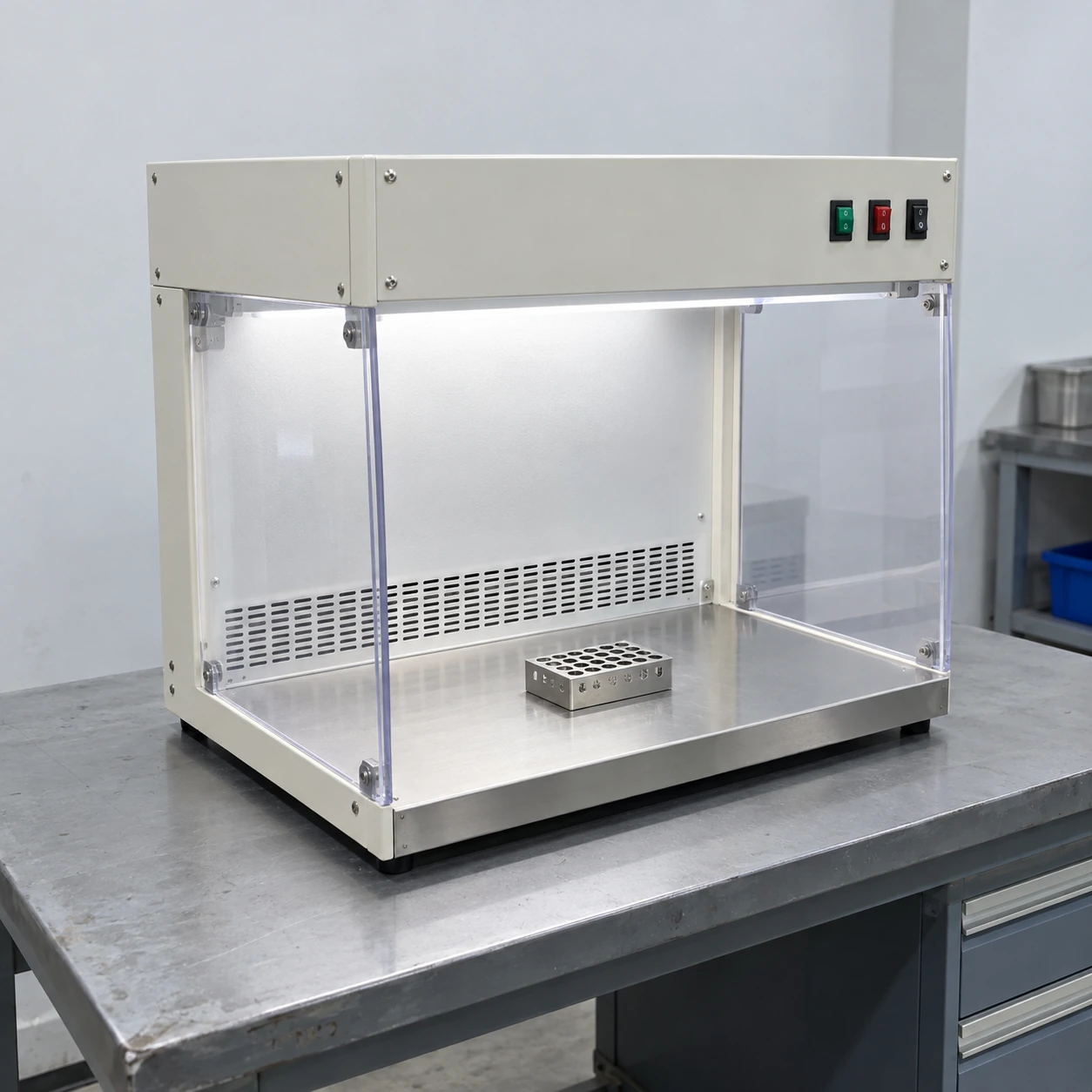
desktop laminar flow hood
| Brand | shengtongJH |
|---|---|
| Installation | Benchtop vertical clean-air enclosure |
| Compact overall W × D × H | 680 × 410 × 1160 mm; supporting counter excluded |
| Compact work zone W × D × H | 630 × 375 × 615 mm |
| Wider bench configuration | Overall 933 × 629 × 1080 mm; work zone about 908 × 610 × 730 mm |
| Surfaces | Coated metal body; cleanable tray and transparent side panels |
| Air treatment | Inlet prefilter and final HEPA filter |
| Airflow adjustment | Matched fan/filter control; installed work-zone uniformity to be verified |
| Electrical options | 220 V, 50/60 Hz or 110 V, 60 Hz, selected as a complete configuration |
| Work lighting | Integrated lighting with separate switching |
These are industrial and laboratory workstation formats. The support table is separate, and the final enclosure drawing determines clear access and usable space.
Tray dimensions, side screens, lighting and control details can be customized for the small-workpiece application.
A desktop laminar flow hood is a compact industrial clean-air workstation for a limited task. It is most useful when the work fits comfortably inside without turning the enclosure into a storage area.
Give one task a defined clean-air position
Small optical parts, precision assemblies and inspection fixtures can need a protected work zone without needing a full room enclosure. A compact hood concentrates the clean-air supply around that position and keeps the equipment close to the operator.
The benefit depends on a controlled load. If trays, tools and packaging fill every corner, the nominal enclosure size no longer represents a usable working area. Keep bulk materials outside and bring in only the items needed for the current operation.
Reach is part of the internal dimension
A short operator or a high support counter can make the rear of the tray difficult to reach. Repeated stretching encourages large arm movements through the clean-air path. Choose the counter height and enclosure opening together, using the normal tool and viewing position.
Lighting should illuminate the component without requiring a loose lamp to sit in the air stream. Where magnification is used, check that the viewing device and cables do not obstruct the filter face or the critical surface.
Stable support
The counter should support the complete cabinet and task load without rocking. Vibration from nearby equipment can be a problem for fine inspection even when it does not visibly move the enclosure.
Clear intake
Do not fill the space above or behind the inlet with storage boxes. An attractive compact fit under a shelf can leave inadequate air or service access.
Keep the role limited and repeatable
This is a product-protection station for assessed nonhazardous work, not a household air purifier, room clean-up device or biological containment cabinet. Mammalian cell culture requires an appropriate biological safety cabinet selected through the laboratory assessment.
Define the normal arrangement of fixtures and trays, then verify the relevant work-zone performance after installation. Relocation or a major layout change should trigger review of the affected conditions. A small cabinet is easier to move than a floor-standing station, but its performance still depends on where and how it operates.
For a wider task or a heavy instrument, compare a floor-standing vertical hood before forcing the process into a compact enclosure.
Tray dimensions, side screens, lighting and control details can be customized for the small-workpiece application.