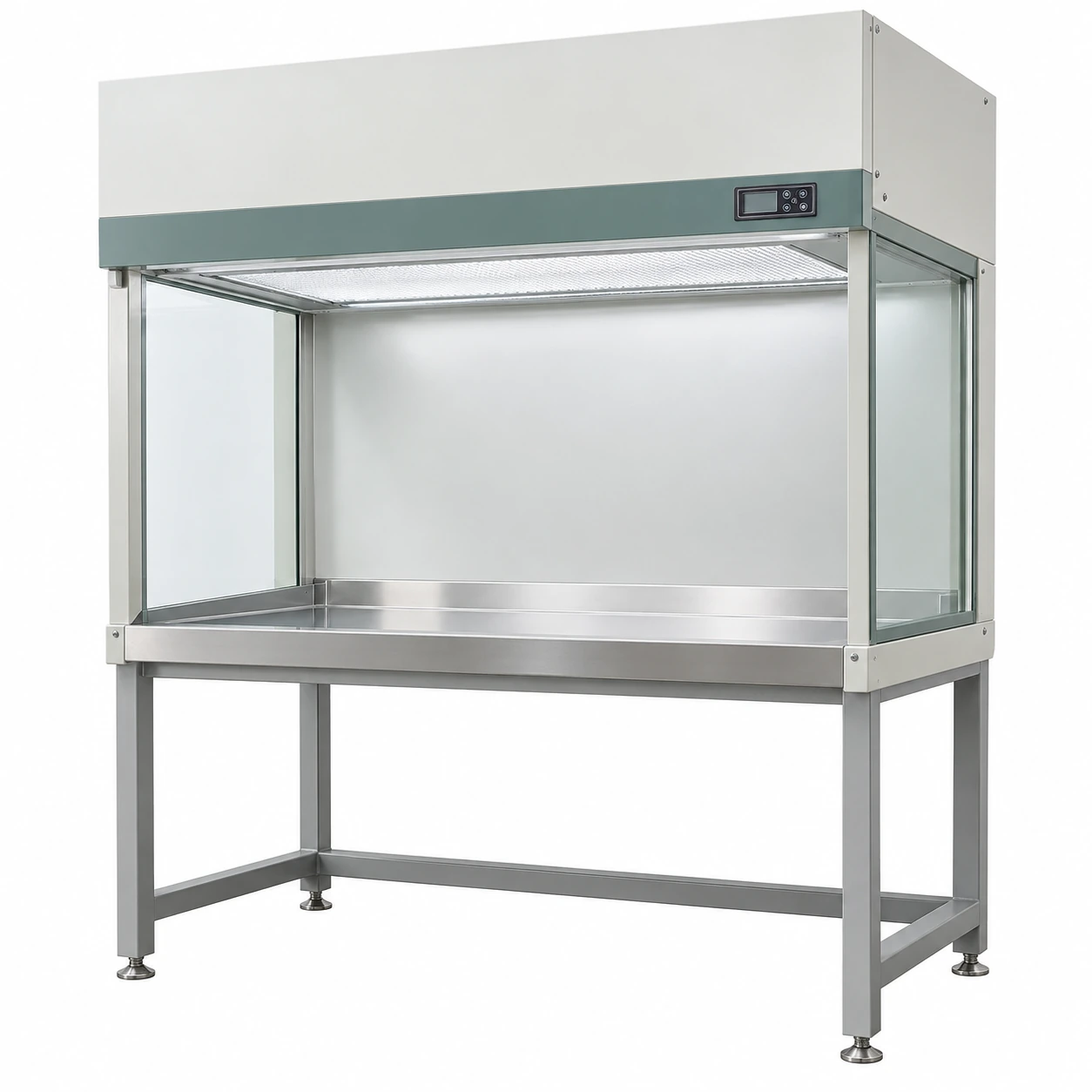
Clean Benches & Local Clean Air Systems
vertical laminar flow hood
| Brand | shengtongJH |
|---|---|
| Air direction | Vertical downflow; product protection only |
| Overall W × D × H | 1060 × 620 × 1850 / 1460 × 620 × 1850 mm, including stand |
| Work zone W × D × H | 935 × 530 × 650 / 1335 × 530 × 650 mm, paired with the respective cabinet |
| Materials | Coated steel body, stainless work surface and glazed sides |
| Final filtration | Sealed HEPA cassette with upstream prefilter |
| Working airflow | Adjustable; 0.3–0.45 m/s setting range selected with the filter and work layout |
| Electrical supply | 220 V, 50/60 Hz; destination-specific supply option |
| Cabinet input selection | 150 / 250 W configurations, excluding equipment plugged into the work area |
| Controls | Fan speed, lighting and manual front access; airflow monitoring option |
Dimensions and electrical figures describe selectable configurations, not interchangeable parts. Final drawings and the complete supplied configuration determine fit and operating duty.
Cabinet width, working height, access opening and service connections can be customized for the application.
A vertical laminar flow hood delivers filtered air from above the work surface. Its overhead supply can accommodate a different arrangement of equipment than a rear-filter horizontal bench.
Leave a path from the filter to the product
Vertical flow reaches the top of a fixture first. A broad lid, tray or instrument can shelter the area beneath it, while the stream divides around its edges. A taller cabinet provides clearance but does not remove this effect.
Place the exposed product where air can reach it directly. Use the actual equipment layout when assessing the working zone; an empty-bench result does not show what happens after a large instrument is installed.
Height must include the operation
A fixture may fit when closed but need more room to lift its cover, exchange a tool or remove a finished part. Include these movements in the working envelope. Route cables and small services so they do not hang across the supply face.
The front opening and the clear internal height are different dimensions. Check both for loading, and ensure operators can reach the task without lifting parts into the filter protector.
The work surface shapes the exit path
Air meeting a solid worktop changes direction and leaves the enclosure. Deep bins and crowded storage can create recirculating pockets near the task. Keep the quantity of material inside limited to the operation being performed.
A recirculating clean bench may include return grilles. Their presence alone does not make it a biological safety cabinet; the full containment design and verification determine that distinction.
Use it where product cleanliness is the requirement
Suitable nonhazardous applications include preparation of clean precision parts, inspection fixtures and selected assembly tasks. Dust-generating cutting or abrasive work should be kept out of the protected zone or handled with a separately designed control system.
A vertical clean bench does not provide personnel or environmental containment. Do not select it for mammalian cell culture, infectious material or hazardous chemical manipulation on the strength of its downward airflow.
For installation, check top inlet clearance, filter withdrawal space and the effect of nearby ventilation outlets. Clean the accessible surfaces with compatible materials and keep a record of the normal airflow. A new obstruction, changed room diffuser or replacement filter is a reason to reassess the affected work zone.
Cabinet width, working height, access opening and service connections can be customized for the application.