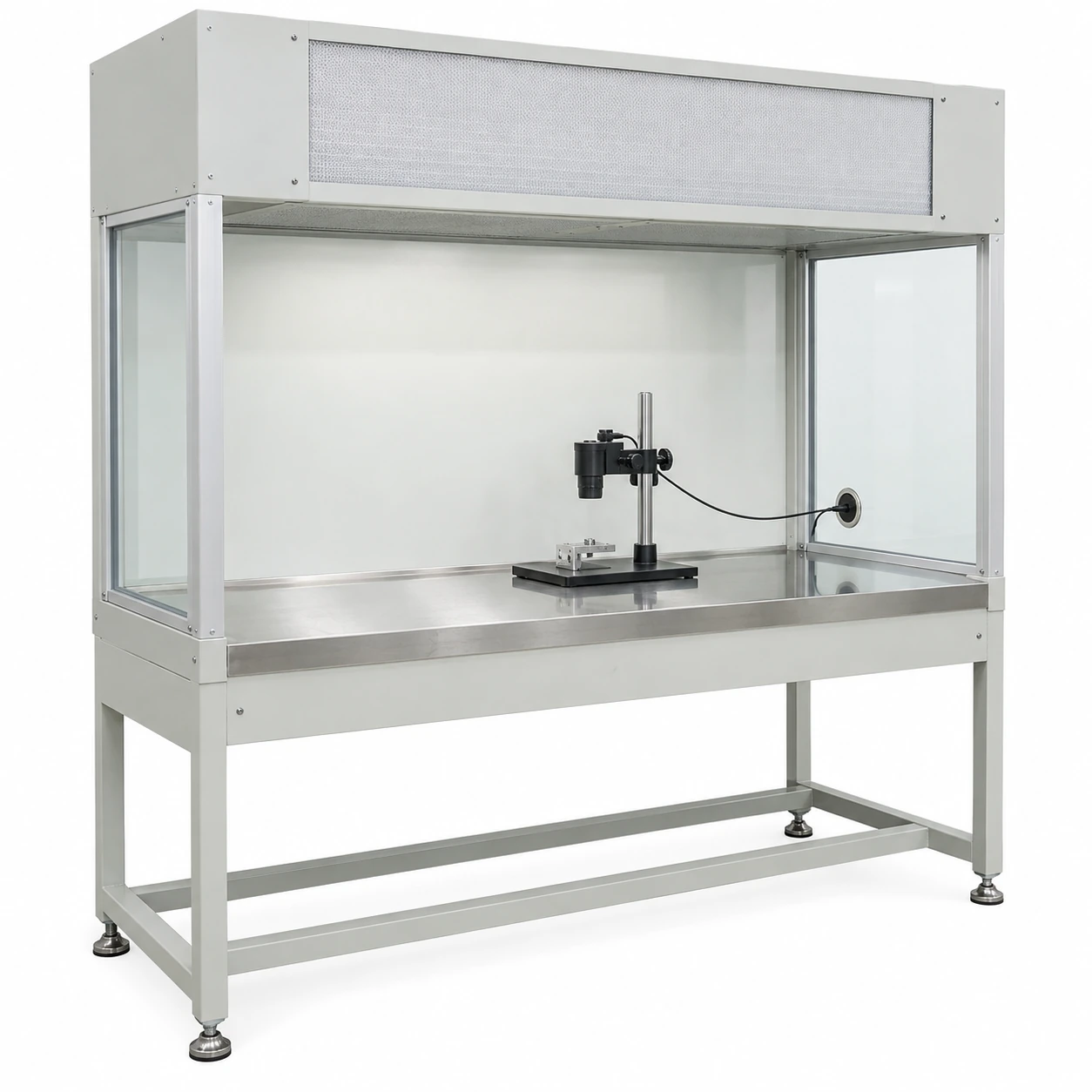
Clean Benches & Local Clean Air Systems
customized vertical laminar flow clean bench
| Brand | shengtongJH |
|---|---|
| Air arrangement | Vertical filtered downflow over the work zone |
| Work-zone W × D × H | 1200 × 645 × 610 / 1700 × 645 × 610 mm |
| Cabinet W × D × H | 1300 × 750 × 2040 / 1800 × 750 × 2040 mm, including stand |
| Work surface / housing | 304 stainless steel / powder-coated steel; stainless enclosure option |
| Final filtration | HEPA; H14 selection with matching filter test documentation |
| Air velocity setting | 0.3–0.5 m/s average, selected and checked for the working arrangement |
| Cabinet electrical input | 400 / 450 W configurations; connected instrument loads additional |
| Supply options | 220 V, 50/60 Hz; 110 V, 60 Hz by matched configuration |
| Controls and lighting | Fan adjustment and LED task light; airflow monitor option |
| Work opening | Glass side screens; sash and opening height selected for the task |
| Custom interfaces | Work height, fixture clearance, cable/tube pass-throughs and access layout |
| Dimension control | Standard size options above; modified dimensions defined on the approved drawing |
Select one matched cabinet configuration. Working space, outside size and service clearance are different; final dimensions and electrical loads follow the approved equipment schedule.
Working height, width, enclosure depth, services and fixture interfaces can be customized following the process layout and agreed performance requirements.
A customized vertical laminar flow clean bench is developed around the equipment and movement that standard cabinet dimensions cannot accommodate. Changes to height, width or access must preserve a useful filtered-air path to the product.
Define the task envelope before the cabinet envelope
Include the product, fixture, instrument and every movement needed during the operation. An opening may need to accommodate a raised lid, a tool change or removal of a finished assembly. A drawing of the instrument in its parked position can miss these requirements.
Mark the surfaces that need direct filtered air. The cabinet can then be arranged around them, rather than enlarged uniformly in every direction. This keeps the custom design focused on a useful working result.
Geometry
Set clear internal dimensions and access openings separately from outer size. Include operator reach, cleaning space and the delivery route.
Air delivery
Coordinate the filter, diffuser and fan with the larger or differently shaped work area. Added width or depth changes the required air distribution.
Interfaces
Locate service penetrations and controls where they can be reached without crossing exposed work or preventing panel removal.
A taller cabinet is not automatically a better cabinet
More clearance can make a large fixture easier to load, but an overhead obstruction may still shield the product. Review the instrument shape and the direction air takes around it. Changing the fixture position or separating a preparation stage may solve the problem more effectively than a taller enclosure.
Large heat sources and instrument cooling fans deserve attention because they can change local airflow. The custom design should account for the normal operating state, not only a static empty cabinet.
Keep services accessible
Cable and tube pass-throughs should suit the actual connectors and cleaning method. Avoid placing them where a filter cannot be withdrawn or a service cover cannot be removed. Specify accessory loads separately from the cabinet's own electrical demand.
Where a fixture needs a drain, gas connection or other specialised service, assess that service and the process independently. A custom fitting does not establish chemical or biological containment.
Freeze the agreed design before manufacture
Record the approved drawing, materials, included accessories and test condition. A later change to the fan, filter or opening may affect the work-zone performance and should be reviewed accordingly.
Site acceptance should use representative equipment where the process requires it. Retain the final configuration so replacement components can be matched during future service.
Coordinate the complete purchase
shengtongJH can coordinate a custom configuration with the selected equipment supplier and the site's installation interfaces. State the exposed process, instrument envelope and required evidence. Where a standard vertical laminar flow clean bench already fits the task, it can provide a simpler service arrangement; custom work is useful when it solves a defined operational need.
Working height, width, enclosure depth, services and fixture interfaces can be customized following the process layout and agreed performance requirements.