Clean Benches & Local Clean Air Systems
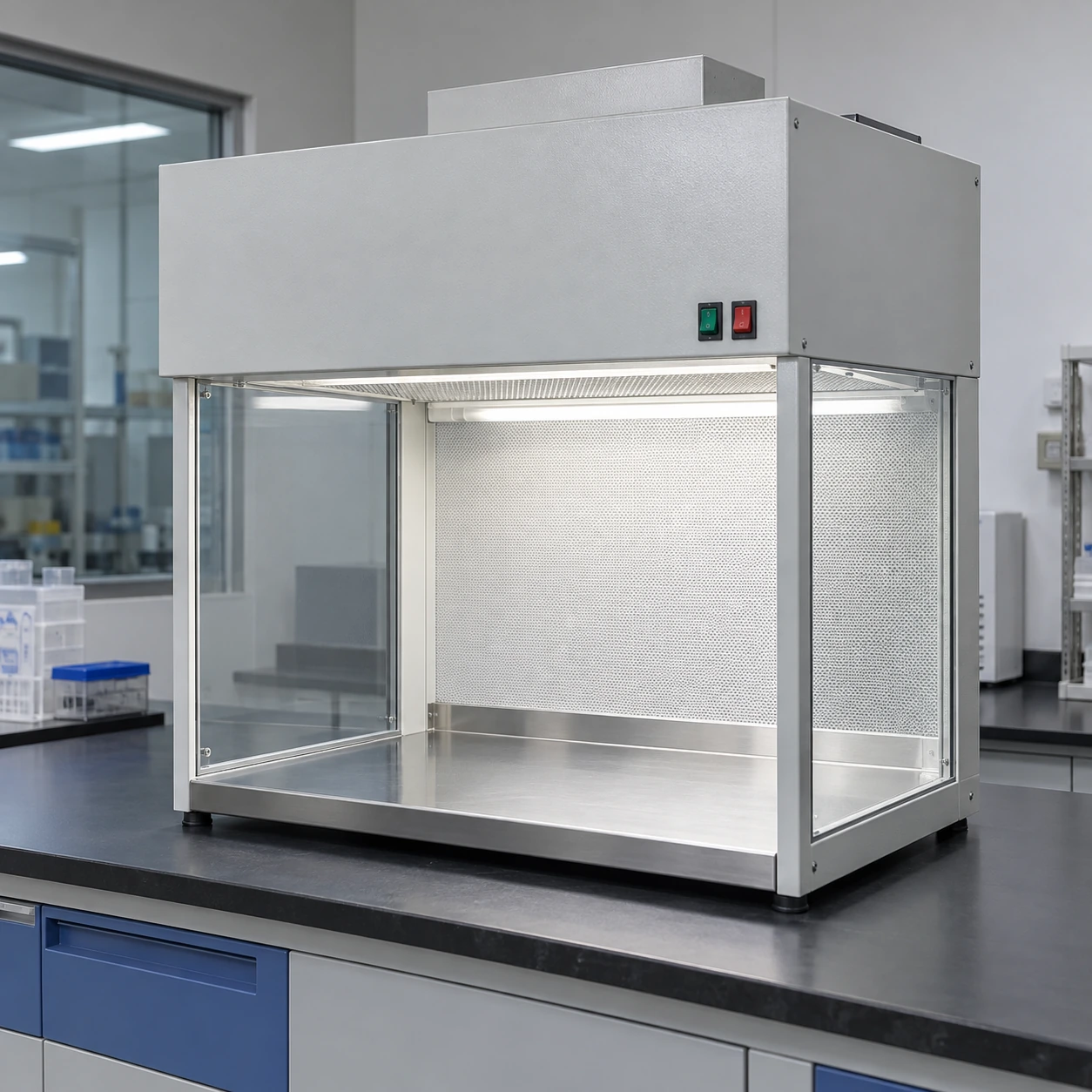
benchtop laminar flow hood
| Brand | shengtongJH |
|---|---|
| Installation | Benchtop vertical clean-air enclosure |
| Compact overall W × D × H | 680 × 410 × 1160 mm; supporting counter excluded |
| Compact work zone W × D × H | 630 × 375 × 615 mm |
| Wider bench configuration | Overall 933 × 629 × 1080 mm; work zone about 908 × 610 × 730 mm |
| Surfaces | Coated metal body; cleanable tray and transparent side panels |
| Air treatment | Inlet prefilter and final HEPA filter |
| Airflow adjustment | Matched fan/filter control; installed work-zone uniformity to be verified |
| Electrical options | 220 V, 50/60 Hz or 110 V, 60 Hz, selected as a complete configuration |
| Work lighting | Integrated lighting with separate switching |
The compact and wider dimensions describe separate equipment formats. Confirm countertop load capacity and the final enclosure drawing before installation.
Enclosure width, tray material, side screens and control arrangement can be customized to the workbench and process.
A benchtop laminar flow hood places a small clean-air enclosure on an existing counter. The supporting furniture, room airflow and service clearance become part of the installation.
The counter is part of the equipment decision
A cabinet can fit the available width yet overhang the counter or leave no room for its power connection. Confirm the supporting depth and stability with the complete load. A light office desk can transmit movement or deflect when instruments are added.
Consider working height after placing the enclosure on the counter. Raising the tray too far above a seated operator makes precise handling difficult and encourages awkward reaching through the opening.
Measure the usable space inside
The external outline includes the fan housing, filter and side structure. The useful working zone is smaller. Place the largest tray or fixture inside a proposed layout and allow room for hands, tools and movement without contacting the filter face.
A compact station works well when one controlled task uses a limited set of clean components. It becomes less useful if every operation requires removing equipment, storing supplies against the filter or repeatedly passing objects across the product.
Routine access
Keep the loading direction clear of neighbouring instruments. Position consumables outside the enclosure until needed, so the protected zone remains usable.
Service access
A fixed shelf immediately above the hood may block the inlet or filter removal. Confirm the access route before securing the enclosure to its counter.
A compact footprint still needs a suitable room position
Doorways, ceiling supply jets and moving people can disturb the open working face. Set the enclosure in a stable location with a clear intake rather than carrying it between rooms as if it were an ordinary appliance.
Use the station for assessed nonhazardous preparation, inspection or assembly. It supplies product-protecting clean air; a small enclosure does not provide biological containment, vapour capture or room environmental control.
Record the normal loaded arrangement when commissioning. After relocation, confirm that airflow and required cleanliness remain suitable in the new location. The desktop configuration focuses on small repeatable tasks, while a floor-standing bench can offer a more flexible working envelope.
Enclosure width, tray material, side screens and control arrangement can be customized to the workbench and process.