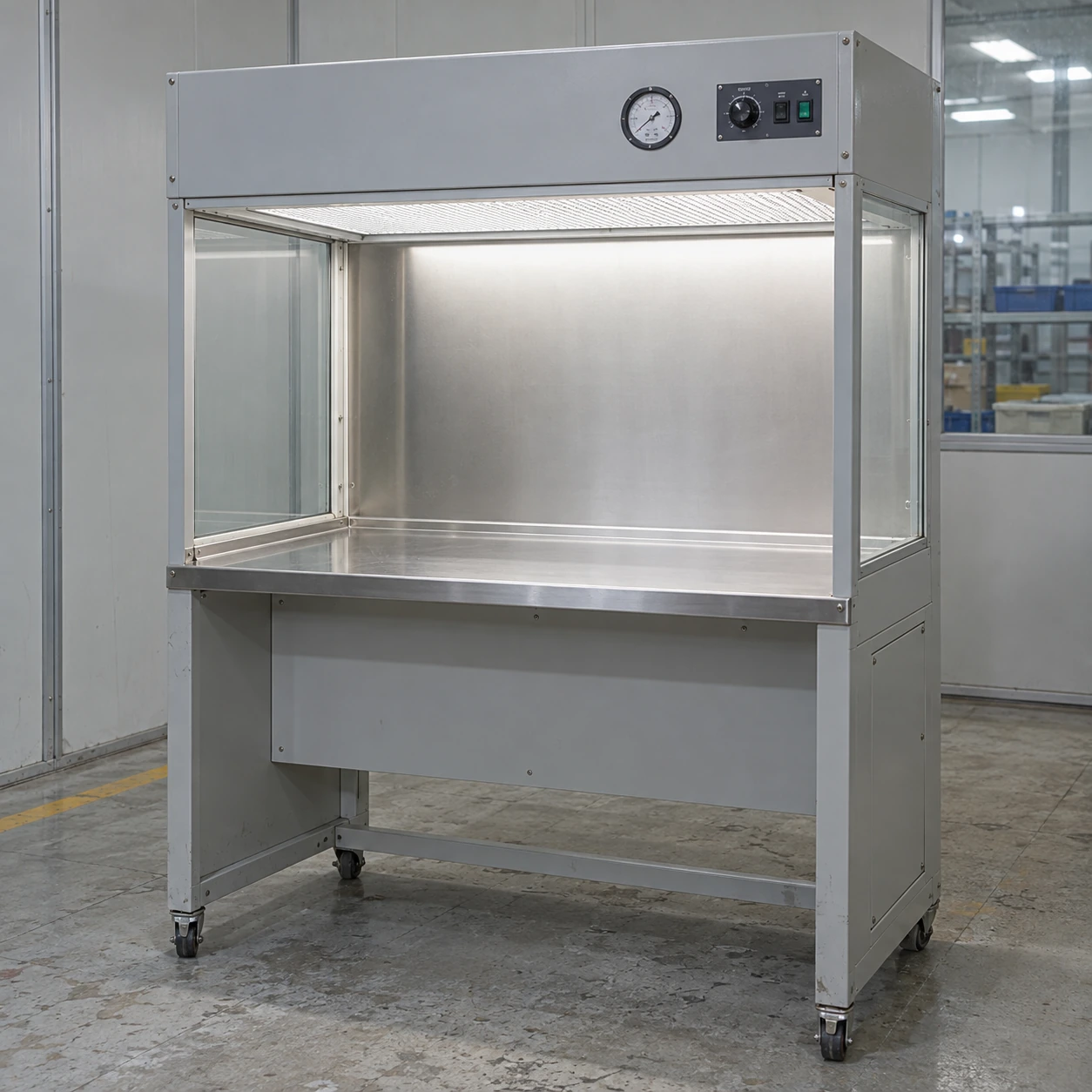
Clean Benches & Local Clean Air Systems
air flow clean bench
| Brand | shengtongJH |
|---|---|
| Air arrangement | Vertical filtered downflow over the work zone |
| Work-zone W × D × H | 1200 × 645 × 610 / 1700 × 645 × 610 mm |
| Cabinet W × D × H | 1300 × 750 × 2040 / 1800 × 750 × 2040 mm, including stand |
| Work surface / housing | 304 stainless steel / powder-coated steel; stainless enclosure option |
| Final filtration | HEPA; H14 selection with matching filter test documentation |
| Air velocity setting | 0.3–0.5 m/s average, selected and checked for the working arrangement |
| Cabinet electrical input | 400 / 450 W configurations; connected instrument loads additional |
| Supply options | 220 V, 50/60 Hz; 110 V, 60 Hz by matched configuration |
| Controls and lighting | Fan adjustment and LED task light; airflow monitor option |
| Work opening | Glass side screens; sash and opening height selected for the task |
Select one matched cabinet configuration. Working space, outside size and service clearance are different; final dimensions and electrical loads follow the approved equipment schedule.
Airflow controls, monitoring points, working dimensions and access arrangements can be customized to the intended process.
Air flow is what carries filtered air from the cabinet to the exposed task. A useful clean bench specification considers direction and distribution as well as the average velocity shown on a data sheet.
More air is not always better protection
Increasing blower speed can disturb lightweight parts, affect an open balance or create stronger interaction with objects on the table. The objective is a suitable, consistent working flow. A high reading at one point does not establish that the whole task receives the same air supply.
Separate three different questions
- Is enough air passing through the system? The inlet, prefilter, final filter and fan operating point influence the delivered volume. A restriction upstream can reduce output even with an undamaged final filter.
- Is air reaching the exposed surface? The diffuser and normal equipment layout determine distribution. A large object can create a local sheltered region while the average velocity elsewhere remains acceptable.
- Is the surrounding room disturbing the opening? A doorway, nearby supply jet or passing trolley can create intermittent effects that disappear when the area is empty.
These questions prevent a common purchasing error: replacing the whole bench when the main problem is a changed layout or unsuitable position.
Use indicators for the quantities they measure
A fan speed display reports a control setting or motor condition. A pressure gauge compares pressure at its connected points. An airflow sensor measures at its own location. None of them automatically reports particle cleanliness throughout the work zone.
Choose monitoring around the decision operators need to make, and define what action follows an abnormal indication. An alarm that has no agreed response can become a signal people ignore.
Make comparisons under the same condition
Record measurement positions, loading, screen opening and control setting. Comparing a loaded operating bench with an empty cabinet at another setting can suggest a fault where the conditions have simply changed.
When a trend appears, inspect the accessible components and recent changes first. Look for blocked intake area, a dirty prefilter, altered fixtures or a different room-air setting before increasing fan speed.
Specify a workstation, not an isolated air-speed number
For a new purchase, identify the sensitive surface, required working envelope and material behaviour in moving air. Decide whether rear-to-front or downward delivery is more suitable. Then specify the fan/filter duty, control range and acceptance checks for that configuration.
shengtongJH can coordinate these elements with the enclosure and installation interfaces. For filter-related selection, see the HEPA clean bench. If the process releases hazardous material, the requirement is containment and cannot be resolved by adjusting an ordinary clean bench's airflow.
Airflow controls, monitoring points, working dimensions and access arrangements can be customized to the intended process.