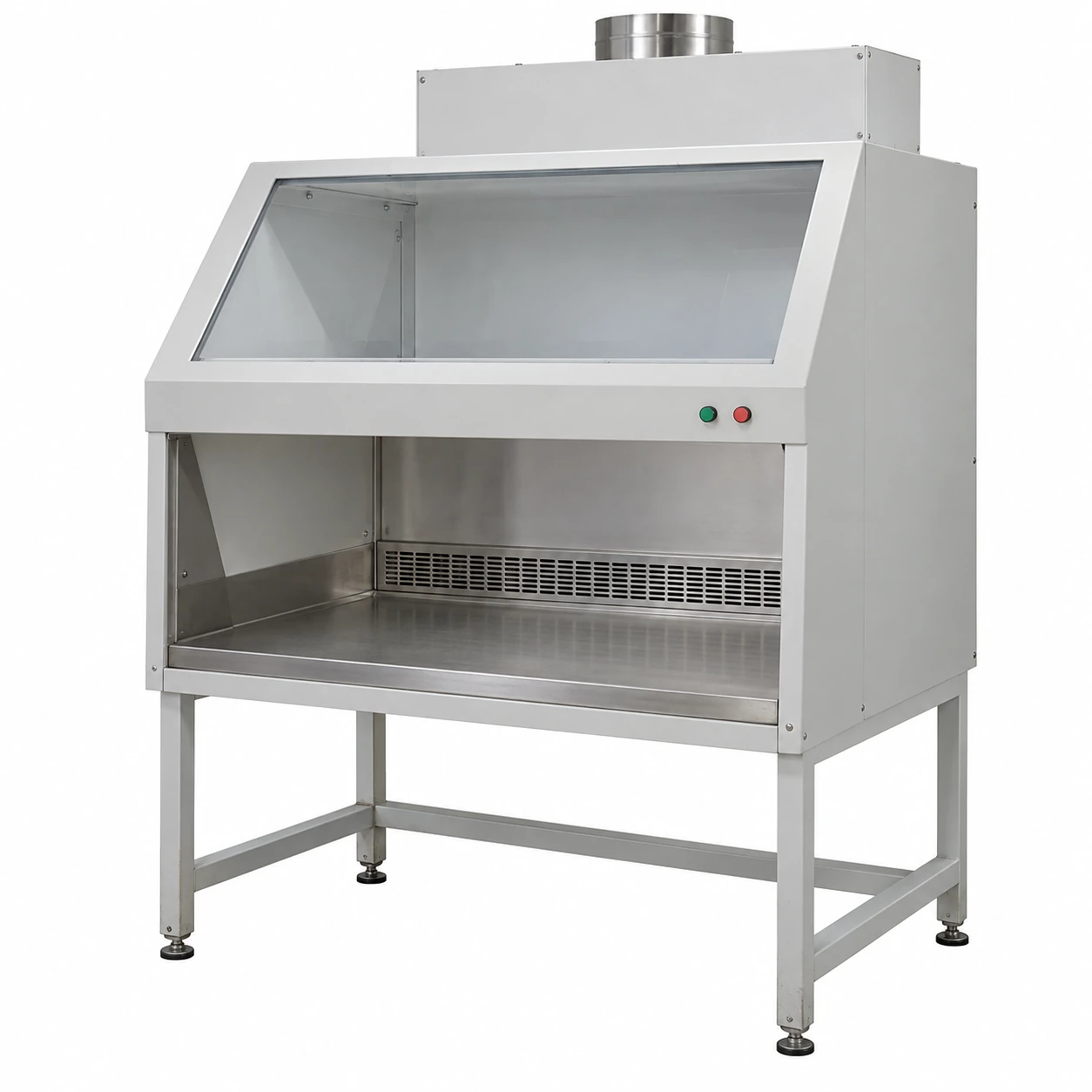
Biological Safety Cabinets
class 1 biological safety cabinet
| Brand | shengtongJH |
|---|---|
| Protection principle | Open-front inward airflow; personnel and environmental protection without product protection |
| Cabinet body W × D × H (mm) | 1000 × 725 × 1275 or 1200 × 725 × 1275; support bench selected separately |
| Alternative wider formats | Nominal 1500 or 1800 mm work widths; overall body size depends on the selected construction |
| Work surfaces | Stainless steel tray and interior; access-panel and cleaning arrangements selected to suit the task |
| Air filtration | HEPA exhaust filtration; prefiltration and additional stages according to the selected cabinet |
| Exhaust arrangement | Filtered return to room or outdoor duct connection, selected for the assessed materials and facility |
| Controls / power | Airflow indication, audible and visible low-airflow alarm; 220–230 V single-phase supply as configured |
| Support / installation | Existing bench or compatible floor stand; seated/standing working height and service access options |
Cabinet-body dimensions exclude the support bench, ductwork and service clearances. Work-zone dimensions and the tested opening position are specified with the selected cabinet; nominal width is not the clear loading width.
Cabinet width, support height, exhaust connection and service interfaces can be customized for the intended process and laboratory layout.
A Class I biological safety cabinet draws room air into an open-front enclosure and passes the extracted air through particulate filtration. Its purpose is personnel and environmental protection; it does not provide the product protection of a Class II cabinet.
Does the task need product protection?
This is the first selection question. Room air enters a Class I cabinet and passes across the working space before extraction. That movement helps contain airborne particles generated inside, but room-borne contamination can still reach the material being handled. The cabinet therefore suits assessed activities where protecting the operator and surroundings is required and product protection is unnecessary.
When contamination of the material would spoil the task, a different biological safety cabinet configuration may be needed. A clean bench has a different purpose again: providing clean air to a product does not establish operator containment. Selecting by similar cabinet appearance can produce the wrong protection arrangement.
The working opening and extraction act together
A glass front does not form a sealed barrier during normal Class I operation. Containment depends on the inward air movement across the defined access opening. Increasing that opening or changing the exhaust conditions can affect performance. The usable opening position, airflow monitoring and alarm arrangement should therefore belong to the same selected configuration.
The filter treats particles in the extracted air. It does not make every material suitable for a filtered return to the room: gases and vapours need separate assessment, and a HEPA filter is not a general chemical-vapour control device. Adding a carbon stage does not turn a biological cabinet into a universal chemical fume hood.
Fit the enclosure around the equipment
Space to use the instrument
A chamber can contain a small laboratory instrument, but its footprint alone does not establish suitability. Allow for moving lids, loading trays and the operator's access to controls. A tall object close to the extraction path or a heat-producing device can alter local airflow. The intended equipment arrangement should be considered in cabinet selection and installation assessment.
Space to bring it in
Nominal cabinet width, clear work width and maximum loading aperture describe different things. An instrument that fits behind the window may still be too large to pass through the normal opening. A larger hinged access panel can help loading and cleaning, while the cabinet must return to its approved operating arrangement before use.
A larger cabinet provides layout flexibility but occupies more bench space and can demand more extracted or replacement air. Choose capacity around the complete task rather than simply selecting the widest available unit.
Choose the exhaust route with the room
Filtered room discharge
Where the assessed activity and selected cabinet permit it, filtered discharge avoids installing an outdoor duct. It still releases air and equipment heat into the room. Outlet clearance and the room's air distribution remain relevant.
Outdoor extraction
A ducted configuration needs a compatible exhaust connection and building provision. An unmatched external fan can change the cabinet's operating conditions. Agree the fan responsibility, airflow controls, alarm interface and on-site verification before connecting the equipment.
Location
Door traffic, open windows and supply-air jets can disturb the open-front boundary. Positioning the cabinet away from these influences helps the intended air pattern remain stable. Maintenance space above and around the enclosure also needs to remain accessible.
Keep serviceability in the purchase specification
Filter loading changes resistance as the cabinet is used. A fan running audibly is not evidence that the required airflow is present, which is why monitoring and a clear low-airflow alarm matter. Accessible filters, a cleanable tray and identified replacement parts reduce avoidable downtime.
Filter replacement and work on potentially contaminated internal parts require the facility's approved decontamination and service arrangements. Installation assessment and periodic verification establish performance for the actual location. shengtongJH coordinates equipment sourcing and configuration requirements; the supply scope should distinguish the cabinet, support, duct connection and specialist commissioning services so that these responsibilities are clear.
Cabinet width, support height, exhaust connection and service interfaces can be customized for the intended process and laboratory layout.