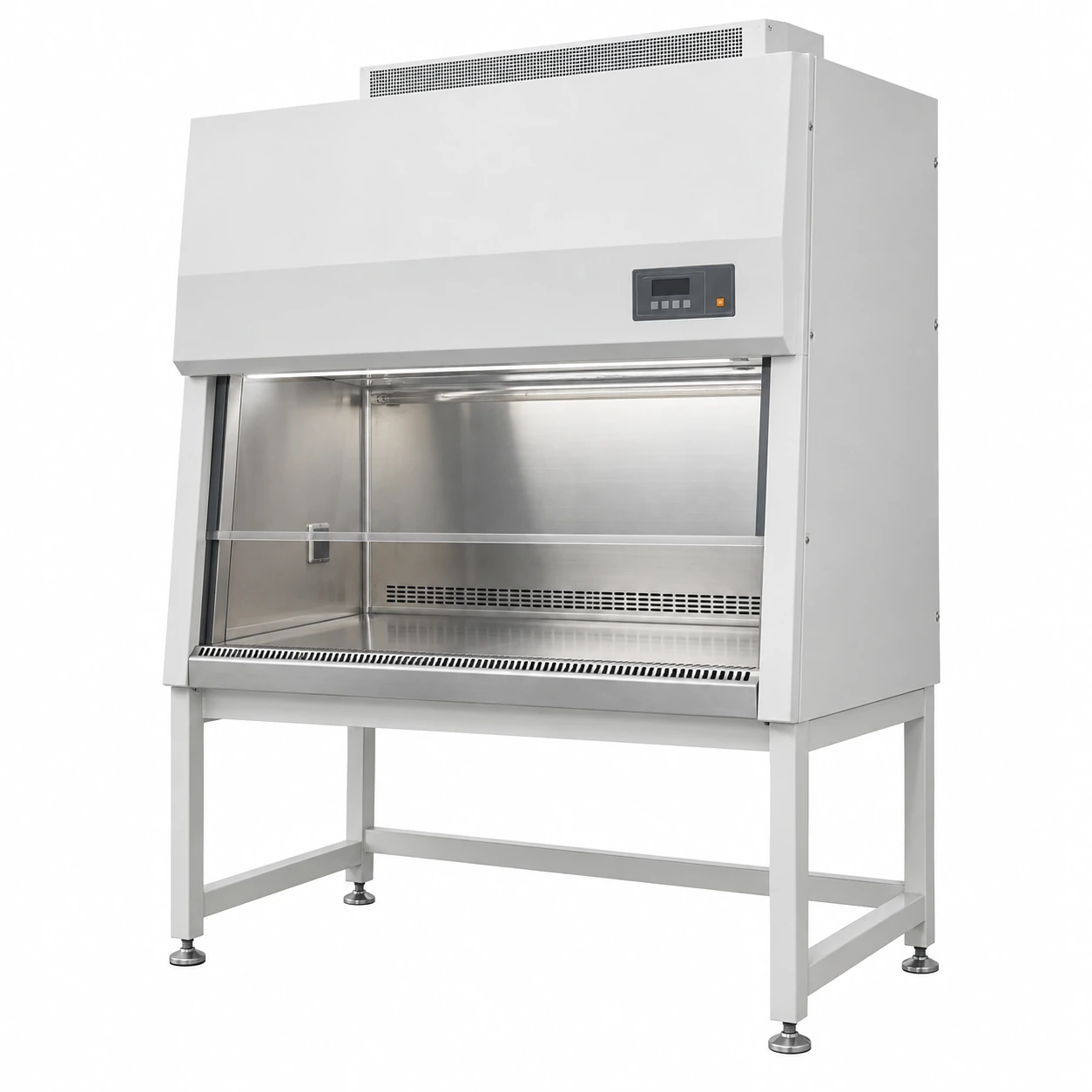
Biological Safety Cabinets
biosafety laminar flow hood
| Brand | shengtongJH |
|---|---|
| Equipment selection | Class II biological safety cabinet; containment type selected from the laboratory risk assessment |
| Work zone W × D × H | 1000 × 520 × 640 / 1300 × 520 × 640 mm |
| Overall dimensions | Set by cabinet type, stand and exhaust arrangement; working dimensions are not the delivery envelope |
| Air system | HEPA-filtered downflow and exhaust with inward airflow at the front opening |
| A2 option | Partial air recirculation; exhaust connection follows the selected cabinet design |
| B2 option | Total exhaust with dedicated compatible building extraction |
| Surfaces | Coated steel cabinet and stainless steel work area |
| Power supply | 220 V, 50 Hz; destination-specific selection |
| Controls | Sash position indication, airflow monitoring and applicable alarms |
| Installation acceptance | Field verification of airflow, filter integrity, alarms and exhaust interfaces |
The configuration refers to a biological safety cabinet. An ordinary laminar-flow clean bench cannot acquire containment capability from its name or filter label.
Working width and service interfaces can be configured to the assessed laboratory application within the selected cabinet design.
“Biosafety laminar flow hood” is an ambiguous purchasing term. Where biological containment is required, specify the appropriate biological safety cabinet and its protection functions explicitly.
Replace the mixed label with a defined cabinet function
A Class II biological safety cabinet uses controlled inward airflow at its front opening together with filtered work-zone air and exhaust. Those functions distinguish it from a clean bench that directs supply air over a product and back into the room.
A supplier description should identify the cabinet type, intended application and installation requirements. “Biosafety” printed beside “laminar” is not evidence that an enclosure offers the required containment.
Match the cabinet to the assessed procedure
The biological material, operations that may generate aerosols, equipment inside the cabinet and any associated chemicals all affect selection. Mammalian cell culture should not be assigned to an ordinary clean bench on the assumption that clean air alone protects staff.
A2 recirculation and B2 total-exhaust arrangements have different room-service requirements. HEPA filters remove particles rather than vapours, so chemical compatibility and allowed use must follow the specific cabinet and laboratory assessment.
Work-zone layout
Leave intake and return grilles unobstructed. Fit the largest instrument without forcing the critical task outside the intended working area.
Room position
Keep the opening away from strong draughts and frequent passing traffic. Provide access for testing and service around the cabinet.
Installed evidence
Agree the airflow, filter integrity, sash and alarm checks required for the actual cabinet and exhaust interface.
Separate procurement from permission to operate
Supplying a cabinet does not complete the laboratory's risk assessment, training or maintenance arrangements. The responsible laboratory team should define the procedure and acceptance requirements, while the supplier and installer provide the relevant equipment information and installation scope.
Keep service access in the layout. A filter or internal component used with hazardous material may require specialist decontamination before work. Do not treat it like an ordinary replacement filter in a nonhazardous clean-air bench.
For enquiries, describe the procedure and room exhaust provision alongside the required working width. The existing cabinet options provide a starting point for that discussion.
Working width and service interfaces can be configured to the assessed laboratory application within the selected cabinet design.