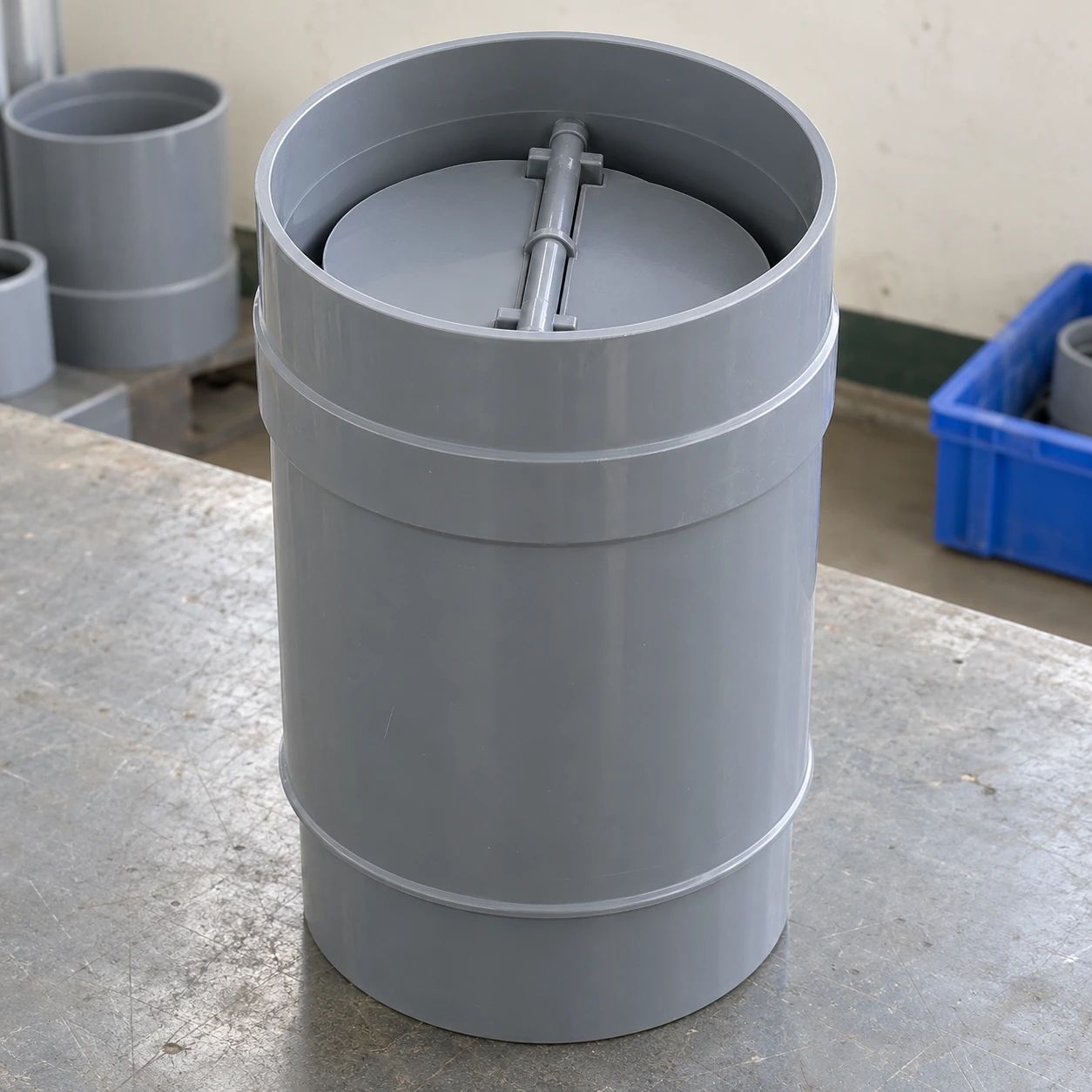
Air Volume Control Dampers
pvc backdraft dampers
| Duct Ø × damper height H | 160 × 330 mm; 200 × 350 mm; 250 × 380 mm; 315 × 420 mm |
|---|---|
| Body and moving parts | Rigid PVC body; PVC flap and shaft options for the selected construction |
| Connections | Socket-and-spigot construction; matching duct dimensions and joint method required |
| Operation | Gravity non-return action without an electric drive |
| Mounting | Installed plane, hinge position and airflow direction matched to the specific damper design |
| Exposure conditions | Chemical identity, concentration, condensate and air-stream temperature reviewed together |
| Duty selection | Opening resistance, reverse pressure and allowable leakage specified for the ventilation system |
Ø identifies the nominal duct connection size; H is the damper height. Neither defines socket outside diameter or installed length after joint insertion. Metric and nominal inch pipe systems must be checked by their actual mating dimensions.
PVC damper connections, dimensions and internal materials can be customized to compatible ductwork, exposure conditions and the required airflow direction.
PVC backdraft dampers provide a non-return function in ventilation ducts where rigid PVC is compatible with the air stream. Their purpose is to limit reverse airflow; selecting a corrosion-resistant body does not by itself establish compatibility of the flap, shaft, seals and joining materials.
Assess the complete wetted and exposed assembly
Rigid PVC can be useful where an ordinary metal duct component is unsuitable for the chemical exposure. The assessment still needs the actual substances, concentrations and temperatures. A broad description such as acid exhaust is not enough: different substances and mixtures can behave differently, particularly when moisture condenses on the damper.
Trace the air path through the body, flap, shaft, bearings and any sealing material. Include the socket joint or adhesive system as well. A resistant housing does not protect an incompatible seal or metal pivot hidden inside it. Conversely, a fully plastic mechanism removes some metal exposure but still needs its own mechanical and chemical limits to be respected.
Normal air stream
Identify the operating mixture and temperature, including changes during a production cycle. Material selection should cover the actual range rather than only the nominal room condition.
Condensate and deposits
Liquid collecting on the flap or seat can create a different exposure from dry air. Deposits can also obstruct closure even where the PVC itself remains compatible.
Cleaning exposure
A cleaning chemical may differ from the material normally extracted. Check the cleaning method and its contact conditions before applying it to the body, joints or seals.
Match the pipe system by dimensions
A metric ventilation connection and a nominal inch pipe size can sound similar without fitting together. Confirm the mating outside diameter, socket bore, engagement depth and permitted joint method. A quoted duct diameter alone does not identify every one of those dimensions.
Socket-and-spigot connections also change the installed length after engagement. Leave enough straight duct and removal space for the selected joints. If a transition is needed, include it in the supported duct arrangement rather than distorting a socket to accommodate a mismatch.
Support the duct without distorting the body
The damper should not be used to pull misaligned pipework into position or carry an unsupported duct run. Loads at its sockets can alter the body shape and interfere with a lightweight flap. Coordinate the nearby supports and any movement allowance with the duct-system design.
Where routine removal is necessary, use a suitable accessible connection arrangement. A permanently joined damper hidden above services may be difficult to inspect when a flap sticks, even though the original installation was compact.
Specify the hinge orientation, not just the pipe direction
Gravity provides the closing action only when the flap arrangement is installed as intended. A design for an upright duct is not automatically suitable when laid on its side. Other constructions can serve horizontal ducts with a different hinge position. The correct installation must follow the drawing for the exact assembly.
Include an airflow direction and installed orientation in the order. Before the surrounding duct is closed up, the installer should be able to establish that the flap moves through its intended range and returns correctly. A reversed body, an intrusive fixing or excess joining material in the moving area can prevent operation even when the nominal connection size is correct.
Non-return action is not hazardous-gas isolation
A gravity flap needs a closing force and a suitable seat, and some reverse leakage may remain. Do not treat a general PVC backdraft damper as a gas-tight process valve or as evidence that fumes cannot return to an occupied area. Define the required containment and shutdown functions as part of the exhaust-system design.
Likewise, PVC construction alone does not establish suitability for high-temperature, combustible or explosive service. Those duties require separately selected equipment and documented system requirements. A temperature limit quoted for one PVC damper should not be applied to every resin, seal or duct connection.
Plan for deposits and replacement parts
Inspect the flap seat, pivot and accessible body surfaces at intervals appropriate to the process. Remove deposits using a compatible procedure and check for sticking, cracking or distortion before returning the system to service. Increasing fan pressure is not a repair for a binding flap.
Retain the selected material description and connection drawing for replacements. Two grey plastic dampers may differ in resin, internal construction and joint dimensions. Identifying those details makes it easier to replace the part without introducing a new compatibility or fit problem into the ventilation system.
PVC damper connections, dimensions and internal materials can be customized to compatible ductwork, exposure conditions and the required airflow direction.