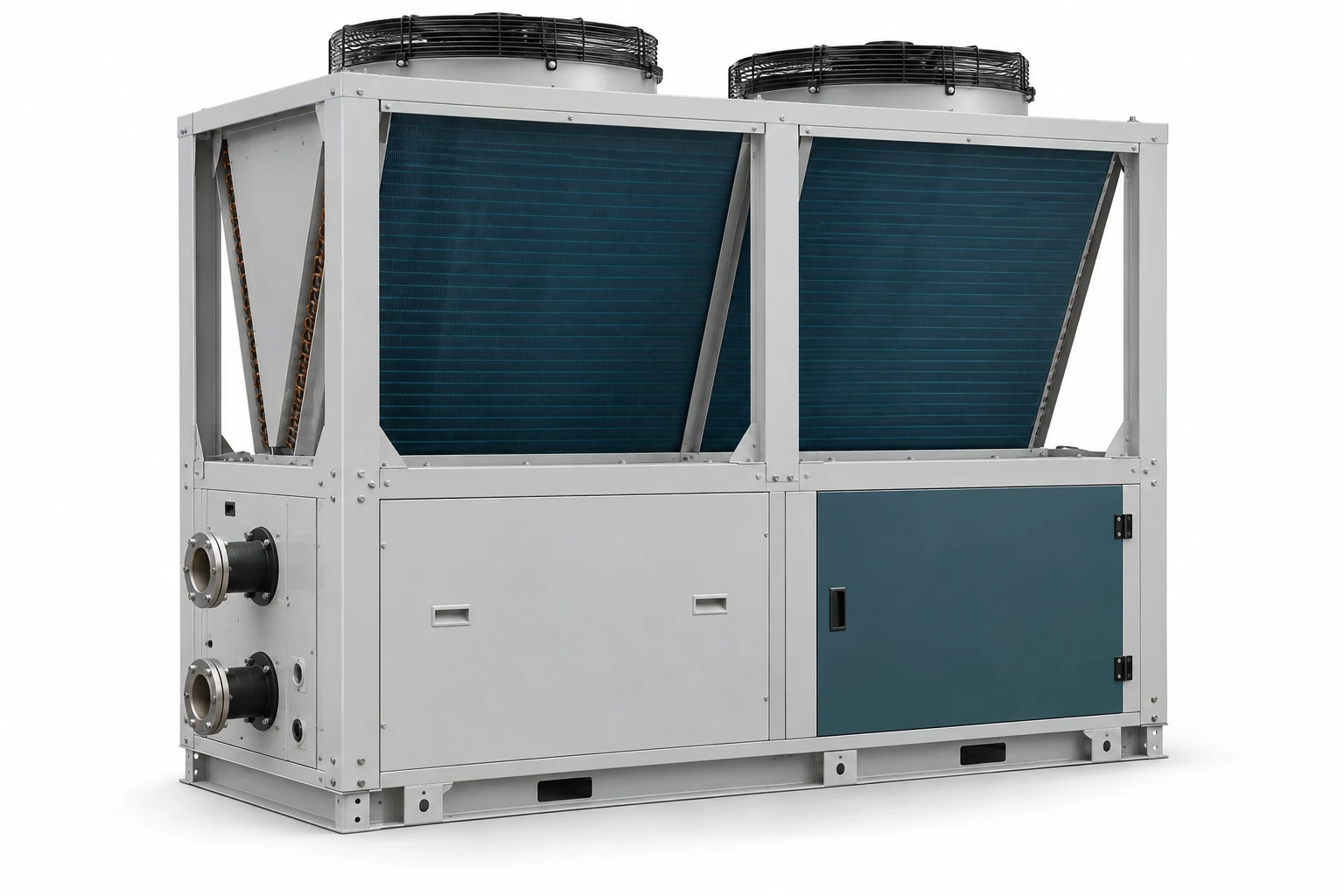
Air-to-Water Heat Pumps
air to water heat pump
| Brand | shengtongJH |
|---|---|
| Equipment type | Outdoor packaged reversible air-to-water heat pump |
| Nominal capacity classes | Approximately 30 / 65 / 110 kW; heating and cooling selections specified separately |
| Heating selection | Common leaving-water duties: 35°C, 45°C or 55°C; output selected at the winter design ambient |
| Cooling selection | Common comparison condition: water 12/7°C entering/leaving, outdoor air 35°C |
| Electrical input | Specified separately for heating and cooling at the selected duty; not equal to thermal capacity |
| Power supply | 380–415 V / three-phase / 50 Hz configurations; destination alternatives by selection |
| Envelope options, W × D × H (mm) | Approximately 1,800 × 1,000 × 2,000 or 2,300 × 1,150 × 2,250, depending on capacity and architecture |
| Water side | Plate heat exchanger; integral or separate pump, buffer and expansion equipment |
| Control options | Water-temperature control, mode changeover, flow proving, defrost and remote alarms |
| Construction | Coated steel cabinet with finned outdoor coil; site-specific corrosion protection options |
These are selectable equipment classes. Final capacity, input, dimensions and operating limits are supplied as a matched configuration at the agreed duty conditions.
Capacity, water-side equipment, enclosure and control interfaces can be customized for your industrial application and site conditions.
An air to water heat pump transfers heat between outdoor air and a circulating water system. A reversible industrial unit can supply warm water in heating mode and chilled water in cooling mode, serving compatible air handlers, fan coils or process heat exchangers.
Heat delivered through water
Match the water temperature to the work
The unit is only one part of the heat-transfer path. Water carries energy to a coil, jacket or heat exchanger, which must deliver it at the required rate. Existing equipment designed for very hot boiler water may provide less heat at a heat pump's lower supply temperature. Check the receiving equipment before selecting the outdoor unit.
Lower heating-water temperature generally reduces the refrigeration temperature lift, provided it still satisfies the load. In cooling mode, a warmer chilled-water setpoint can also be useful where the process and humidity requirements allow it. The appropriate setting follows the application rather than the widest advertised temperature range.
Select for winter performance
Heating output and electrical input change with outdoor temperature and required water temperature. A nominal capacity at mild conditions does not establish the duty available on the coldest operating day. Obtain a selection for that condition and decide whether supplementary capacity is required.
Allow for defrost
Moisture can freeze on the outdoor coil during heating. The selected unit needs a defrost strategy and suitable water-side support. Drain the resulting water away from access routes and arrange the base so ice cannot obstruct airflow or equipment drainage.
Heating and cooling are separate operating duties
A conventional two-pipe reversible package supplies either warm or chilled water through one circuit. It does not provide both simultaneously. A facility with cooling demand in one zone and heating demand in another needs a suitable plant arrangement, separate units or purpose-designed heat-recovery equipment.
Make the outdoor installation serviceable
Preserve intake and discharge airflow, access to coil cleaning and the route for replacing major components. Protect exposed water circuits against freezing during shutdown as well as operation. Refrigerant choice, operating envelope and electrical protection must match the equipment and destination requirements.
For several loads or staged units, the system page explains how circulation and control fit together.
Capacity, water-side equipment, enclosure and control interfaces can be customized for your industrial application and site conditions.