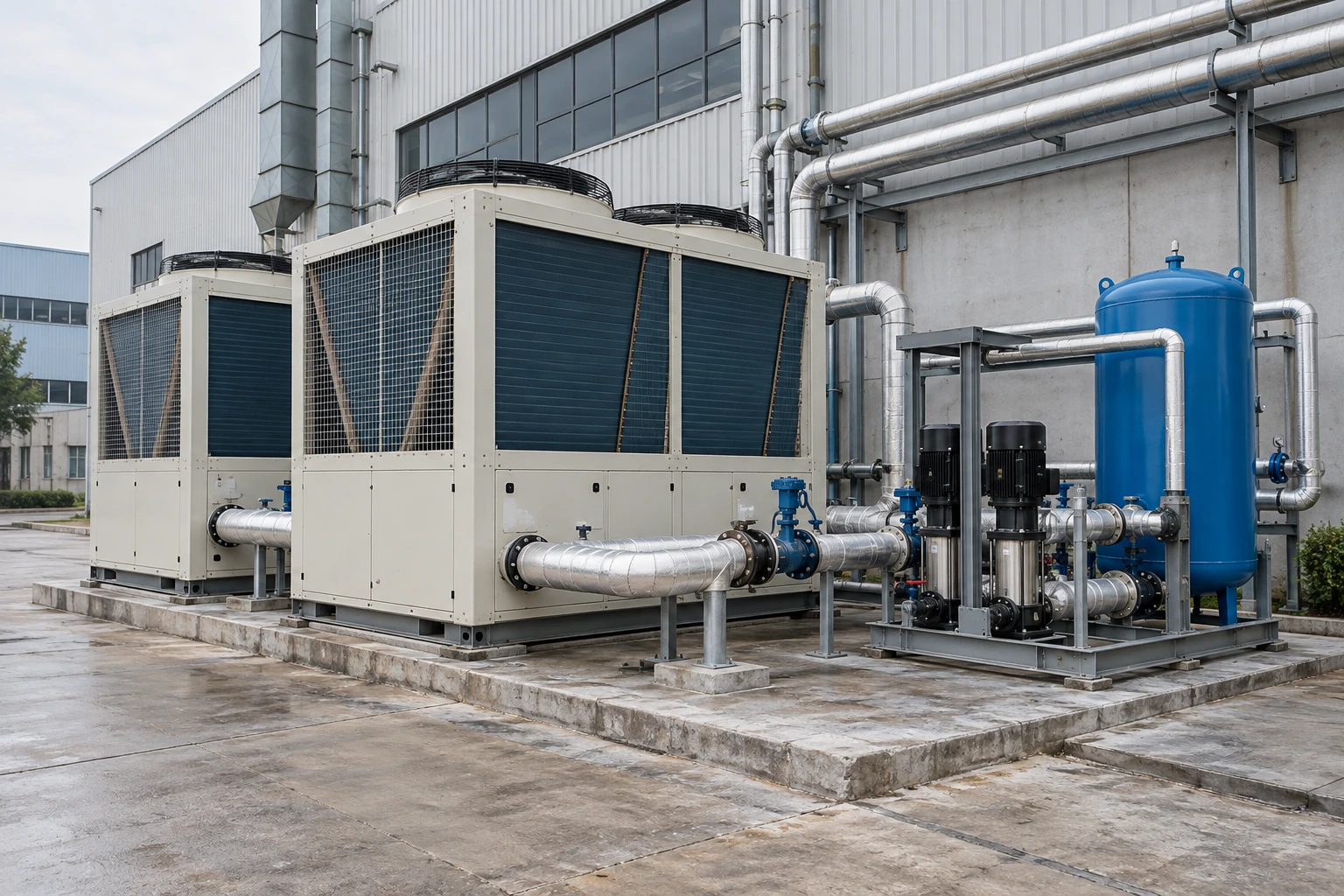
Air-to-Water Heat Pumps
air to water heat pump system
| Supply brand | shengtongJH |
|---|---|
| Plant arrangements | Single package, parallel modules or coordinated heating and cooling banks |
| Module capacity classes | 30 / 65 / 110 kW nominal classes; selected output depends on duty |
| Distribution | Two-pipe changeover; separate hot/chilled circuits where simultaneous demand requires them |
| Water temperatures | Heating supply selected around 35–55°C; chilled-water duty commonly selected at 7–15°C |
| Pump arrangement | Constant primary or approved variable-primary circulation; secondary pumps where needed |
| Storage | Buffer volume selected from active capacity, cycling limits and defrost requirements |
| Module envelope options, W × D × H (mm) | Approximately 1,800 × 1,000 × 2,000 or 2,300 × 1,150 × 2,250; hydraulic skid and vessels additional |
| Electrical scope | Three-phase module feeds, pump feeds and any auxiliary heating identified separately |
| Plant controls | Lead/lag, mode arbitration, flow interlocks, defrost coordination and alarm handling |
| Expansion / protection | Expansion vessel, air separation, filtration and freeze-protection strategy matched to the loop |
Plant size includes more than the outdoor units. Final layout must include hydraulic equipment, airflow clearances, service aisles and the selected operating sequence.
Module quantity, hydraulic layout, buffer storage and controls can be customized to your load profile and expansion requirements.
An air to water heat pump system combines outdoor units, water circulation, thermal storage and load-side equipment. Good system design keeps the units within their operating limits while delivering useful heating or cooling to each connected circuit.
Give the plant one clear operating decision
Independent room or process controllers can request incompatible modes. A plant controller should determine whether a common two-pipe loop is heating or cooling, then coordinate valves, pumps and setpoints. Merely sending opposite requests to the same heat pump does not create simultaneous output.
If a facility genuinely needs both modes at once, map the concurrent loads. Separate banks connected to suitable hot- and chilled-water distribution, or an appropriate multi-pipe heat-recovery system, may be needed. The piping and controls must support the chosen equipment architecture.
Establish the flow path
Confirm valves are in their required positions, start circulation and prove adequate flow before enabling the unit. A pump command is not evidence that water reaches the heat exchanger.
Match active capacity
Stage modules to follow the load while respecting minimum run times and flow limits. Rotate duty where appropriate without causing unnecessary changeovers.
Handle an interruption
Define responses to lost flow, unit faults and power restoration. Coordinate defrost and supplementary heat so a temporary operating event does not cause uncontrolled supply-temperature changes.
Buffering and expansion have different jobs
A buffer adds active thermal mass and can support stable operation. An expansion vessel accommodates changes in fluid volume in a closed loop. Select each for its function. A vessel connected where little water passes through it may contribute less useful buffering than its labelled volume suggests.
Separate incompatible circuits
A process requiring special fluid quality or pressure may need a secondary heat exchanger. Include its temperature approach and pressure loss in equipment selection. Water treatment, flushing and suitable filtration protect the plant after new pipework is installed.
Check the smallest operating condition
A system sized for peak winter duty may have very little demand in mild weather. Compare the smallest active output with that load and ensure sufficient circulation remains when zone valves close. The same review is needed in cooling mode; a heating-only commissioning sequence will miss seasonal problems.
Prepare an operating handover
Record mode priorities, sensor locations, pump settings and alarm responses. Test the agreed operating states during commissioning, including a changeover and reduced-load operation where site conditions permit. Keep future module connections and electrical provision accessible if expansion is planned.
Module quantity, hydraulic layout, buffer storage and controls can be customized to your load profile and expansion requirements.