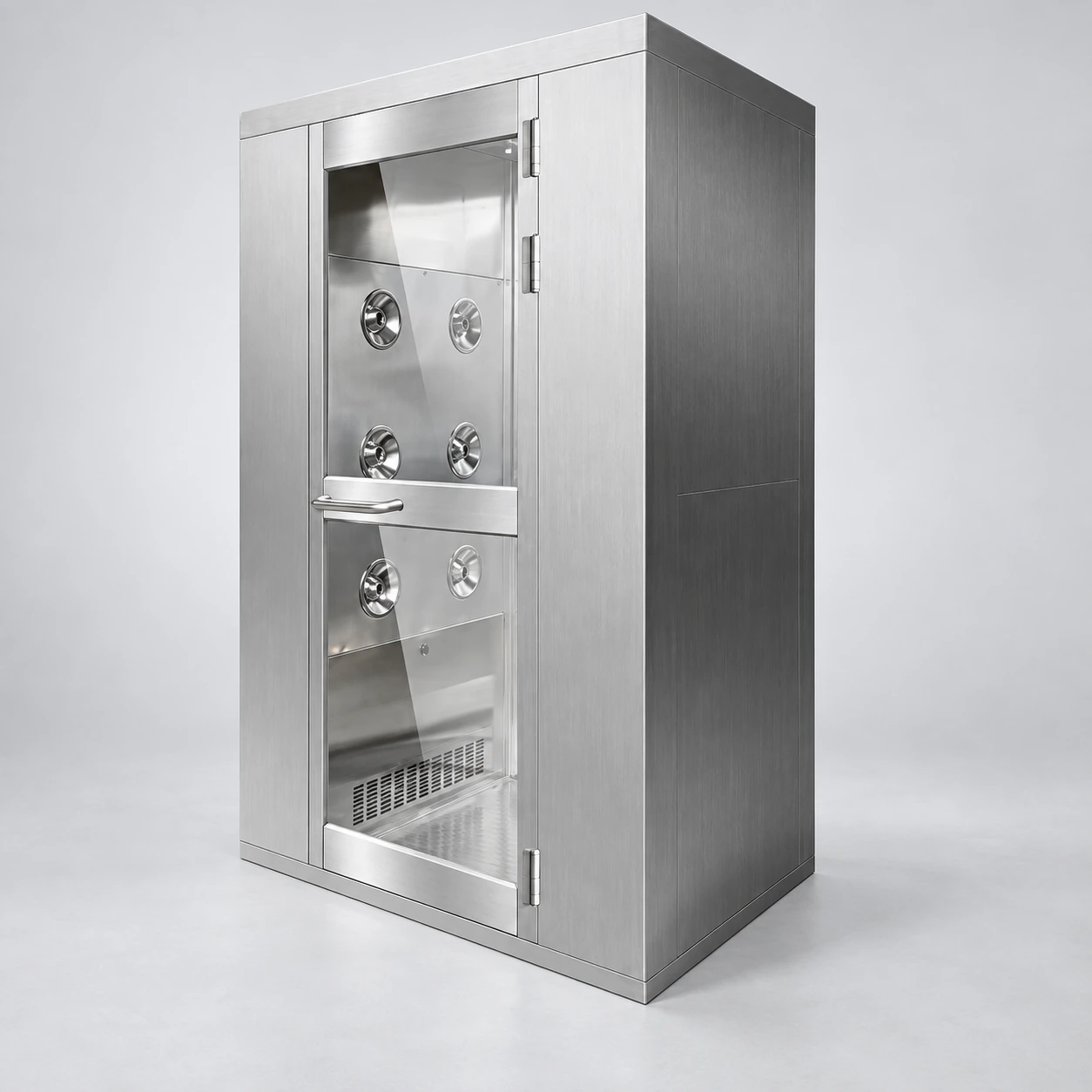
single blow air shower
Product specifications
| Spec | Configuration |
|---|---|
| Blowing arrangement | Single-sided nozzle bank; “single blow” describes the supplied side, rather than the number of occupants. |
| Outside W × D × H | Stainless reference: 1200 × 1000 × 2100 mm. Compact panel-built reference: 1050 × 700 × 2100 mm. |
| Inside clear W × D × H | Stainless reference: 800 × 910 × 1980 mm. Panel-built reference: 710 × 600 × 2000 mm. |
| Clear doorway W × H | Stainless reference: 760 × 1960 mm. Panel-built reference: 660 × 2000 mm; opening and chamber height are separate dimensions. |
| Reference nozzle layout | 6 outlets in the listed single-sided references; direction coordinated with the operator's turning movement. |
| Enclosure choices | Stainless cabinet, stainless-lined coated cabinet or panel construction, with reachable unsupplied-side surfaces. |
| Air circuit | Accessible prefilter and documented final-filter option; return placement that permits the prescribed movement. |
| Entry controls | Programmed shower duration, visible cycle state and coordinated door release; operating instruction visible inside. |
| Supply and service | Site-matched voltage, phase and frequency; service-panel arrangement matched to the single-sided air cabinet. |
Reference dimensions for layout planning. Final clearances, door openings and outlet arrangement follow the approved configuration drawing.
Cabinet width, supplied side and user movement can be coordinated for the available entry space, clothing and traffic.
A single blow arrangement supplies jets from one side of the chamber. It can reduce the equipment envelope, while placing greater importance on how the operator exposes both sides of the garment.
One blowing side is not the same as one occupant
The term single blow refers here to the jet arrangement, not the number of people or the number of cycles. A longer single-sided chamber is still single blow. Establish that distinction when reviewing a drawing: a supplier's use of the name should be checked against the actual outlet locations.
With jets on one side, the near side of the body receives the most direct airflow. A defined turning movement can present the other side to the outlets. A person who stands still facing forward may shield the far sleeve or garment panel. That is a coverage issue, rather than something a longer timer necessarily fixes.
Compare usable space, not the name alone
Reference sizes below are in mm. They show two source-based single-sided layouts and an opposing-jet comparison. Final dimensions follow the approved configuration drawing.
| Layout | Outside W × D × H | Inside clear W × D × H | Decision |
|---|---|---|---|
| Stainless single-sided reference | 1200 × 1000 × 2100 | 800 × 910 × 1980 | More front-to-back space for the defined turning movement |
| Compact panel-built single-sided reference | 1050 × 700 × 2100 | 710 × 600 × 2000 | Smaller chamber; assess movement and clear doorway carefully |
| Opposing-jet reference | 1400 × 1000 × 2100 | 800 × 910 × 1980 | Wider equipment envelope with jets from two sides |
The compact panel-built example has a reference clear doorway of 660 × 2000 mm, compared with 760 × 1960 mm for the stainless reference. Internal height and door height should therefore be checked separately. These differences can matter more than the nominal cabinet category.
Make the movement part of the design
Place the standing instruction where it is visible after the entrance closes. Review the movement with the intended gown, footwear and gloves. A narrow chamber that technically fits one person may not provide comfortable turning space for that clothing or for every user.
Maintain a clear return path on the lower wall and keep the unsupplied side clean. After a repair or nozzle adjustment, check that the intended pattern has not changed. If the application requires more simultaneous exposure, an opposing-jet arrangement may be the better choice even when it occupies more outside width.
Single-sided or opposing-jet configurations can be customised to suit the installation space, traffic and application.